November 2002, Issue 84 Published by Linux Journal
Front Page | Back Issues | FAQ | MirrorsThe Answer Gang knowledge base (your Linux questions here!)
Search (www.linuxgazette.com)

Editor: Michael Orr
Technical Editor: Heather Stern
Senior Contributing Editor: Jim Dennis
Contributing Editors: Ben Okopnik, Dan Wilder, Don Marti
![[tm]](../gx/tm.gif) ,
http://www.linuxgazette.com/
,
http://www.linuxgazette.com/

...making Linux just a little more fun! |
From The Readers of Linux Gazette |
 Linux Voice Mail
Dear Answerguy:
I am looking to make a Linux Voice-mail system, and using Google, I found
the following:
|
............... From THerbic on Sat, 06 Feb 1999 integrated e-mail, messaging, voice mail, faxing capabilities Yep. Linux has integrated mail, messaging, voice mail and faxing capabilities. They all work and you integrate them with shell, Perl, TCL/Tk and/or CGI scripts. ............... |
Claiming to be a response from:
By James T. Dennis, linux-questions-only@ssc.com
Starshine Technical Services, http://www.starshine.org
So, can you tell me what hardware and software I need to make a Linux-based voice mail system (preferrably with 2 or 3 ports)? Thanks in advance for any help.
Sincerely,
Christine Jamison
I think you want to start by looking at GNU Bayonne... Cheers -- jra
I think that someone describing how they are really using such a setup would be a lot of fun. Prospective authors, please see our Author Guidelines.
Although "Linux has integrated..." is expressing at too broad a scale. If someone knows of a specific distro which has set these up together as an integrated answer, please tell us so we can mention it for News Bytes. -- Heather
mgp (magicpoint) and mplayerHi Folks
Ben recently said (in the powerpoint thread) that he uses mgp and since I wanted to fiddle with it a little too I thought I ask here: Is it possible to embed the mplayer window in mgp? Has anyone done this? I managed to get mplayer to play with the %system call but I had to disable mgp to take over the screen (thus become windowed) and mplayer will run in its own window too.
Not that I'm an expert on "mgp", but I believe that's the only way you can have it: "mplayer" does not take a "-geometry" option, and that's what the "%xsystem" tag (which embeds an X app) requires. For an example of this, take a look at "sample.mgp" in your "docs/mgp/examples" directory. -- Ben
If no one has, mplayer might get embedded when I know the win id of mgp via -wid id. xwininfo spits it out but I wanted to do something like this.
in bla.mgp:
> %system "mplayer vid.mpg -vo x11 -wid `some bash script or command to get the win id`
But for xwininfo I have to click into the window or provide it with the win
id

Does anybody have a idea?
TIA Robos
Hi, Robos

Which Window Manager are you using? If you are using FVWM2, then it is possible to give the window a default ID anyway.
-- Thomas Adam
I still don't think you'll be able to do it (please let me know if you do manage it, though!), but we've talked about how to do this already (I think it was Thomas who asked about it): you can specify a name for your "mgp" window when you launch it, then feed that name to "xwininfo" with a "-name" parameter. -- Ben
There you have it, folks. Looks like Robos stumped the Answer Gang. Fellow readers, if you are Making Magicpoint A Little More Fun
Net2Phone and LinuxHi,
We just had a "Linux" technician come out to our office and install RedHat as our Internet Proxy and Mail Server and he has now left...however, I am left holding the bag to figure it all out and how to fix various things.
One item is the figure out how to make the Net2phone program work.. Except for the Linux Server, everyone uses Windows. Since we are in Africa, this program is very important for the staff to call home. I have no idea what to put in the TCP or UDP port sections. Is there a standard port or do I have to configure something on the Linux server (a machine totally dedicated to Linux) or what?
Also, with our previous Mdaemon email service where we used Windows 2000, we were able to keep a copy of all emails going in/out in an archive area so that we could refer back to them should someone lose their mail or couldn't find an email sent to them/from them. I don't know how to configure the RedHat to place outgoing/incoming mails onto another computer as an archive. Can you help with this as well?
I assume the tech installed sendmail as your mail server. While it is a very good mail server, it doesn't do copies as you'd like. (Things might have changed in the years since I tried it, but I'm too tired to investigate it right now.) If you uninstall sendmail and install postfix, it can easily be done. Postfix has a configuration option called "always_bcc" which will copy all incoming and outgoing email to another account. However, without knowing the setup you have (did the tech set up aliases? Any special options like masquerading?), it might not be as simple as un/installing some RPMs. -- Faber
I'm here in West Africa where I have little or no help and no reference books.
Since you say "the Internet works", you've got a plethora of reference materials! All you need actually. Check out The Linux Documentation Project at http://www.tldp.org. There are HOWTOs on setting up mailservers and much more.
Another great resource is Google (www.google.com). Searching for "Net2phone linux" at google brought up several links that might help you. -- Faber
Only a little common sense and alot of prayer. I would appreciate ANY help anyone could give me concerning these two items. I may have been vague with my requests but since I'm new at this, I'm not very clear about anything other than the Internet works and the mail does go out and come in.
THANKS A MILLION FOR ANY RESPONSE
Hmm, I know we have LG mirror sites in South Africa; it's only on the same continent, but it should hopefully be close enough to speed up searching our back issues. Still, I don't think I've seen Net2Phone go by. The LinuxDoc mirror to remember is Zambia's? http://www.linux.org.za/LDP
I think this is only the voice/video conferencing portion of a bigger question above, but it sounds like that'd be a popular topic for an article here. -- Heather
X Display's own mind after installing Japanese language support and programmesSummary: after some struggles and some success with setting up Japanese on his European setup of Linux, Wilf also hopes to set up some other languages too. Most of our Gang hang out in one language only, so I'm invited any reader with a more worldly penguin on their desk to help out.
If you want to submit in article style, please see our Author Guidelines. Otherwise, please make sure to copy The Answer Gang (linux-questions-only@ssc.com) as well as Wilf when you reply. -- Heather
Hya folks!
I am struggling to install Japanese support on my Linux box based on Mandrake 8.1 (western Europe edition). Despite following instructions on how to do this I am quite at a loss what's going on. (Is that another point I have in common with 90% of all Linuxians using/understanding 10% of Linux' capacity?)
Reminder: I'd like to have the facility to enter and read Japanese text in a wordprocessor and email programme and to look up a dictionary, but run a Linux box based on a western European interface and latin1/latin15 input. JWPce (a Freeware for Windows and, DO believe it, stable) would be an excellent comparsion.
So far, I have used two different methods:
- I added Japanese language support and programmes to my -then- quite well running linux box, undertook necessary changes in following instructions found at quite a few places too many to remember, and experimenting myself with different configurations and setups. Now, using a user account to work with the linux box I start up the x-display (KDE) : in a quite random fashion the icons and panel show up and I can get on working, or it may show only the icons on the desktop and no panel at all, or, at the worst, just show a blank screen. Only several "logouts" or even "reboots" may grant me with an eventual display of a correctly fonctionning environment. This problem does not all turn up when I log in as root. I de-installed all programmes and replaced changed config files with the original ones I saved as backups. However, even having carefully "cleaned" up the problem persisted. Having been (and I still am) at a loss I decided to
- I reinstalled the whole system with Japanese language support and programmes which -at the beginning- worked out fine ... just fine for two sessions when the X-Display seemed to have changed its mind. Now, despite much praying on my knees, it may start up correctly and show the working environment, or it may show icons on the desktop only but no panel at all, or it may just show a blank screen. Here, too, root encounters no problem whatsoever.
The actual problem is not the permission to use this or that programme, but that the x-Display only displays when it is (and I take it for being just that) in the mood to do so.
Strangley, the Japanese fonts I installed show up in a browser, Emacs or wih a fontviewer, but so far I have not yet had the opportunity on how to using them in applications like Kmail or a wordprocessor.
For now, I re-installed the whole system without Japanese support and programmes, and all runs as smoothly as before.
I would greatly appreciate it if you and/or a reader could help me out here. I wonder if the problem is due to programmes which supply Japanese support (FreeWnn, Kinput2 and the likes) and upset the X-display or if I am missing out something very badly but am too blind to see... Would you know if Japanese have the same problem the other way round? If they install the Japanese version of a Linux Distribution and install let's say European language support and programmes, does the x-display play up, too?
. . . a day passes . . . -- Heather
Hya folks!
Refering to my recent email concerning the installation of Japanese language support and programmes, I hasten to inform you that I solved the mistery (or missery?) after some clicks only. Why make it easy when it you can make it yourself difficult...
In fact, when installing a distribution (reminder: I use Mandrake 8.1, western Europe edition) you need to select your language, the Japanese language and some programmes needed to enter Japanese text in a wordprocessor, email programme etc. Once the distribution installed, ROOT needs to execute "/usr/sbin/localedrake" and choose Japanese instead of the original language.
A user can configure his environment in two different ways:
Grand A
Personal Country, Language and Keymap are set of the user's choice. This does not alter the the display of the interface or menus : they continue to be displayed in the corresponding language. To enter Japanese text in say Kword, hit the keys SHIFT and SPACE and then enter the text in r-o-m-a-j-i. Nevertheless, how to get out of this mode I would not know... One more thingy : having set the iso8859-15 keymap, the user will not be able to type in the EURO currency symbol - although the personal configuration panel for Country and Language show that symbol. Luck¥ Japane$e, Bri£ish and American$!!! Another thingy : mc displays illegible caracters when it comes to OK, CANCEL or displaying names of directories. Other thingies remain to be discovered yet. Hint : only ROOT can help here. ROOT needs to reset the language to the original language via "/usr/sbin/localdrake" and Europeans can join the "international-currency-display-users'-club", meaning all's back to normal, meaning as normal as normal can normally be.
Grand B.
To display a Japanese interface and menus the user needs to select his country (not Japan - unless you have a Japanese keyboard or you do not mind searching for the right keys and combination, that is). As to language and keymap the user needs to select Japanese in the first case, and a keymap compatible with Japanese input (say keymap "jisx0208.1983-0" or "iso10646-1") in the latter case. Sure, the user may as well go for a real Japanese distribution, but you KNOW what they are saying: "Do it at your own risk!" Personally, I don't, and, mind you, I don't even know where to click when it reads "Quit" on a Japanese screen.
It is interesting to note the different effects this has on GNOME and KDE.
I have come across suggestions like adding someTHINGs to SOME files like "XMODIFIERS="@im=kinput2" LANGUAGE=xx_yy LC_TYPE=ja_JP" (where xx_yy stands for the abbreviation of your country) or something like "LANG=ja8JP.eucJP" or "LANG_ja.JP.UTF-8" ... but hey! Hey, wait a minute! I am just a simple minded user (Yours respectfully, of course) and not a fullblown Linux administrator with years of experience. But then again, I could become one as LinuxG@zette has helped me in the past. So, I remember a Perl script "Uncle Ben" sent me to rename quite a view files... but I'm straying and Ben might have some trouble steering off the course of an oil tanker.
Now that I have overcome this -how shall I put it- "Japanese problem", I am interested in learning how to install, configure, handle and use Indian input. Any readers up here willing to help me, please?
It is my hope that some readers could find some assistance.
Thanking you in advance (not only in case you put in a higher gear to get me some help), I remain
Your linuxely, Wilf.
. . . Robos gives his best shot, though it's not much . . . -- Heather
The only things I can contribute are: look at /etc/locale.gen, see what LC_ALL, LC_LANG and LC_LANGUAGE are set to (echo $LC_LANG) and change them so something else via (for instance in ~/.bashrc)
export LC_ALL=en_GB
and then
source ~/.bashrc
I managed to change something with this but I'm not sure if this is the right way. Maybe this helps? -- Robos
info about xkbcompDoes anyone know a good source of info about xkbcomp - all I can find are very basic man pages (several saying we are depreciated)
Any pointers appreciated
The only reference I see regularly is a note when X starts up saying not to worry about XKB errors if there are any. Or something like that.
Readers? -- Heather
problem installing on linux on ultra2sparc regi downloaded all iso files (from the suse site) and burnt the CDs at 2x speed. the Cds have been checked and tested on different machines and verifies/satisfied that there all files are generated and intact. i am trying to install suse linux sparc on an ultra 2 machine and
i seem to have problems that is least expected. following are the details.
The hardware details of the machine:
Sun Ultra II  CPU speed 296 MHz
128 MB RAM
Open Boot Ver 3.7
Two SCSI hard disks:
     Internal 17 GB
     External 4 GB
We are trying to install Suse Linux Ver 7.3
The O/S is being installed in the external 4 GB HD
The system hangs at stage 6 during installation with CD 1 While installing through GUI, the system hangs without any message.
While installing through command mode (after using fdisk), the error message is 'Cannot create /dev/... '
thanks once again,
Dr. Nagesh R. Iyer
Question about compiling against different C libraryI have a RH based system with gcc3.2 glibc-2.2.92
I want to compile some programs (old gnome2 etc) against glibc-2.2.5 - is this feasible?
The basic reason is to distribute RH7.3 rpms (ATM mozilla and galeon)
More about CADIn a previous issue someone mentioned they were running AutoCAD on Linux. That is, they were running it most happily inside VMware, if I recall correctly: http://www.linuxgazette.com/issue83/lg_tips.html#tips/9
One reader, Frank Smierciak wrote in:
We currently have a dozen engineers running Autocad on Windows (various
levels). You mentioned you are running Autocad on Linux. I didn't know
Autocad had a Linux version. I don't mean to be a total newbie here but
what version of Autocad are you running and have you ever tried LinuxCAD
which claims to be 100% Autocad compatible.
...and I innocently thought to myself, "Gee, okay, that sounds neat, I'll mention it." Both these authors are obviously experienced engineers. I went looking for myself, to see what else I could find, to mention next to it.
But I didn't find it in Freshmeat (though there are 53 listings in their
electronic design subcategory alone). The product's commercial
(http://www.linuxcad.com). As is AutoCAD, of course. There are drawing
ryam3d.orgograms mentioning CAD as one among many 2-D uses they can offer. (Is
it still CAD if you are only drafting in two dimensions? well, it's a
computer, and you're designing, so I guess so.) I found one that
designs LEGO layouts
The question then comes up, what do you want to use CAD for ...
I asked my friend 'Dillo, an experienced 3-D artist (among other things), what he uses. He made special note to warn me that the difference between modelling software and CAD is that CAD will enforce real-world measurements. E.g. the intaglio on this pot is exactly 0.125 cm deep. For what he usually does, he's not sending things to a lathe, and just modelling is fine; he uses Ayam, a free front end for Renderman: http://www.ayam3d.org
I have big dreams of replicating little starship cutaway views, re-plotting my garden or living room layout, abusing my SMP motherboard with lighting calculations, stuff like that. "Dreaming" is the key word here. I found myself in the deep side of the CAD swimming pool with no water wings, and drowning -- things are pretty polarized, either no documentation or it assumes that you're already experienced as an engineer. I have a great sense of geometry, and I'm a good hand with the GIMP, but this just isn't my field. So far I'd be safer staying in the GIMP.
We need someone with some real examples to measure these things up against, to bring this all to life with some fun, and give us something that engineering newbies like me can enjoy and work our way through too. Having a bit of a bake-off about the different kinds of CAD and modelling available would be a plus.
Interested? See our author submission guidelines
Mizpelling and RekoiningGooooood Morning LG!
There I have it (thanks Rick!) : what with my eternally installing Linux instead of putting poorly configurated files and setups right ...
Thank you so much for having sent some helpful mails concerning the (hum, "my" ) x-display's mood and configurating foreign languages support.
Mizspelling (yes, MiS) : all that fumbling on the keyboard trying to get foreign languages support on my linux box has given me some bad habits, I reckon.
Rekoining : as to rekoining (with a C, please) a phrase, in fact, it should not be known as "nobody's perfect" but "nothing's perfect". So, raising on one of the back benches I bow me head and admit not having payed much attention whilst setting up the email prog, particularly the e-address.
Felicitation -excuse me/veuillez m'excusez/'tschuligung- congratulation for your restyled web pages! You may now rightly raise and shine and ask around "now, who's the best?" unless, well, unless you do even better!
Yours linuxely, Wilf
sendmail and courier imap serverpart kudos, part juicy answers, yet a question still. -- Heather
Hi,
Google had me stumble over your request in the Linux Gazette. Since I have the same problem (have to use sendmail for a specific reason, but still want to use courier imap), I'm interested in whether you found a solution yet?
Regards,
Eddy Buhler
Oh, that.
I've had no problem using sendmail with courier-imap; in fact it's nearly ideal, since Courier's own MTA is too young for prime time whilst IMAP is a path to the future.
The client who enjoyed these goodies was also handling enough traffic to warrant some serious tweaking, or to switch to Postfix, which he did.
The key in honoring IMAP well was not in the MTA, but in the local delivery agent -- procmail can easily deliver to maildirs, you just have to tell it to do so, and tell the MTAs to use procmail instead of the builtin local mailers.
Hope that helps! -- Heather
This is the first time I am faced with the task to set up a mailing system...would you mind supplying a few directions as to how to tell sendmail to use procmail as delivery agent, and roughly what to do to make procmail deliver in the maildir format and, say, into "~/mail"?
...
I got the thing working, thanks.
Glad to hear it! -- Heather
Yes, rather annoying to find out that things worked in the first place and I spent 3 days hunting shadows. Turned out sendmail was already configured to use procmail in my distro (SuSE 7.2 on a remote server), and all that was basically missing were
a. /etc/procmailrc with the source and target directories
b. courier-imap, though that had me turning in circles again until I found the pw2userdb and makeuserdb commands in /usr/lib/courier-imap/share after building and starting the daemon.
Sheesh. Now I just need to figure out what auth module courier is using and see how to use PAM if it's not using that yet. I guess I should also try compile a Step-by-step guide for other Linux mail Newbies like me...
Excellent! We'd love to see it. It'd make a good Article for the Gazette if it's long enough, or an Answer Gang posting if enough of us are all chattering during the notes.
If you're inclined to do it article style, our article guidelines are pretty simple, see http://www.linuxgazette.com/faq/author.html.
the least I can expect is that ppl rip it apart in the air and point out the millions of errors I made and the myriads of places where I could have done something better, which means I get to learn more, and gather a few more e-mails belonging to intelligent and helpful individuals I can contact in the future when I again have mail problems (e.g. in case I really have to change my sendmail config, or go deeper into fetchmail or promail or...whatever).
Good attitude, I like that.
You can always post questions to the Gang at linux-questions-only@ssc.com; if you're inclined to help others too, and not afraid of dealing with the extra burst of mail, you can join the mailing list. Don't worry, we're all good at something and not so great at other things ... even the really experienced souls among us.
Oh, that reminds me. I want to offer a web interface for users to access my imap server. That alone should be perfectly doable since there are a couple imap webmail interfaces out there. But I want them to be able to add pop3 servers to their fetchmail list.
Which suggests that you'll either want a privileged CGI )to let them get at their fetchmailrc) or some cronjob help (to let them work in unprivileged CGI space, then have something sanity check and apply the change to the real fetchmailrc).
Internally, I want to run a single fetchmail daemon (probably I'll just create a dedicated fetchmail user (e.g. "getmail") and let the scripts add the account/user mappings to that user's .fetchmailrc so I don't have one fetchmail demon running per mail user, which could be a bad idea if there were 50 users all polling 5 POP3 accounts every minute, I don't really know about the load though).
Hard to say ...
My main question is if I can tell fetchmail to not only run as a daemon, but to configure each and every individual POP account to be polled at their own intervals, like this:
> poll account1 for user toby every 5 minutes

> poll account2 for user sam every 60 minutes

> poll account3 for user anne every 10 minutes
I've read about the "set daemon" command in .fetchmailrc, but that only determines the interval the daemon wakes up at to do its job. A very ugly solution that I basically discarded before I tried it would be to create one fetchmail user for every account used, and set a daemon for that. But that would not only see the server run one daemon per user, but even one daemon per POP3 account. There must be a nicer way.
Do you know one?
I don't - maybe one of our readers can chime in.
Regards,
Eddy Buhler
Our pleasure.
etymology of "daemon"In issue 83 of the Linux Gazette, you give some possible origins for the word "daemon": http://www.linuxgazette.com/issue83/tag/1.html
The term "daemon" comes from the demons in Oliver Selfridge's paper 'Pandemonium', MIT 1958, which was named after the capital of Hell in Milton's 'Paradise Lost'. Selfridge likened neural cells firing in response to input patterns to the chaos of millions of demons shrieking in Pandemonium." He proposed program elements, called "demons" that would model the activity of the neural cells and respond whenever a particular pattern appears in the input. The term later grew from its use in Artificial Intelligence to being used in the context of operating systems. The concept of "interrupts" was considered akin to a demon "shrieking" in response to the input pattern.
Bob
That "Day Monitor" was clearly a misguided guess by the querent. The rest were references from the Gang's scattered array of knowledge.
In the context of the Berkeley students who worked on BSD, Evi's comments are considered canonical. I add the link here so readers may see the more complete quote: http://www.freebsd.org/copyright/daemon.html
Many times similar ideas sprout in different places, only to discover each other later. (The Calculus, for instance, was independently developed and the main thing left mismatching were the symbols used.) In this case, it looks like me got concurrent homonymic results, from different origins. Evi clearly states that a system can easily have both... -- Heather
Ettiquette among the Answer GangI'd like to kindly request that if you are not going to answer someone, do not take the extra time nor waste the extra bits to blow them off.
We do not promise to give all requesters an answer, and I know that a lot more off-topic questions are arriving since we re-opened the floodgates labelled "tag" and "answerguy".
We also didn't promise that we're suits, keeping our thoughts squeaky clean and so on... but I note that there is some line between advocacy, curmudgeonly 'tude, and just plain being rude. I do not believe we're meeting the prime directive -- Making Linux A Little More Fun! -- if we make the borg kids run away in tears. Let 'em meet silence until they're ready to ask real Linux questions.
In other words if y'all sharpen the razor wit too far I'm gonna have to install a first aid kit in the TAG beer lounge.
However if you answer in the off-the-cuff spirit of the original Answer Guy, Jim Dennis (hi hon!) ... by answering a patently mswin/solaris/weird-OS question with the Linux version of the answer, then I'll cheerfully make sure that your favorite brewski is present in the TAG Fridge. In this way Jim often actually answered them, while hinting strongly that Linux makes it, whatever "it" is, a bit less painful. Pass the pretzels, please.
I'm pleased to say that in addition to some backroom silliness about coffee, ginger beer, and the exact methods we use to refill the pretzel jar, we've also been seeing a bit more helpfulness from the Gang in regards to cross-platform issues.
Issues where Linux is not involved at all are still for somebody else to deal with, though. Please mention which variety of Linux you're having trouble with when writing to us. Thanks. -- Heather
|
...making Linux just a little more fun! |
By The Readers of Linux Gazette |
 Hiding your email on websites from spammers
Here's a way to "munge" your email address on your Web page so that spammer's bots can't grab it:
perl -we'map{printf"&#%s;",ord}split//,pop' user@host.com
Use your address, and stick the output into your HTML where you'd normally use your address. It will display correctly, but all that the bots will see will be something like
user@host.com
Of course, if bots get smart enough to undo this, it won't help... a friend of mine also uses tricks to confuse them as to where the @ sign has gotten to... SGML comments within their domain name, stuff like that. Yet another shows their address and phone number within a PNG of their business card (although, admittedly, this is not lynx-clean).
A combination of such tricks, combined with a couple of "sentinel" addresses which look legit but are only for spambots to find, should aid you greatly in both reducing the total spam, and in having bait to feed to Razor to reduce the overall spam even further. -- Heather
Help on LILOI can usually resolve LILO issue myself but I read your help solutions out of curiosity. The one thing that I noticed that you missed (hopefully -- I only skimmed your replies) is the fact that LILO is printed one character at a time. Each character means the following...
Characters
Description
none
LILO has not yet started. Either it was not installed or
the partition is not active
L errorcode
The first stage boot loader has been loaded and started.
However, the second stage boot loader cannot be loaded.
The errorcode typically indicates a media problem, such
as a hard disk error or incorrect hard disk geometry.
LI
The second stage boot loader was loaded, but could not
be executed. Either a geometry msimatch or by moving
/boot/boot.b and not running the map installer.
Or the "lba32" option was specified and the BIOS or drive cannot handle it. Solution: switch to "linear". -- Mike
LIL
Second stage boot loader started, but could not load the
descriptor table from the map file. Typically a media
failure or by a geometry mismatch.
LIL?
Second stage boot loader loaded at an incorrect address.
Typically a geometry mismatch or by moving /boot/boot.b
without running the map installer.
LIL-
Descriptor table is corrupt. Either a geometry mismatch
or by moving /boot/boot.b without running the map
installer.
That is, you made it into 32 bit or other paged memory processing, beyond what old DOS hacks call "real mode" -- but the page descriptors don't look good, and LILO refuses to jump to hyperspace with such ugly coordinates. -- Heather
LILO
Everything successfully loaded and executed.
Statistics: 3 out of 6 troubles mention the map installer. Just run /sbin/lilo again and see if it helps.
4 out of 6 mention geometry. linear, lba32, and compact are all options which relate to geometry; if you're using one, try changing this and running /sbin/lilo. But you just might have to tweak CMOS instead. For instance, LBA32 often needs to be turned on in CMOS before the lilo option can do anything.
2 mention media problems. Sorry. If you're lucky the mangled piece of disk is not track 0, and you can just copy fresh lilo bits out of their package, to new disk locations that aren't bad. For goodness' sake run fsck -c to get the bad spots marked useless before going much further. And make sure your partition table is good.
And #1 on the "whap yourself on the forehead" list: If you get no LILO response at all, make sure that /etc/lilo.conf says boot=/dev/hda (or sda if you're on SCSI and not a numbered partition like /dev/hda1. -- Heather
Courtesy of Linux Tutorial
http://www.linux-tutorial.info/cgi-bin/display.pl?68&0&0&0&3
Regards
Tres
bad clusterswhere do bad clusters come from?
The Great Bad Cluster Cabbage Patch in the Sky.
Seriously, bad clusters represent errors in a file system. They may be soft errors, for example where power failed or the OS crashed during a write to disk. It could be where there are some bad bits on RAM that was used to hold data on the way to the filesystem. It may be that the computer has problems with its power circuitry, either in the power supply or in the power distribution circuits, filters, regulators and so on on the motherboard. Or the underlying problem may be failed sectors on the disk.
also my friend has an HP pavilion with windows 98, she has 3 bad clusters and her computer is running anciently slow. i'm running a windows 95 format disk to reformat her computer and so far it has been running for 3 days just trying to recover the allocation units, why is it running slow, and will re-formatting take care of some of the problems since she does have bad clusters?
In either the Linux case, which is what this mailing list is about, or other operating systems, it's time to enlist the services of somebody with serious diagnostic tools and skills. Simply reformatting the disk is very unlikely to cure the underlying problem, unless it was merely due to a power glitch. It probably wasn't a good idea to begin the reformat prior to consulting an expert, as you may have erased some of the information that would lead to a correct diagnosis.
Or, it might just be time to replace the computer.
I wouldn't rush to that as the first thing; it may only be the hard disk that's bad, not the whole machine.
If a bad controller on the motherboard is doing it, well yes, then it's probably easier to just replace the box. -- Heather
CDRW plugging-it-in mini-howtoI know nearly nothing about drives. I purchased a cd-rd drive and can't get it to work. I have installed the drive, but it won't work. The switch on the back of the drive is set in the middle. There is no writing on the switches, so I assumed the switch was set on the slave from the factory. From what I have read it seems like it has something to do with my ide. But I have no idea how to set that. The drive does not show up in my hardware properties. Do you think you can help?
Thanks in advance
[JimD] .... That's an MS Windows dialog box. Right?
If so you should call Microsoft and see if they offer support for their products.
Strictly speaking, it's the CD bay manufacturer to call, not the MSwin guys. -- Heather
[K.-H.] Start earlier -- bo into bios setup and do a "drive detect" if available. Does it show up there? Also All IDE CD drives I had gave some boot message during the BIOS search for IDE devices. This is before the box with the summary comes but after the memory countup.
If it's not there the hardware is not detected and something is quite wrong on hardware level.
[Dan] Try the HOWTOs...
You'll probably have to rebuild your kernel or load a module to support these. If you need help with that, check back here after you've taken a look at the HOWTO.
[JimD] The best resource for this topic right now is probably:
- Winfried Trümper's CD-Writing HOWTO
- http://www.tldp.org/HOWTO/CD-Writing-HOWTO.html
... though there are a couple of comments at:
- The Answer Gang 65: cd-writing mini-howto
- http://www.linuxgazette.com/issue65/tag/17.html
In general IDE CDR/CDRW drives under Linux are accessed through the SCSI emulation layer. Thus you normally have to build the ide-scsi module (either into your kernel, statically, or as a loadable ".o" file). Normally you'd also have to pass the kernel a command line hint like hdc=ide-scsi which will force the system to direct all traffic to that IDE device through the SCSI emulation subsystem.
The oddity of this is that it affect normal access to CDs via that device, too. Thus to mount a normal CD in that drive you'd use the /dev/scd0 (or other /dev/scd*) device node. Writing to CDR and CDRW media would generally go through the /dev/sg0 (or similar) devices -- sg is "generic scsi device" (printers, scanners, etc). (Actually the cdrecord command uses a three part bus, ID, LUN address for this).
[Iron] If it's a new drive, I would return it and say the inadequate labeling is preventing you from using the drive. Maybe that will goad the manufacturer into doing what practically all other manufacturers have done: put labels with diagrams on the drive.
An IDE drive normally has a jumper (not a switch) with three positions: "master", "slave" and "cable select". Some also have a position for "single". IDE cables have three plugs so they can fit two drives on one controller. If this is the only drive on the cable, it must be "single" (if such a position exists) or "master" (if it doesn't). If there is another drive on the cable too, one must be "master" and the other "slave". "Cable select" was one of those nifty new ideas that never caught on, so don't bother with it.
If an IDE plug fits it, it's probably an IDE drive. I've never seen one with a switch instead of jumpers, but it's possible. Is it an external drive? Those would be more likely to have switches.
If the switch is unlabeled you'll have no choice but to try all three positions and see which one works.
The IDE cable should be connected with the red stripe facing toward the power cable. On the motherboard, the red stripe should go toward the pin marked "1".
The power cable is connected, right?
It's possible it's not an IDE drive at all but a SCSI drive. The plug would be a different shape and the switch would have numbers (0-8 or 0-16).
1 ut2003a.tgz: The archive is corrupthey i have downloaded a .tar file and it says its corrupted, and i changed it to .tgz and it's still corrupt, any ideas?
thanks.
[Dan] Believe tar. The file is corrupted. Throw it away. Download it again.
You didn't say how you downloaded it.
Rick Moen proceeds to answer the question he should have asked ... "how do I keep it from arriving corrupted?" -- Heather
If you were using the ftp protocol, make sure you were using binary transfer mode, not ascii mode.
How to delete LINUX?This is the best framed question of this type I've seen in years, and Daniel had a fast, neat answer ready to hand. So I'm publishing it even though it's an FAQ.
As long as later editions of Windows continue to have a tool to replace the MBR cleanly, this note will continue to be useful. -- Heather
Dear Friend,
I have a computer with two operating systems: Win98+Linux. Now I want to delete the whole Linux system to free its space into Win98. The selection of boot for a certain operating system is by LILO at start. Can you tell me 1) How to delete the Linux? 2) After delete Linux, that means delete LILO too, so can I still boot the computer into Win98?
Many thanks
Use a win98 startup disk or the win98 cd to boot. Run fdisk, delete the linux partitions using the non-dos partition optoins. Then exit, run fdisk /mbr. Reboot with the disk or disc, run fdisk again and create a new dos partition. Reboot, format the parition. Why you would want to do this is beyond me. You should be deleting the win98 partition to free up some disk space for the linux partition.
How to write C program?Hello,I am a university student from China. Now I write C program with vi,and compile with gcc,but I find write program like this is unefficient.There are very good tools for Windows, like Visuanl C++, Tubro C/C++ etc. So I want to ask what tools we can use in Linux and the step to write a program.
If you find vim and command line gcc too rudimentary for your taste, a lot of visual-like and IDE tools for Linux are available. Some of the popular ones are -
KDevelop (KDE/Qt based)
Glade (Gtk based)
If you cannot find them, then maybe you have not installed them from the CDs. Please do so and give them a try. They ship with all popular Linux distros (distributions).
... ashwin
In case it will help, I maintain a list of all known Linux IDEs / GUI Builders / RAD tools, at http://linuxmafia.com/~rick/faq/#idedev . The list has passed 100 entries.
... Rick Moen
cd-writer device driverhello answerguy,
Hi Sarath,
It's gang now, not guy: see http://www.linuxgazette.com/faq/index.html or www.linuxgazette.com/authors
I am a final year software engineering student and I want some driver writing information. I would like to know how to obtain enough information about my cd-writer to write a driver for it. This is important for my final sem project and I can't seem to find anything on the web.Even a few helpful links would do.
You already asked this on the cdwrite mailing list and you got one answer pointing you to the SCSI MMC-3 specifications, so why not try to locate it? The cdwrite mailing list certainly has the more knowledgeable people on this particular issue. So they do expect you to know at least to some degree what you are talking about if you venture to write a cd-writer driver from scratch and they think a pointer like they gave should be sufficient. If you have particular questions/problems on implementation that will be a good place to ask again.
I read that u are an LG fan.
I am certainly not an LG fan (neither the cdrom manufacturer nor the Indian(?) electronics manufacturer (TV's and stuff) if they are not the same.
I certainly am a fan of Linux Gazette so....
The device I'm talking about is an LG GCE-8160B (16x max).Hope you can help me with it.
So -- that might be an IDE drive or might not be an IDE drive. I guess it is.
in any case: The protocol used to access these devices --- and all newer CD-writers are ATAPI/SCSI MMC-3 compliant --- is the MMC-3 specification. Actually ATAPI for CDROM drives is nothing but SCSI over IDE, so the devices understand scsi commands which are sent over the IDE hardware connection. In Linux (to be a little bit ontopic for a LINUX-questions-only) there is a ide-scsi driver which is taking care of the scsi over ide commands part, so you don't have to worry about that when writing the driver. (NT BTW does the same, burners and Co are treated as SCSI devices).
SO:
- try to get hold of this specifications like typing "mmc-3 specification" in www.google.com... but this is not the first hit there and will require some digging. It is well possible that you have to buy that in printed book form from somewhere. I get lots of *.msdn.* hits, maybe you find something generic there too. you are trying low level hardware programming so getting used to that kind of bit poking manuals will be unavoidable I guess
- get cdrecord and/or cdrdao and have a look at their code, especially the library libscg might be interesting since it's handling all the low level data transfers
- be aware that this is a major project, i.e. to write a successful driver for at least most of the CD-R's features
If you need info on how to write a device driver for Linux there is a HowTo out there..... hmm. (some poking about in the web-shelves ensues)
Look for SCSI one page down.
(it doesn't evade view for long, though.) There is a Linux kernel module programming guide:
http://www.tldp.org/LDP/lkmpg/mpg.html
K.-H.
It's quite old and the interface is a bit changed in 2.4(from 2.2). The best reference for driver writers is Alessandro Rubini's book
This is a must if you are planning to do any serious kernel module hacking. It's quite affordable too. I guess it costs around 170/- in india.
--pradeep
Cheap duplex fixHi:
I wanted to share a trivial printing fix, and ask a question. We recently upgraded here to a duplex printer, which worked terrific, except that when duplex printing from my Redhat 7.3 box every second page was offset an extra centimter to the right. It didn't matter which application I used either.
I tried a few different drivers, but they all had this problem. Rather than approach this trial and error I decided to intercept the input Postscript and fix the margins. Admittedly this is not finding the cause of this problem, but it works.
I edited the /etc/printacap file (after backing it up) to point to a different magic filter wrapper for the duplex printer, and copied the original wrapper to a new "improved" one.
I called this mf_wrapper_duplex, the diff output from the original mf_wrapper and mf_wrapper_duplex follows:
diff  /usr/share/printconf/util/mf_wrapper
/usr/share/printconf/util/mf_wrapper_duplex
45c45
< /usr/bin/magicfilter-t "$TMP_FILE" $DEBUGSTRING < /dev/stdin
---
 > pstops -b 2:0\(0,0\),1\(-1cm,0\) < /dev/stdin |
/usr/bin/magicfilter-t "$TMP_FILE" $DEBUGSTRING
I use pstops to adjust margins on the postscript data stream, using the '-b' option to strip binding information, and push the margins over 1 centimeter to the left via the 2:0(0,0),1(-1cm,0) rule, - see the pstops manual. I then restarted lpd.
Of course this is not a perfect, or even a really correct solution, for one the printconf utility will overwrite this, so it should be put in /etc/printconf.local but I was getting really annoyed at the margin drift on the even number pages. Also, I believe the data stream into magicfilter might not be postscript, so it would break on this as well.
I think this should really be done in magicfilter - does anyone know how to hack this nicely?
Thanks
Allan
For quite a while now, I've had a printing problem - plain text always came out shifted about an inch to the left, and some characters "fell off" the page. Until recently, I didn't bother fixing it - instead, I'd bring up the text in "vim", issue an ":ha" (hardcopy) command, and presto!... of course, this required setting up "vim" to print (see my "Fancy Printing in Vim" tip in LG#79.)
However, I really dislike it when things don't work the way they should, and I got around to this recently. Since I use "magicfilter" to process all of my print stuff, I simply edited "/etc/magicfilter/StylusColor-II@720dpi-filter" (which is what I use for my Epson Stylus), and changed the last entry, like so:
See attached leftshift.sed.txt
Note that I also add a formfeed (FF or ^L) at the end of the file. This character is not a '^' followed by an 'L' - that won't work! Instead, use a Real Editor ('vi', or something else that lets you enter raw characters). In "vi", as an example, press <Ctrl-V> ("raw character entry") followed by <Ctrl-L> ("formfeed"). Also, you may need more or fewer spaces than I did; simply adjust that string of spaces in the beginning of the "sed" expression.
odd use for ejectEject is of course, the command to spit out the CD that's inside your system, rather like the Macintosh does.
If you're a system admin at a large rack of pretty much the same machines, you can double-check which one your KVM switch is pointed to right now... by making it 'eject' and spit out its CD tray.
Then it'll be obvious!
If you have ever rebooted the wrong machine in your server rack or
colo facility, you definitely can use this trick to keep that from
happening again
Also handy if you have a habit of ssh'ing into any of several workstations in your development offices. You can probably even hear the whirring of the drive tray. But don't do it if you know the boss keeps their coffee in front of the CD bay...
emacsI'd imagine there's someone here who's fairly knowledgeable in Emacs...
Fairly knowledgeable, no. Slightly knowledgeable, yes.
So, I pull down the "Tools" menu, and choose "Read mail". OK, everything's fine. I exit Emacs, not saving anything... and shortly thereafter note, with an ice-water-down-the-back shock, that my "/var/mail/ben" is GONE. Zeroed. Empty. WHAT THE FSCK???
Fortunately, after some seriously POed muttering and high-speed maneuvers with "find", I thought: "what if Emacs did something weird with it? It shouldn't have just deleted the thing!" So, I open up Emacs again, "Tools/Read Mail"... and there it is! Big sigh of relief, and about a dozen blind avenues later I figure out that it stuffed my mail into a file called "~/RMAIL" and munged the format.
Typical emacs arrogance. It assumes that its way of handling mail is the best and that other mail utilities are stupid not to conform. I had the same problem when I tried emacs mail in 1990. And I stopped using emacs mail for precisely that reason: it didn't handle mail in a way that was compatible with other mail utilities.
So, my question to you guys and gals is, is Emacs ALWAYS this bloody rude? That is horribly intrusive behavior, as I see it: I never explicitly asked it to change, delete, move, mung, or do anything of the sort to my mail. I could see where a new user would be totally lost. If I did something stupid, OK - I'll just be extra-extra cautious of the beast. If, however, that's Emacs default behavior, I'm deleting it off my system with extreme prejudice and it shall never darken my STDOUT as long as I live.
Ben: Emacs is so rude!
Emacs: Why didn't you read the FM?
Ben: Why didn't you give me a warning the first time I ran it, O Editor That Calls Itself "Self-Documenting"? You're the one that's using an esoteric, incompatible format.
Emacs: It was probably the standard format in the environment where emacs mail was written, and then remain unchanged three decades later.
Ben: I'll show you who's boss!!! I'm going to uninstall you with extreme prejudice!!
Emacs: Bigot!
Ben: Bloated piece of crap! You've got more features than Internet Explorer, nyaa, nyaa, nyaa!
Emacs (Eliza mode): Is the fact that I'm a bloated piece of crap the reason we're having this conversation?
<*Splort*> <FOTCL>
Mike, that's one Diet Coke with lemon you owe me. I does not belong on my keyboard, and spraying it out through the nose hurts.
how many roots?I have a two part question.
How many root directories can you have in Linux?
How deep do you want to chroot? -- Heather
OOOH! Nominated for Answer of the Year. -- Ben
[mike] File systems work a bit differently in linux. There is only ever one root directoery wich is /
All partions or drives are mounted on subdirectories from this root
drives and partions are numbered like so
/dev/hda		first Hard disk
/dev/hdb		second hard disk
/dev/hda1		first partition on first hard disk
[SGD] Basically - it is not possible to have more than one root directory in the box
The real answer is "one at a time"
The guys here are correctly describing a normal directory setup.
However, an application can be working from a deeper directory than the real one; that's called a "changed root environment" or chroot and is actually done all the time by things like Apache and postfix and qmail. -- Heather
I you have more than one disk drive, what steps do you have to perform in order to make them available for use.
[SGD] what you can do is mount your other harddisk under a subdirectory for example, if you have /dev/hdb as your secondary harddisk, and you want to use the first partition of that harddisk under linux, just issue the command
mount -t <filesystem> /dev/hdb1 <mountpoint>
here <filesystem> may be vfat (if it's fat32) or ext2, or ext3 <mountpoint> may be any empty directory in your box - usually /mnt/disk2/ or something like that.
Yup, this is so. You can have lots of partitions, mounted anywhere you want, including on top of each other, though I don't recommend covering up any files as they will look like lost space.
To help make this more readable I made mike and Sayamindu's code describe the same system. I use /mnt/c when referring to a C:\ drive, I think it's nice and memorable. -- Heather
[mike] To eg add a second hard disk you could eg do this
mkdir /mnt/c
mount /dev/hdb1 /mnt/c
(assuming second drive has been partitioned and formatted)
to make this permanent edit the file /etc/fstab to add an entry like this
/dev/hdb1 /mnt/c vfat defaults 0 0
and save the file (please note the above file system is fomatted for w32 - adjust to taste)
Your response would be greatly appreciated
Thanking you in advance
Maria Diaz
You're very welcome! -- Heather
[LG 82] help wanted #3 Postfix hates OutlookShahid,
Postfix is an SMTP server and Outlook will send mail out through it but not get mail from it. The problem seems to be there is no POP3 server running. Have a look here: http://www.postfix.org/addon.html#pop
for info on obtaining and setting up a POP server.
Edward
Fun With IoctlsHello Gang,
A while ago, Shreedar V. K. from India asked for a program that would list the IP addresses for all of his interfaces. Back then, I joyfully referred him to one of those Stevens TCP/IP books. We got quite a thread from that response. I like that.
I got bored today, so I cranked out a simple program that prints the interface names with their associated primary IP address. I intentionally omitted the display of alias to keep the program simple. It's really a quick hack.
The purpose is to illustrate why the simple solutions, provided by Ben O., really make sense. Still though, I never turn down a challenge. Everyone can use and hack it at will. Just compile the program and run it. It takes no command line arguments. Example output, as well as the program listing, are displayed below.
Good night, Chris G.
See attached interfaces.c.txt
Hey, pretty nifty! I saved it in interfaces.c and here's what using it looks like -- Mike
% gcc -o interfaces interfaces.c
% chmod +x interfaces
% interfaces
lo: 127.0.0.1
eth0: 216.39.[censored]
eth1: 10.0.0.1
Thanks Mike! The program kinda shows how much work goes into our beloved network programs such as ifconfig.
Later... Chris G.
lkmlHi there,
I'm doing a report for Uni, I was wondering how many subscribers are there to the Linux Kernel Mailing List? Is there a more popular list? Estimates are fine.
Hi,
I have no idea, so the traffic on that list seems rather high (~1000 posts/day).
You might want to subscribe and send administrative commands like "help" "info" and if available "who" which would give you a list of all subscribed members. These commands depend on the exact mailing-list managing program but most have these options.
K.-H.
Many people subscribe to digests so they can get their mailing list stuff a little less often, all in one chunk.
But there is a brave soul who actually summarizes the Linux Kernel Mailing List, and publishes the results on a website he calls Kernel Traffic: http://kt.zork.net/kernel-traffic/latest.html
The Linux Weekly News notes about what's going on in the kernel are available to LWN subscribers
But you can see some of the latest patches some of these guys have whipped up at http://lwn.net/KernelPatches/ ... and they warn that these things might drink all your beer. From what I know of development parties, perhaps they are speaking from experience?
WHIZBANG Patch
Adds /proc entry for refrigerator chilliness support.
Highly experimental, the beer keeps disappearing. Hope
to fix in next rev. Suspect memory leak in purchaser
algorithms.
workaround: we recommend Jolt Cola; or home zymurgy kits
stored in a seperate directory.
When the Weekend Mechanic loses his tools
How many of you have been guilty of using mc (midnight
commander), hitting the key sequence "<ALT><SHIFT><?>" before,
and then filling out that nice dialog box to find the file that
you require?? Don't lie, we've all done it (Hi Ben
).
<blink, blink> Thanks for the vote of confidence, Thomas... but I didn't even know about that feature until you mentioned it. <grin> So, _now_ I'll be guilty of it - maybe. I'm pretty used to "find" by now, and would miss things like "-exec" too much to use some constraining box. -- Ben
I actually wrote that?
he he.....
Oh no, Ben. I simply meant that as you keep promoting
the use of "mc" for things like: rpm viewing, tar/gz
viewing, etc, it was logical (?) to assume that you'd
have used the "find" feature occasionally?
<grin> It's one of the things I like about it; after all this time of using it (and using Norton Commander, which is was modeled after, for some 15-20 years before then), I _still_ discover cool new features occasionally. I wrote Miguel a nice letter back when; he deserves lots of kudos for this one. -- Ben
ATI Rage M4I would like some help configuring my Dell Latitude C800 display (ATI Rage M4 16MB). No matter what magic I try to accomplish with Xconfigurator or hand editing of the /etc/X11/X86Config-4 files, I can't convince my XWindows display to set-up in anything but 1600x1200. This is very hard on my varilux bespectacled eyes.
[Robos] Just as a short answer (no time right now): down in xf86config-4:
 SubSection "Display"
   Depth           16
   Modes           "1024x768"
 EndSubSection
 SubSection "Display"
   Depth  24
   Modes           "1024x768"
 Exchange the numbers (swap em) to something like this
 Modes "1024x768" "1600x1200"
Robos is right on the dot. From my own "/etc/X11/XF86Config-4":
Modes "1600x1200" "1024x768" "800x600" "640x480"
Works fine on this Dell Inspiron. -- Ben
Some posts elsewhere have said to use <Ctrl><Alt><-> or <Ctrl><Alt><+>, but this seems to have no effect. Any help would be extremely appreciated.
Thanks
Mark Gorat
Something I just realized: if you're hitting <Ctrl><Alt><-> or <Ctrl><Alt><+> using the "_/-" or "+/=" keys, that definitely will not work - you need to use the keypad plus or minus. On most laptops - certainly on a Dell - that works out to <Alt><Ctrl><Fn> with the "blue" plus or minus (the ":/;/+" and "p/-" keys.) -- Ben
Cannot Login as root at allThis is a multi-part message in MIME format.
(sigh. The MIME has been put in a box on the sidewalk. Maybe that will help him communicate.)
Hi...
I had installed RedHAt 7.0 It was working perfectly fine. One fine day I cannot login at all.. After booting it says login... and when I type my root user it doesnot ask for password.. but just comes back to the login again... But I can access it from Webmin from a remote computer.
Please help me.
Thanx Danny
Check your securetty file, or PAM. Either of them could suggest to the system that root cannot be trusted to login from where you are at.
If it were a regular user, but root could login, I'd suggest checking if the nologin file is present.
You could also be on a system that cannot handle passwords longer than 8 characters, but be trying to work with a longer password, or be using something that is not shadow-aware while your password is stored in the shadow file. This used to cause trouble when Gnome was much younger.
I would have called, but...Imagine our sysadmin's surprise when a help question came in through the customer service webform for Linux Journal ... (empty fields snipped) -- Heather
Subscriber:                          hotshot
  Comments:

 do we have pc2phone dialer software for linux ?

      Name: satheish
   Country: India
     Email: hotshotis@yahoo.com

Form: CustomerService    Version: 1    Request ID: 6584
[Heather] Hotshot, your question has been forwarded to the Linux Gazette Answer Gang. Linux Gazette is a web-based magazine hosted by the same publisher as Linux Journal. I greet you as the editor in charge of the monthly column.
I took a brief look at the internet search engines to see what you appeared to be talking about. There's apparently a company offering software which turns your computer into a phone, provided that it's plugged into a phone line and you have a full service sound card. It also looks like "2.9 cents a minute" comes up a lot.
There are a lot of internet-phone applications - voice conferencing is especially popular. If you type "phone" as a keyword into the application search engine at Freshmeat (http://freshmeat.net) you'll have about 250 projects to check on. You may want to start at the category : Communications :: Internet Phone.
As for the 2.9 cents a minute that just depends how they implemented it.
- Maybe you just need the right long-distance provider - theirs - in which case, you might want to find out who that is and sign up with them so you gain even when you use a handset.
- Maybe their software implements some magic protocol, in which case, your question is perfect, except that you don't know what their protocol is called.
- If it's called H.323 lots of folks use it for voice conferencing applications, and yes, we have OpenH.323 programs coming out of our ears.
My suggestion would be to contact the folks who make the "ordinary" PC2Phone software and ask them the same question - is it available for Linux, and if not, what is the protocol used. If the protocol is an open standard, note it down, and ask them what settings you'll need to set your Linux software to, in order to enjoy their service.
Good luck in your quest.
[jra] I believe you mean "client software for a voice over Internet phone service called "pc2phone"... which appears to actually be net2phone...
and I'd recommend persuing the results of
http://www.google.com/linux?hl=en&lr=&ie=ISO-8859-1&q=net2phone
there appears to be some useful answers in there.
Please see also
http://www.tuxedo.org/~esr/faqs/smart-questions.html
Getting rid of offensive content on your hard disk dreged up by your web browser[Forwarding to LQO as a 2-cent tip. Anyone want to write such a script or write an article about it?]
The original message was a spam promoting commercial software that would scrub your (Windows) system of "offensive content" (pornography, drug references, terrorism references) you may have accidentally dreged up while websurfing.
Part of the scare tactics it mentioned is a claim that you can get convicted for child pornography merely for visiting a site once that has child porn pics on the home page, even if you didn't know the nature of the site beforehand, or 3rd-party Javascript sent you there without your approval, or you never saw the pictures in the visible portion of the window. This => cached porn pics on your HD => discoverable evidence of a crime => why you need this commercial program.
[tag-admin] Speak right up, what's the best way to delete offensive content that may have been automatically saved on your hard disk while you were websurfing?
Can you say, "Open the preferences/settings dialog and press the 'Empty Disk Cache' button?" I knew you could.
[Don Marti] What about history and cookies?
A script to clean all traces of web activity from your .mozilla directory (except cookies from sites you like) would be an interesting exercise. All of these files seems to have some potentially "incriminating" info in them:
history.dat

downloads.rdf

localstore.rdf
This should work just fine. However, there's other semi-personal info scattered throughout, e.g., info about filenames to which you've printed content in "prefs.js", etc.
<shrug> You could just whack the whole "~/.mozilla" directory if you're really concerned.
Wind*ws people need expensive software to do this... amazing. -- Ben
See attached scrub-mozilla.sh.txt
The canonical way to deal with this in email gardens is to wipe out the guest user home on logout ... completely ... and re-establish it via popping open the tarball of its homedir again.
This, together with having the system be one-user and wiping the /tmp directory, should be sufficient to most purposes. It also keeps nameless guests from using your e-garden as a storage bin. -- Heather
At a loss for wordsHi,
My name is Lon Diffenderfer. I am looking for a way to convert some very important files created by my father in SCO Lyrix into a .txt file. Is this a simple procedure or will I need a the help of a professional? Is there a file conversion program that I can purchase or download that would be able to handle this job? I thank you in advance for your time and assistance.
Best Regards,
Lon Diffenderfer
[Ashwin] Now can you please elaborate on what kind of files these are? Knowing the file format will be essential ...
[Thomas] Ashwin, I agree with you that the filetype is important. Indeed, Lon could acheive this by issuing the command:
file /path/to/file
and then reporting it back to us. This would, as Ashwin has said, help us in determining which program(s) to use.
[jra] Lyrix was a third-party word processor which ran under Xenix.
SCO bought it (or it's resale rights), and I haven't seen it in years. I strongly suspect that you're going to have to hunt up copies of both Xenix and Lyrix to open those files...
[Frank] ... Lyrix was once known as Unixplex, I seem to remember.
While I don't know exactly anymore, I seem to remember that it was always one line of text, followed by a line of formatting code below it, each line ending with a <CR>, a new paragraph is signaled by an empty line.
[Rick] be aware that at least two other software efforts have borne the name Lyrix: a computer-telephony product from Lyrix Systems, Inc., and early versions of the excellent TeX-based graphical document processor subsequently renamed "LyX".)
[Thomas Adams] But in most cases, I would recommend the use of the program: "strings", which trys to report back useful "character literal" information. You could try issuing the command:
strings file | less
where "file" is the file that you are trying to view. (I've piped it through to "less" for convenience, although:
strings file >& ~/some_file
is perhaps better if you want to store the information)
N.B. Strings does work on ELF files, but the result is somewhat unpredictable.
[Frank Rodolf] Lon, if all you need is the text portion, you should do quite nicely with the strings command, as Thomas writes above.
I heard rumors that there has been some conversion utility (lyrix2wrd, or something like that), but when a friend of mine needed that a while ago, I was unable to find it.
To all who replied, "THANK YOU!"
[Thomas] You're welcome!!!
I'm glad that people such as Jay, and myself, were of some use. Makes a change actually!!
He he....
With the information you provided, I was able to find a local professional who had administered Xenix systems in years past and was able to use "strings" to recover the data. I still do not understand exactly what he did, but I am elated and very grateful to your group for your assistance. If this is the kind of help I can get for Linux, maybe it's time to learn it and switch.
[jra] Probably.
Outstanding; glad to ehar you got your data back. Now you understand why Unix people (and especially Linux people) are fond of textual configuration and data files whenever possible...
What he did was to use the Unix strings(1) program, which sifts through a [random] file looking for strings of characters that appear to be ASCII text, extracting them from the surrounding (binary) data, and printing them on it's output. Once you do that, it's usually just a cleanup pass.
need your helpquestion
You are the Linux system admin of your company, and an employee has forgotten his password and cannot login. How would you reset this employee's password?
su - passwd mrforgetful
question
you are sending mail to an "answer gang" list with potentially a big number of people reading it... using ordinary email clients. How do you send them plaintext only to not waste lots of bits?
http://expita.com/nomime.html
question 2
does HR give him a grilling first for losing this important piece of company data (his password) ?
2 tips for the TAGFolks,
you are SO GREAT, I've gotta drop you 2 tips .
System:
                ABIT KT7A mb

                AMD Tbird 1.3 Ghz

                Nvidia Geoforce II GTS

                Redhat 8.0
1
Symptom: System reboots automatically when trying to load Nvidia drivers v 3123
Solution: Turn on "Plug and Play OS = YES" in BIOS setup.
Side Effect: I had been getting this error message:
"usb-uhci: Host controlled halted, trying to restart" (USB mouse)
That message is now gone, with the new BIOS setting.
[Ben] That could be very annoying... Turning P&P off is what allowed my old laptop to "see" the audio subsystem; I'd hate to be faced with a choice of "pick only one". Just as a point to consider, I'm using NVidia's drivers (v.2802) on my Dell Inspiron 8200 (NVidia GeForce2GO), and it seems stable - certainly no rebooting.
2.
Symptom: RH 8.0 default firewall killed my SAMBA shares on local net.
Solution: open up these FW rules (I suggest using WEBMIN for FW tuning, much better than "lokkit")
        ACCEPT  incoming protocol UDP destination port range 137:139

        ACCEPT  incoming protocol TCP destination port 139
Use arrows on right had side to move these ACCEPT rules above the DENY rules.
HTH,
Don Radick
you can print my name, but not my email address. THANKS!
No problem! Thanks for the tips. -- Heather
Troubleshooting GRUBRemember: GRUB numbers partitions from ZERO while linux counts from ONE So:
 	root (hd0,0)

	kernel /boot/vmlinuz root=/dev/hda1
... and:
 	root (hd0,5)

	kernel /boot/vmlinuz root=/dev/hda6
... note how GRUB's (hd0,0) is Linux' /dev/hda1 and GRUB's (hd0,5) is Linux' /dev/hda6
please clear my doubtshai , i am muthukumar.
Hi, I'm Heather, one of the folks here at The Answer Gang. And this over here is Sayan.
I hope you don't mind that I split your message into paragraphs. -- Heather
[Sayan] Hi I will try to answer your questions one by one.
i did my B.E at vellore engg college.i have 2 PCs.
(i) celeron 266Mhz with 92 mb ram (windows 9
&
(ii) celeron 1Ghz with 128mb ram (windows 98 & xp ).
Either of these machines should run Linux just fine, although the Gnome or K desktop environments would probably feel as comparably slow as Windows on them. With a lighter window manager and some careful setup it could feel faster. -- Heather
i want to load redhat 7.1 in any one of my pc . i have few doubts in this matter
1. is it possible load linux as 3rd os on my system( ii ) ?
[Sayan] Well, of course it is. Provided you have the required amount of space left on your hard disk to install the packages that you need. You see while installing multiple operating systems you have to follow the rule "stupidest os first". So up till now you have not gone wrong. So go ahead and install Linux.
Yes.
The usual way is to clear some space for it (Partition Magic, parted, or FIPS are most commonly used) and then install Linux in the empty space. For Redhat to be the installed flavor you'd need to do this. With some other flavors of Linux (Slackware's "bigslack" for example) you would need to set aside some space, but you wouldn't need to adjust the partition types first.
If LILO replaces your master boot record, and your kernel is on the same disk, LILO should have no problem selecting among all three operating systems.
If you use LOADLIN.EXE from inside either of your Windows environments, and make a copy of the Linux kernel visible in your drive, you could add an entry to your mswin boot menu for Linux. -- Heather
2. after installation how the dos partition drives can be mounted as the system starts.
In the file /etc/fstab add an entry for the mountpoint which you'd like to use, and tell it that the filesystem type is vfat instead of ext2.
I like to use /mnt/c, myself, and set aside /mnt/a for using DOS floppies ... that is, if I don't simply use mtools commands.
THe LSB tells us that /mnt is expected to be used for temporary mounts, though, so you might prefer /home/c-drive or something like that. -- Heather
[Sayan] This issue was earlier discussed in this magazine in issue 34. You can read through it at:
http://www.linuxgazette.com/issue34/lg_tips34.html#young
Still I quote it as it is
|
...............
|
So you see you can always access your dos files SECURELY from Linux.
You may already have such a user, for dosemu or wine for example.
You can reuse one of that sort, as long as you're sure you are assigning a similar privilege. Also, you want to avoid making a userid that will classh with something else; if all else fails pick something above 65000. -- Heather
3. i am bit more confused while installing linux so please kindly send me the procedure how to install linux on the system in step by step method.
[Sayan] Big question, demands big answer. Maybe some other more experienced person in the List will be able to give better answer. But I hope you will have no probs trying to installl Redhat. But why do you want 7.1 when 8 has become available. Try to get a copy of the latest distro from your local LUG (Linux Users Group). They are always very helpful. If you can send us your location, somebody can give you the contacts of your nearest LUG. And, these new distros are soooo easy to install, you just cant go wrong.
The commercial package of Red Hat comes with a fine set of manuals. In addition you could get the current version; they've gotten up to 7.3 now.
But if you're going to buy it you might also compare with Mandrake or SuSE and get whichever looked best to you. -- Heather
what are the features available in linux.
Most things that you would expect, many that you wouldn't, and for almost any package, source code if you need it, or some particular programmers to go ask for more features. -- Heather
important things in linux. do's and donot's.one more thing
Mmm, donuts. Important things to do:
- Have fun. The computer is supposed to be your tool, not your boss.
- Be willing to read README files, and HOWTO documents. Linux is all about becoming more self reliant. Search engines are expecially handy.
- Once you've learned, help others with stuff that you understand. It improves the community.
- The perl motto "There's More Than One Way To Do It" also applies to most activities in Linux. If there isn't, probably some college student somewhere is working on another way, but hasn't gotten around to releasing their code yet.
- (NOT SPECIFIC TO LINUX) make backups! Whenever things are looking good, make a good copy of how it is; that way you always have something good to come back to if later things go haywire. I recommend a good backup of your present windows setups before you go ahead with your Linux setup, for example.
Important Don'ts:
- Don't despair. We agree that not everyone's advances in self reliance will include becoming a programmer type. There are web sites dedicated to Linux newbies, and to specific topics as well. There are also IRC channels to talk to people across the internet live about this, and mailing lists, and newsgroups.
- Don't send HTML attachments to mailing lists; some people get grumpy about it. (Don't worry, I snipped it.)
i have worked in linux in my college on a system with windows nt i want to how to connect the two os.thank u,muthu
Samba is the usual way. It lets Linux look like yet another Windows box with active shares, as far as its Microsoft-y neighbors are concerned. See http://www.samba.org for details.
Good luck! -- Heather
 Floppy Disk Repair Utiliti
read the manual!
Need help with ftp
Video Question
Floppy Disk Repair Utiliti
read the manual!
Need help with ftp
Video Question
 Greetings from Heather Stern
Hello everyone, and welcome again to the world of The Answer Gang. We've had a very active month (657 non-spam, non-administrivia messages) and I'll have to make extra certain to keep the TAG back room well stocked with pumpkin pie.
Of course, given the usual hours that coders and sysadmins work, pumpkins are probably not too hard to come by. Oops, wrong kind. We meant the kind we just scooped bits out of for a glowing Halloween.
This time I dressed in the same costume as my hubby -- a computer geek. I was hacking on this
Anyways, we've got some notes about dealing with those annoying floppies, and some real notes about linux - X, some ftp stuff. I hope you like it. And the Two Cent Tips are worth more than their average share this month. Enjoy!
 Floppy Disk Repair Utiliti
From Dilip Boda
Answered By Jim Dennis, Rick Moen, Mike Orr, Jay R. Ashworth, Karl-Heinz Herrmann, John Karns
I am have much many 0 track bad Floopy disks. How can i repair it?
[JimD] In general I've noticed that floppy media and drives have dropped so drastically in quality that they can no longer be relied upon.
Maybe it's just me, but every indication I've see suggests that this is a real shift. When we were spending $100 (US) on a drive and anywhere from a dollar to 50 cents each for the media --- we could usually expect to get only 1 initial failure from a box of ten (or less) and I'd usually see the drives last for three or four years of moderate use (several floppies and a few dozen file writes per day) with very few failures. Now we spend less than $20 on a floppy drive and flip a coin to see if it'll work with any given diskette.
Yes, it is possible to sacrifice quality to the point where there is no value in the commodity. I think we've now seen it with floppies.
Sadly CDR, CDRW, and DVDR related technologies are a poor substitute. I have a nice Magneto Optical (MO) drive that needs no special software or drivers! It just looks like a removable SCSI hard drive to any OS can handle such a thing. There's none of this fuss about mkisofs, just pop in the media and copy files thereto/therefrom.
The computer industry as done us a great disservice by having each company come up with it's own high capacity removable media standards (ZIP this, Jaz that, etc. This leaves no clear choice for the consumer to have high capacity, removable media with sufficient ubiquity that they know they can get media at any local office supply joint and that they can hand their media to almost any associate with a reasonable expection that it's useful to them.
[Scream! Type="blood curdling"] ARGH! [/Scream!] [Rant mode="off"]
However, before you give up entirely on that floppy, try, while logged in as the root user[1], "fdformat /dev/fd0". /usr/sbin/fdformat performs a low-level format of the floppy, and sometimes will fix problems that originate in logical disk organisation (formatting), as opposed to surface defects.
Rick's right, though, mformat is more equivalent to mkfs than to a low-level format.
It's worth remembering here, too, that maybe the problem is the drive. Floppy drives do go bad sometimes, and one possible symptom of a head-carriage misalignment could be Track 0 bad.
In any event, for those so inclined, before tossing out the drive it may be worth attempting to clean the heads with isopropyl alcohol, and some kind of cotton swab, like a que tip, although I remember head cleaning kits for audio gear in years past including cotton tipped utensils on which the cotton was packed a bit more densely than a que tip - which might avoid leaving unwanted shreds of loose cotton behind. Or perhaps a camera lense cleaning tissue.
Smoking (as in cigarettes) and humidity (oxidation) used to be pretty common causes of occasional floppy drive failure. It may be that a large factor of the failure rate that I'm seeing recently is more due to the extremely low duty cycles on them. I'm only using floppies to install (often Kickstart) or repair (Tom's root/boot) systems these days. Even then I use CD (for most interactive installation) and CDR (once enough of a given Kickstart configuration is finalized).
Honestly I'd try using floppy cleaning kits to alleviate the problems (and have some sense of the success rate for it) if I had floppy cleaning kits available to me in the cases where I'm encountering the problem. Naturally this is usually happening to me in a server room or co-location cage at some random client's site. I should probably just find a buy a couple of cleaning kits and keep them permanently in the van (along with an extra floppy and an extra floppy/CD combo drive).
Usually out of a rack of a dozen machine I can get one of them working and use it to bring up the others. I'm getting increasing convinced that floppies are a lost cause and that I should bring in my laptop with full DHCP server, PXEboot and tftp deamon, etc --- that I should set it up for PXE installations.
read the manual!From Benjamin A. Okopnik, John Karns, Ashwin N
If i know the syntax of the command then i will be able
to use it in my c program through popen or system call.
{{{ All of this information is available via the "man" program. The Unix/Linux information infrastructure is tremendously powerful (although admittedly rather non-intuitive for a new user.) I suggest that you make it your friend.
For more information on using it, see "man", "apropos", "whatis", "whereis", and (if your tastes run to torturing small defenseless animals and pushing old ladies under passing automobiles) "info". {{{{
{{{ Also, make sure to check out the documentation that literally every installed program places in "/usr/doc/<program_name>" or "/usr/share/<program_name>" on your system; this is an additional treasure trove of information. {{{{
KDE users can use konqueror for viewing their docs. Just type
man:/fortune
in the addressbar to view the manpage of "fortune".
Incase you need to access a particular section of a manpage,
man:/ip(7)
should do it.
To view info,
info:/gcc
For GNOME users there is gnome-help-browser. Just type
man:fortune
or
man:ip(7)
in it's addressbar to get your manpages.
And to view info files,
info:gcc
The advantage with viewing man pages like this is that you can switch to a particular manpage you see listed there by just clicking on it.
Similarly, info painlessly transforms into just simple HTML-like browseable docs.
# I need to know about everything that deals with TIFF files.
ben@Fenrir:~$ apropos TIFF
# Whoa, man! That was too much stuff! I just want _programs!_
ben@Fenrir:~$ apropos TIFF | grep '(1'
# OK, I know which one I want ("ras2tiff"); how do I tell where it is?
ben@Fenrir:~$ whereis ras2tiff
# I know the name of a program ("foo"), but not what it does. What now?
ben@Fenrir:~$ whatis foo
# Naw, I want a _complete_ explanation, syntax, descriptions, etc.
ben@Fenrir:~$ man foo
# But I *HATE* man pages! I want more structure, indexes, etc...
ben@Fenrir:~$ info foo
# Command-line stuff, YUCK. Can I have a pretty GUI?
ben@Fenrir:~$ tkman foo
# I meant for "info"!
ben@Fenrir:~$ tkinfo foo
# "man" tells me that the program ("blarg") is undocumented. Help!
ben@Fenrir:~$ blarg -?
ben@Fenrir:~$ blarg -h
ben@Fenrir:~$ blarg --help
ben@Fenrir:~$ ls /usr/doc/blarg*
ben@Fenrir:~$ ls /usr/share/doc/blarg*
ben@Fenrir:~$ ls /usr/lib/blarg*
# What I *really* want is a Wind*ws help file, with pretty pictures and
# instructions for pressing the "any" key! And I want it to say "Your
# mouse is unplugged - click 'OK' to continue". And, and, I want a big
# juicy burger with onions and lots of cheese and just a little
# ketchup...
ben@Fenrir:~$ export YOU_ARE_REALLY_GETTING_ON_MY_NERVES=1
ben@Fenrir:~$ su -c 'slay -9 annoying_user'
Password:
Note: several of the programs mentioned above are not installed by default on most distros. Download, install, and be joyful.
Need help with ftpFrom Carolyn
Answered By Dan Wilder, Ben Okopnik, Rick Moen
This originally arrived with an automated confidentiality note. She later responded into the thread, so I assume she knows this is a webzine, but I have kept her anonymous other than by first name.
I remind people that since the only pay we get is in sharing the information, to please specify that readers of the worldwide Linux Gazette are the intended audience, which usually satisfies such attachments. -- Heather
I am an AIX administrator who has been made responsible for several
preconfigured Linux servers. I know little or nothing about Linux.
Situation: I need to be able to ftp a virus .dat file nightly to the Linux machines.
Info: All are running Linux v7 and using xinetd. FTP does not appear to be installed on the systems.
Questions:
What is wu-ftp? I see it referenced in many docs on the ftp subject.
Which daemon should I be using ftpd or wu-ftpd & why?
Where can I find the downloads for the appropriate daemon?
Once installed, how do I configure a service file for the xinetd daemon?
Thanks in advance for any help you can give...
How can I tell that??
If not, and if you can ssh or telnet in, look at the welcome message. If it doesn't ring any bells, post it.
echo /etc/*_ver* /etc/*-rel*; cat /etc/*_ver* /etc/*-rel*
... Red Hat derivatives and other RPM bases systems usually have a file named something-release (RedHat-release, SuSE-release, etc) in /etc. Debian based systems have a file named /etc/debian_version (Progeny, LibraNet, etc might namem it /etc/progeny_version, etc).
As for your original question, regarding automatically moving files to these systems. I prefer scp (a part of the OpenSSH package at: http://www.openssh.org ). rsync (by the author Samba at: http://www.samba.org/rsync ) can also transparently use an ssh tunnel. rsync also has the distinct advantage in that it can efficiently determine which files, and portions of files, to transfer (for minimal bandwidth utilization).
The advantage of using ssh (in both cases) is that you can configure these systems for reasonably secure client server access using the public keys that ssh supports.
How and where you get that will depend on which distribution you're running.
If you're comfortable building from source, that's an option too.
My own favorite du jour is pureftpd:
http://www.pureftpd.org
pre-built binaries are available there for SuSE, Mandrake, Polish, Stampede, Slackware, Multilinux, Sorcerer, Gentoo, and there are links for binaries for several other UNIX-y OSs.
I think one could make a case for any of these:
aftpd (Ranum's version), but only on *BSD
Libra FTP Server
oftpd
Pure-FTPd
vs-ftpd
Also worth looking into:
bftpd
ginseng-ftpd
hftpd
lukemftpd (portable edition)
Twoftpd & twoftpd-anon
- Also possibly of interest:
- http://linuxmafia.com/~rick/linux-info/ftp-justification
I don't recall when I discovered it, but it rocks. Sadly google would imply that its home is ancient. That's its original author. The current maintainers are here: http://www.nongnu.org/muddleftpd
This presumes, of course, that sftp or plain scp isn't able to do what I need.
Video QuestionFrom Steve Burrow
Answered By Sayamindu Dasgupta, Mike Orr, Faber Fedor, Ben Okopnik, Daniel Washko
I think I have a relatively easy or basic question:
I installed RedHat 6.0 on a small machine (PIII/500/64RAM) designed
specifically to be a web server. I replaced the small 10 gig hard drive
with a blank 30 gig, created 6 partitions, and completed the install.
It's way too old and outdated And for a web server, why do you need X ??
Well, I guess it came down to convenience. I have a disk of Red Hat 6.0 and
being a newbie, I didn't think 6.0 was so far behind the times. (Not so
convenient now, I guess!) I guess I would like to run X because it is a
graphical tool I can use to administrate the box...at this point I need all
the help I can get!
The installation went pretty easy except for the video configuration part.
I first tried to use the probe utility...it could not determine what card I
am using. Actually, the video card is wired to the motherboard so I don't
know the specifications so I chose the last option "card not listed".
Yeah, sorry bout that. After cracking the box, this is what I see:
MB = sahara - 1000 with integrated video/network
Video looks like a SIS 5595 chipset, although there is another chip on-board (with heat rails) that is green in color and reads SIS 620. Not sure if that is the video controller or not.....
Network = 3Com chip that reads Parallel Tasking II ...have not gotten the network to work yet!
Next it asks for the monitor I plan to use with the system. It did not have
my exact monitor so I manually entered in the specifications of my monitor.
With all that said, I have no problem starting up the machine and the video is fine for login and command prompt screen, but when I try to enter startx, it opens a session just fine but the screen is magnified so I can only see the top left-hand quarter of the screen. I can see the background and a couple default RH icons but I have no idea how to change the resolution to fit the entire screen.
Any suggestions????
Thanks!
As mentioned, Red Hat 6.0 is bit old, and it's a .0 release of Red Hat which means it should be avoided like the plague, IMNSHO. I suggest you upgrade to a lter distro (Red Hat 7.3 (NOT 8.0!), Debian, Suse, Mandrake, etc.)
look for your vga controller, it may list the make and model, that's enough to get you going at the very least.
Ideally, you should consult your mb manual, or the mb manufacturer's website to find out the full specs of your mb. For your video chipset, you may want to know how much memory should be allocated.
I echo the sentiment that why would you need X for a webserver? It's just wasting space and leaves a security hole open.
The gentleman in question said he was running "startx". That tells me he's is running X only when he needs to. Since he is, I assume, as a relative newbie to Linux, it is perfectly okay for him to run a GUI to configure his system and get around in it in general. Since it is a (web) server, it would be wasteful for him to run a GUI all of the time .
I suggest to all of my non-CLB clients that they run X whenever they need to do some work and then exit X when they are done. For those who are CLB, I suggest running X so they can have multiple command lines!
- Be glad you got a graphical screen at all since you're using an unknown video chip with who knows what proprietary extensions in it.
- If you drag the mouse down past the bottom and right edges of the screen, the display will probably scroll. That's a standard X feature and means that your virtual screen is larger than your physical screen. There are settings in /etc/X11/XF86Config (which may be in a slightly different location in your distribution) to control this, see "apropos XF86Config".
I dragged the mouse...no scroll. Tried "apropos XF86Config" and it returned
3 lines:
XF86Config (5x) - Configuration file for Xfree86
Reconfig (1x)     - Convert old Xconfig to new XF86Config
xf86Config (1x)  -  generate as XF86Config file
- Look in your motherboard manual or on the motherboard to see what brand/version it is, then look on the manufacturer's web site to see which video chip that model uses. Then do a Google search for "Linux hardware" and you'll find several sites with brand-specific information about what Linux needs on different kinds of hardware.
- Since X doesn't know what kind of video chip you have, it's falling back to the lowest common denominator, probably 640x480 or even 320xSomething at 16 colors. Since I can't see your screen I don't know how big is "magnified", but I have had X start up 320 pixels wide sometimes when I changed video cards without reconfiguring the software.
- X comes with a standard SVGA driver that all video cards less than fifteen years old should support. You can tweak XF86Config by hand or use whatever graphical setup utility your distribution provides, or even the xvidtune program. You should be able to get at least 1024x768, although the possible color depth (number of simultaneous colors) depends on how much video memory you have.
- Run "X -probeonly >| ~/.xsession-errors". That will give you a verbose listing of what X tried to do and what it found. It may be trying higher video modes and deleting them because your video chip won't support them. It may also be logging the information under /var/log/ somewhere. The "X" command is X-server, the program that controls the graphics mode. The actual filename may be different on your system.
Ran this line and from what I can tell, I think you are right...it is
reverting back to the least common denominator, here is a summary:
SVGA: chipset: generic
SVGA: videoram: 64k
SVGA: clocks: 25.18
SVGA: Using 8 bpp, Depth 8, Color Weight 666
SVGA: Builtin Mode: 320x200
SVGA: Virtual Resolution set to 320x204
- X comes with lots of documentation under /usr/share/doc or /usr/doc. They may be in separate documentation packages. You probably have XFree86 3.x. My Debian system has XFree86 4.1.0 so the filenames are different, but my directories are: /usr/share/doc/xserver-xfree86 /usr/share/doc/xfree86-common /usr/share/doc/xserver-common XFree86 4.x has only one X-server, XFree86 3.x has several X-servers, each covering a family of video chips. The SVGA server is the lowest-common-denominator one I was talking about, as well as being the correct server for certain chips (CT, Matrox, etc). The S3 server is for S3 chips (e.g., Diamond Stealth), and so forth. The chip-specific servers take advantage of each chips acceleration-optimization code for snappier performance.
What makes sense from here? Upgrading or trying to resolve these issues
before and upgrade? Keep in mind my network isn't working either so I will
have to load all utilities/packages/or drivers via CD....this was my motive
to get X to work first so as to tweak the network settings graphically!
Thanks again for everyone's help, much appreciated!!!!
Yeah, the threads aren't nearly as juicy without debugging reports and the eventual dancing in glee... -- Heather
Video looks like a SIS 5595 chipset, although there is another chip on-board
(with heat rails) that is green in color and reads SIS 620.
- http://www.xfree86.org/4.2.1/SiS.html
[For XFree86 4.2.0:]
"Information for SiS users ... This driver was primarily written for the SiS6326 and SiS530 by Alan Hourihane. It also works on 5597/5598 chips, and probably on older SiS862X5 family... The following options are of particular interest for the SiS driver. Each of them must be specified in the Device section of the XF86Config file for this card..." (The file is called README.SiS in the distribution.)
My Debian computer has a slightly older version, XFree86 4.1.0, and there's an interesting file /usr/share/doc/xserver-xfree86/Status.gz :
	"This document contains one section per vendor (organised

	alphabetically) for each chipset family that is supported in XFree86

	3.3.6 or XFree86 4.1.0.

...

	Unless otherwise stated, hardware is classified as "supported" if

        its driver provides basic 2D support.  Support for additional features

        may or may not be present....

...


	In XFree86 3.3.6, several X servers are available; much hardware

        uses the XF86_SVGA server, which has a set of driver modules that

        are built into it at compile time.  In other cases, X servers for

        specific chips (or families of chips) are provided (such as XF86_AGX,

        XF86_Mach64, etc.).


	In XFree86 4.1.0, there is only one X server,

        called "XFree86", which can load driver modules at runtime...

...

	30.  Silicon Integrated Systems (SiS)

	[Xfree86 version] 3.3.6: Support (accelerated) for the SiS 86C201,

	86C202, 86C205, 86C215, 86C225, 5597, 5598, 6326, 530, 620, 300, 630

	and 540 is provided by the XF86_SVGA server with the sis driver.
[Note that 620 is mentioned but 5595 is not.]
	[XFree86 version] 4.1.0: 530, 620, 6326 is provided by the "sis"

	driver.  The 630, 300, and 540 are also supported, but this code is new

	and there are some problems with it in this version.
[Again 620 is mentioned but 5595 is not.]
	Summary: Support for the 86C201, 86C202, 86C205, 86C215, 86C225,

        5597 and 5598 is currently only available in 3.3.6.
So there are tradeoffs between the different versions of X and which SiS chips they support. I normally say go with the latest, but I know I couldn't upgrade to version 4 while I still had my old video card (I think it was the Diamond Stealth, which I replaced with a Matrox Millenium G400 that I got used with a guarantee for $50.)
If you really care about X, you'll have to decide which version to try and install the latest copy of that. If there's no data on the system you need, it may be easier to just blow it all away and install a newer version of Linux from scratch.
But if you really only care about networking, why waste a couple days configuring X?
Network = 3Com chip that reads Parallel Tasking II ...have not gotten the
network to work yet!
Mike,
Well, I appreciate you responding as much as you enjoy the challenge of my questions!!!
I agree, I noticed that SIS 5595 was not listed in the driver support pages...I guess the video is supported through the 620 chip.
|
............... The following tables indicate the state of Linux support by these platforms : Table 3-1. Brio and Linux +-----------------------------------------------------------------------------------------------+ | Machine | Graphic | Linux | Network | Linux | SCSI | Linux | Sound | Linux | Tested | | | Card | support| Card | support| Card | support | Card | support | | |------------+---------+--------+---------+--------+-------+---------+-------+---------+--------| | Brio BA | Sis 5595| Yes | None | N/A | None | N/A | Cirrus| Yes | No | | (D7581A, | AGP | 3.3.6 | | | | | Logic | driver | | | D7584A, | | in | | | | | CS | Alsa | | | D7585A, | | Frame | | | | | 4614 | | | | D7587A, | | Buffer | | | | | | | | | D7586A, | | mode | | | | | | | | | D7591A, | | (FBDEV)| | | | | | | | +------------+---------+--------+---------+--------+-------+---------+-------+---------+--------+ ............... |
So, there is indeed some support for the SiS5595, starting back in 3.3.6 days. Not that SiS under Linux is anything I'd wish on people. "Minimal", "basic", and "hardly works" are the terms that come to mind... and the ones I'd had to configure were somewhat later models than the 5595.
After reading your response, I guess I have no good reason to spend a couple
days trying to configure the network support or X for that matter. I read
a few articles eluding that X is a easy visual tool to help configure the
machine. Do you have any recommendations on something better?
Some not so nice too.
Look for nice tools which say they need "curses". That's a console interface with nice colors, so many menuing sysadmin tools use it.
Can I assume a newer version of RedHat (7.2) would ship with more recent
driver sets to support the equipment we are discussing? I guess that would
save me some time.
Actually, the unit I bought shipped with two (2) network cards in it. (This
is the unit:
http://www.3com.com/products/en_US/detail.jsp?tab=features&sku=3C19504-US&pathtype=support
One is wired to the board and the other is a 3com PCI 3C905. This is what /proc/pci says about the network controller:
Bus 0, device  8, function0:
Ethernet Controller: 3com Unknown device (rev 116).
Vendor id-10b7. Device id=9200
Medimum devsel. IRQ 11. Master Capable. Latency=64. Min Gnt=10.Max Lat=10.
Hope that helps, it was the only one out of the 7 device descriptions that mentioned a network controller.
# The MASSIVELY brute-force approach!!!
cd /lib/modules/<kernelversion>/kernel/drivers/net
for n in *.o; do insmod $n; done
This will try to load every single module in the "net" category... yuck. However, if one of them succeeds, you'll know it: "ifconfig -a" will show an "eth0" interface. I then do the following cute trick:
ifconfig eth0 10.0.0.1		# Actual IP doesn't matter
for n in `lsmod|awk '/unused/{print $1}'`; do rmmod $n; done
Since "eth0" is now in use, the module won't unload... and now you'll know (via "lsmod") which one it is.
  Bus  0, device  14, function  0:
    Ethernet controller: 3Com Corporation 3c905B 100BaseTX [Cyclone] (rev 48).
      IRQ 10.
      Master Capable.  Latency=32.  Min Gnt=10.Max Lat=10.
      I/O at 0xa000 [0xa07f].
      Non-prefetchable 32 bit memory at 0xf9000000 [0xf900007f].
The most important question is, does the 3c59x driver recognize it? My boot messages say:
3c59x: Donald Becker and others. www.scyld.com/network/vortex.html
00:0e.0: 3Com PCI 3c905B Cyclone 100baseTx at 0xa000. Vers LK1.1.16
Run "dmesg | less" to see your boot messages again. If it's compiled as a module, use "modprobe 3x59x" and "modprobe -r 3c59x" to activate and deactivate it.
I guess my next step is to get a hold of RedHat 7.2..unless you have some
suggestions on my current setup!
Or you can disable the integrated network chip, yank out the almost-compatible card and put in a real 3C905B card (or an Intel EtherExpress Pro 100 for that matter, using Linux's "eepro100" driver, which I also have in my computer).
Thanks again for your help and I will let you know how the upgrade goes!!!
-Steve
|
...making Linux just a little more fun! |
By Michael Conry |
|
Contents: |
Submitters, send your News Bytes items in PLAIN TEXT format. Other formats may be rejected without reading. You have been warned! A one- or two-paragraph summary plus URL gets you a better announcement than an entire press release. Submit items to gazette@ssc.com
 November 2002 Linux Journal
![[issue 103 cover image]](misc/bytes/lj-cover103.png) The November issue of Linux
Journal is on newsstands now.
This issue focuses on internationalization and energing markets. Click
here
to view the table of contents, or
here
to subscribe.
The November issue of Linux
Journal is on newsstands now.
This issue focuses on internationalization and energing markets. Click
here
to view the table of contents, or
here
to subscribe.
All articles older than three months are available for
public reading at
http://www.linuxjournal.com/magazine.php.
Recent articles are available on-line for subscribers only at
http://interactive.linuxjournal.com/.
Cryptography in South Africa
Debian Weekly News has reported on developments regarding Cryptography in South Africa. There have been efforts by the South African government to regulate the distribution of "cryptography products". The law (pdf) will require providers of "cryptography products" to register their details with, and pay a fee to, the government.
Eldred V. Ashcroft
Slashdot reported in mid October on the oral arguments in the Eldred vs Ashcroft Supreme Court case challenging the most recent extension of copyright terms. Linux Weekly News has links to pictures from the day. As reported by The Register, this will definitely be an uphill struggle. A decision is not expected till spring, but you can inform yourself of the issues (from the point of view of Eldred and his co-plaintiffs) at their website.
DMCA
It was reported last month that Dmitry Sklyarov and his boss, ElcomSoft's CEO Alexander Katalov, are having difficulty obtaining visas to return to the U.S. to testify in their own trial. The case results from alleged violations of the anti-circumvention provisions of the DMCA. ElcomSoft produced a product which facilitated readers' access to Adobe eBooks. The result of this is that the trial has been further postponed
In further DMCA madness, RedHat have made a security patch available in full only to those who certify that they are outside of the US Jurisdiction for fear of DMCA violations. Alan Cox followed a similar line before, censoring changelogs for US consumption.
Hopefully moves such as Rick Boucher's DMCRA will alleviate some of the most crippling aspects of the DMCA. The recently reported public consultation on these issues is also welcome, though it looks to have very limited terms of reference.
Fritz's Hit List
Professor Edward Felton has started posting a device a day on his list of devices that would be banned under Senator Disney's CBDTPA bill. Among the devices in the past few days are cockpit voice recorders and the TinkleToonz Musical Potty, talking dog collars, talking pill bottles, traffic speed cameras (maybe not a loss to some people), digital sewing machines, and more.

Some links from the O'Reilly websites:
Some links from The Register:
A few links found via LinuxToday:
Two game tips from Don Marti's Aspiring to Crudeness newsletter: Liquid War and Crimson Fields.
MindGuard offers thought protection for Linux, essential in these paranoid times.
LyX Quickstart. How to get the most out of LyX, a GUI front-end for LaTeX, or in other words, a word processor that's "smarter than your average bear".
An article at Linux Devices examining the catastrophes that Digital Rights Management can create.
Some links from Slashdot:
Research paper by Avaya Labs (pdf) studying the open-source development process, in particular Apache and Mozilla. Explores the difference between the development of software that was always free vs that with a proprietary history.
Jonathan Corbet at Linux Weekly News keeps a cool head and talks about the actual impact BitKeeper is having on Linux kernel development. Also discussed on Linux and Main, with quotes from RMS.
Some links from Linux Journal:
Listings courtesy Linux Journal. See LJ's Events page for the latest goings-on.
|
Southern California Linux Expo | November 2, 2002 Los Angeles, CA http://www.socallinuxexpo.com |
|
USENIX 16th Systems Administration Conference (LISA) | November 3-8, 2002 Philadelphia, PA http://www.usenix.org/ |
|
Kiblix IT Linux Festival | November 7-9, 2002 Maribor, Slovenia http://www.kiblix.org/ |
|
Regina Open Source Expo | November 8-9, 2002 Regina, SK, Canada http://www.losurs.org/activities/expo2002/ |
|
SuperComputing 2002 | November 16-22, 2002 Baltimore, MD http://www.sc2002.org/ |
|
COMDEX | November 18-22, 2002 Las Vegas, NV http://www.comdex.com/fall/ |
|
SD East | November 18-22, 2002 Boston, MA http://www.sdexpo.com/ |
|
Linux-Bangalore/2002
| December 3-5, 2002 Bangalore, Inda http://linux-bangalore.org/2002/ |
|
USENIX 5th Symposium on Operating Systems Design
and Implementation (OSDI) | December 9-11, 2002 Boston, MA http://www.usenix.org/ |
|
Consumer Electronics Show | January 9-12, 2003 Las Vegas, NV http://www.cesweb.org/ |
|
LinuxWorld Conference & Expo | January 21-24, 2003 New York, NY http://www.linuxworldexpo.com/ |
|
O'Reilly Bioinformatics Technology Conference | February 3-6, 2003 San Diego, CA http://conferences.oreilly.com/ |
|
Game Developers Conference | March 4-8, 2003 San Jose, CA http://www.gdconf.com/ |
|
SXSW | March 7-11, 2003 Austin, TX http://www.sxsw.com/interactive |
|
COMDEX Canada | March 11-13, 2003 Vancouver, BC http://www.comdex.com/vancouver/ |
|
CeBIT | March 12-19, 2003 Hannover, Germany http://www.cebit.de/ |
|
4th USENIX Symposium on Internet Technologies and Systems | March 26-28, 2003 Seattle, WA http://www.usenix.org/events/ |
|
AIIM | April 7-9, 2003 New York, NY http://www.advanstar.com/ |
|
SD West | April 8-10, 2003 Santa Clara, CA http://www.sdexpo.com/ |
|
COMDEX Chicago | April 15-17, 2003 Chicago, IL http://www.comdex.com/chicago/ |
|
Real World Linux Conference and Expo | April 29-30, 2003 Toronto, Ontario http://www.realworldlinux.com |
|
USENIX First International Conference on Mobile Systems,
Applications, and Services (MobiSys) | May 5-8, 2003 San Francisco, CA http://www.usenix.org/events/ |
|
USENIX Annual Technical Conference | June 9-14, 2003 San Antonio, TX http://www.usenix.org/events/ |
|
CeBIT America | June 18-20, 2003 New York, NY http://www.cebit-america.com/ |
|
O'Reilly Open Source Convention | July 7-11, 2003 Location: TBD http://conferences.oreilly.com/ |
|
12th USENIX Security Symposium | August 4-8, 2003 Washington, DC http://www.usenix.org/events/ |
|
LinuxWorld Conference & Expo | August 5-7, 2003 San Francisco, CA http://www.linuxworldexpo.com |
Linux and the UK Police
Police in West Yorkshire, England, are reported by ZDNet to be testing a fleet of Linux workstations secured by smart cards. If the test is successful, the force expects to roll it out on 3500 desktops and save UK L1 million a year. And if *that* is successful, other police units in England may join in, for an potential total of 60,000 Linux workstations. This was also reported by The Register.
Linux in India
It has been reported that India is planning to promote Linux country-wide over "proprietary" operating systems. However, as Linux Journal has reported, India's move may not have been all it appeared. Fred Norhona surveys Linux users groups in India and says many of them are sceptical that the announcement was timed so closely to Bill Gates' upcoming visit to India in November. But, the article notes, many people in India are turning to Linux anyway, no matter how sincere the government is or isn't.
Linux Programmer Training Offered For No Fees
Since Jan 2002 iCanProgram.com has been offering its online Linux programmer training courses without fees in return for a voluntary donation to Cancer research in memory of one of the founders.
So far in 2002 over 1300 students worldwide have availed themselves of this service. For more info and online registration forms you can visit the website at: http://www.icanprogram.com.
SIMPL Open Source Project Needs Developers
The SIMPL open source project aims to bring the simplicity of Send/Receive/Reply messaging first pioneered by OS's such as QNX to the Linux platform. The project is now 4 years old and has produced a stable and usable system which has been successfully deployed in several commercial ventures. This project needs developers to extend the network transparency to include a "plug-in" capability. We want to expand beyond the current support for TCP/IP to UDP, SSL, RS232 and other protocols.
If you are interested in helping out you can visit the project site at: https://sourceforge.net/projects/simpl/
Openchallenge
Openchallenge.org calls programmers to publish their "spare-time code" for everybody's pleasure and challenges organisations to seek an answer to their information technology related problems by using open source methods. Openchallenge aims to be a catalyst for materialising creativity and for channelling open source potential into tackling real world problems and doing public good. By delivering quarterly awards to two selected contributors we wish to encourage individuals into materialising and publishing the results of their creativity under open source license and principles.
For more information, consult the Openchallenge website at http://www.openchallenge.org/.
GLUE, Calling ALL LUG'S
GLUE, Groups of Linux Users Everywhere now offers free membership listings to user groups. Benefits include a 20% discount to Linux Journal, 20% off all BRU[tm] Product Purchases from TOLIS, archive cds of Linux Journal (1994-2000), T-shirts, bumper stickers, etc. A Group-of-the-Month wins free T-shirts for everyone in their group (up to 50) simply by providing a group photo by the end of each month. We offer advice regarding establishing a group, considerations for meeting places, trade show attendance, etc. Visit http://www.ssc.com:8080/glue for more details, or email glue@ssc.com.
Sitescooper
Sitescooper automatically retrieves the stories from several news websites, trims off extraneous HTML, and converts them into formats you can read on your Palm computing device for later reading on-the-move. It maintains a cache, and will avoid stories you've already read. It can handle 1-page sites, 1-page with diffing, 2-level and 3-level sites, and it's very easy to add a new site to its list. Even if you don't have a Palm handheld, it's reportedly still quite useful for simple website-to-text conversion, and off-line HTML reading. The Linux Gazette, and some other very useful Linux news sites are always available in the pre-generated area.
Debian
Debian Weekly News reported that Josselin Mouette has announced a public todo list for Debian tasks. This page tries to keep track of which tasks and groups in the project need help.
In a recent review of Debian several criticisms were made of the ease of installation and the quality of the desktop. Well, free software being what it is, this got people interested in doing something about it. Debian Weekly News has linked to a very verbose installation walkthrough, and also highlighted the availability of new Progeny Graphical Installer Images. Additionally, a Debian Desktop Subproject has been initiated. This development has also been noted by ExtremeTech.
Libranet
A Linux Journal review of Libranet, a Debian-based distribution. LinuxOrbit has reviewed the distribution also.
Linux From Scratch
After a very long wait, LFS-4.0 has finally been released. You can download the files from the main LFS site - www.linuxfromscratch.org, and also from mirrors.
Red Hat
OS News have an interview with two guys from Red Hat, mostly about graphical interfaces. OS News have also recently reviewed Red hat 8.
Slackware
Patrick Volkerding of Slackware is interviewed by the Australian newspaper, The Age. The paper notes that Volkerding was somewhat intimidated by the bigger booths of the other Linux distributions at tradeshows during the dot-com boom, but notes that now they're gone but Slackware is still here, and it's still running a profit.
SuSE
The Register reviewed SuSE 8.1, and believe it illustrates MS' fear -- its ease of use is close to Windows XP, and the reviewer predicts it will surpass XP in the next version. Nonetheless, there were a few significant bugs that a seasoned Linux user can work around but will cause problems for newbies.
SuSE Linux, have announced the launch of SuSE Linux Openexchange Server to be available on November 4th. The Openexchange Server combines the SuSE Linux Enterprise Server operating system, an e-mail server, and extensive groupware functionalities; the result is an all-in-one communication and groupware solution for companies of all sizes.
SuSE has also announced a global technology partnership. SuSE is the first Linux enterprise operating system to enable SAP clients worldwide to run SAP's leading e-business applications on Linux and the first Linux provider to become "SAP Global Technology Partner". More information on SuSE Linux Enterprise Server on mySAP.com systems can be found at http://www.suse.de/en/business/certifications/certified_software/
SIXNET
The SixTRAK IPm Open DCS controller is the latest edition to SIXNET's line of open LINUX based industrial control products. SixTRAK IPm's communications (5 Ethernet and 3 serial ports) and programming capabilities make it an ideal solution for process control, Supervisory Control and Data Acquisition (SCADA), or Distributed Control System (DCS) applications. SIXNET IPm products are modular and scalable LINUX based automation solutions that combine installation-ready industrial hardware with a wealth of software solutions that are ready to use right out of the box.
Team ASA NPWR-FC
Team ASA Inc., a manufacturer of products for the Networking and Storage industries, has announced the newest member in the NPWR Single Board Networking Computer (SBNC) family, the NPWR-FC. The NPWR-FC is the first SBNC implemented with the Intel XScale 80321 CPU, Dual Gigabit Ethernet ports, Dual Fibre Channel ports, and four Serial ATA (SATA) ports on a single card.
Every NPWR-FC includes either a Linux or a NetBSD CDROM. The NPWR CDROM also includes all tools, documentation and sources needed to make any NPWR-based product an immediate success. NPWR-FC is factory-configured with a Flash ROM disk running Linux or the NetBSD O.S. to ensure expedited product development.
Spectra Linux Bundles McObject's eXtremeDB
McObject and Probatus Technologies have announced a bundling partnership that pairs an innovative in-memory database system (IMDS) with a comprehensive, professional-grade Linux development and operating environment. In addition to certifying McObject's eXtremeDB as compatible with its Spectra Linux 1.2 distribution, Probatus now includes eXtremeDB with every copy. The arrangement offers Linux developers and systems integrators worldwide a data management solution that overcomes the performance and footprint constraints of disk-based database systems.
Patchlink Update 4.0
PatchLink Update 4.0 claims to have taken a difficult to deal with factor out of patch management by automating its vulnerability assessment and deployment software for all major network operating systems including Linux, UNIX, Microsoft and Novell. PatchLink Update addresses the need for a comprehensive patch management system by giving those responsible for their organization's computer systems the ability to instantly detect day-to-day, software-related security breaches, and a fast and efficient method for immediately correcting them across all platforms and enterprise boundaries.
VariCAD 8.2.0.4 Update Released
VariCAD has launched a new update of its 3D/2D mechanical CAD package for Windows 98/NT/2000/XP and Linux (RedHat, SuSE, Mandrake). The latest VariCAD 8.2.0.4 includes tools for 3D modelling, 2D drafting, libraries of mechanical components (ANSI, DIN), calculations, BOM's, and many others. The software is available "fully-loaded" for only $399 per license worldwide. Free evaluation copies can be downloaded from http://www.varicad.com.
New SSI M-Module supports Linux
A new Synchronous Serial Interface (SSI) M-Module mezzanine card from MEN Micro, Inc., simplifies the monitoring and controlling of shafts and other moving parts in machine tools, automation systems, test and measurement equipment and other industrial systems. The new M-Module from MEN, which is designated the M47, has four, 32-bit, RS422, SSI channels, each capable of Gray and binary decoding. In addition, all four channels are optically isolated from each other. Driver software for the M47 is available for the Windows, Linux, VxWorks, QNX, RTX and OS-9 operating environments.
A digital photo of the product featured below is available for download at http://www.men.de/products/press
Linux Game Publishing
Applications for Beta Testers for Majesty Gold are now open. If you wish to join the beta, please go to http://betas.linuxgamepublishing.com and sign up.
Virtutech Releases Version 1.4 of Simics
The Simics simulation platform allows you to build your own virtual computer system for hardware or software design. In terms of performance, on a 2 GHz Pentium 4 workstation running Red Hat Linux 7.2, for example, it is claimed that Simics delivers the following: Linux will boot in two minutes on a simulated 4-processor Itanium system. Red Hat Linux 6.0 boots in 5 minutes on a simulated Hammer system; Virtutech Simics is now available from http://www.virtutech.com/ at $1500 for a single license.
|
...making Linux just a little more fun! |
By Matthias Arndt |
The following article is intended as a followup to the article Office Linux: Ideas for a Desktop Distribution in issue 81 of the Linux Gazette. If you wonder what this all is about, then I suggest reading that article.
I recieved a lot of feedback concerning that article. It was almost exclusively positive, although sometimes pointing into various directions. I want to let most of the mail speak for itself. At the end I will make just a few more statements concerning the idea.
Some of my contacts preferred to stay anonymous so I decided to keep all my contacts anonymous. I stripped signatures, real names and email addresses out.
  From: Linux Gazette Editor (Iron)
  To  : Matthias Arndt
  Date: Fri, 26 Jul 2002 12:36:56 -0700
On Tue, Jul 23, 2002 at 07:05:49PM +0200, Matthias Arndt wrote:
> I attached a new article for the Linux Gazette.
> I hope it fits.

Formatted for August, preview attached.

My opinions on Office Linux:
** It can be done based on an existing distribution and packaging system.
   That would cut out most of the work, and sysadmins could get packages
   from the upstream distribution if they need a program not included in
   Office Linux.

** You'd need to tighten up the profile of the target user.  What does a
"secretary" run?  Office, web, e-mail and text editing.

** "Secretaries" do not need a development environment -- they wouldn't know
what to do with it.

** Lots of offices will not be able to use a product like the above because
they need one or two applications not in the base set.  For instance, maybe
a certain office needs the Gimp, etc.  These people could get the packages
from an upstream distribution, but wouldn't it be just as easy for them to
install the upstream distribution itself?

** Some distros (especially the "compile it yourself" ones like Rock Linux and
a couple recent ones whose names escape me but are in the LWN distributions
list {lwn.net}) have scripts to allow you to
make custom CD-ROMs containing only a subset of the distribution, precompiled
for quick installation on a number of systems.  This might be a better way to
build Office Linux.

--
Mike Orr, Editor, Linux Gazette    SSC: publishers of Linux Journal
  From: Matthias Arndt
  To  : Linux Gazette
  Date: Wed, 07 Aug 2002 16:18:51 +0200
Hi!

article published fine! Thanks again!

Linux Gazette wrote:
| My opinions on Office Linux:
| ** It can be done based on an existing distribution and packaging system.
|    That would cut out most of the work, and sysadmins could get packages
|    from the upstream distribution if they need a program not included in
|    Office Linux.

Office Linux should be bootstrapped from an existing distribution. Just
to make it easy to create.
The Gimp was actually planned to be included. I do not wanted to leave
all applications out but to distribute only a working subset and of
course one programm per task.

| ** You'd need to tighten up the profile of the target user.  What does a
| "secretary" run?  Office, web, e-mail and text editing.

Office Linux in the current draft state contains everything needed to
achieve this.

| ** "Secretaries" do not need a development environment -- they wouldn't know
| what to do with it.

Development packages should be optional for the sysadmin to compile some
software. It is not meant to be installed by default.

| ** Lots of offices will not be able to use a product like the above because
| they need one or two applications not in the base set.  For instance, maybe
| a certain office needs the Gimp, etc.  These people could get the packages
| from an upstream distribution, but wouldn't it be just as easy for them to
| install the upstream distribution itself?

Office Linux is meant to make the installation easy and do everything in
one go. Compatibility with another distribution will be included because
the project would be bootstrapped from an existing distribution.

The main arguments against a mainstream distribution are still:
* too many packages installed by default
* not enough tutorial documentation (even the Mandrake documentation is
insufficient for Office Linux)
* installation process too long - Office Linux is intended for "stick CD
in and go"

| ** Some distros (especially the "compile it yourself" ones like Rock Linux and
| a couple recent ones whose names escape me but are in the LWN distributions
| list {lwn.net}) have scripts to allow you to make custom CD-ROMs containing
| only a subset of the distribution, precompiled for quick installation on a
| number of systems.  This might be a better way to build Office Linux.

I leave it up to a development team to build the actual Office Linux.
It is a draft, the article was "thinking out loud" in some respect.

I recieved some mail regarding the article so I plan to write a little
followup containing my correspondence. Due to time problems it will not
be ready for the September issue.

regards and thanks for publishing,
Matthias
  To  : Matthias Arndt
  From: +++++ +++++++++
  Date: 01 Aug 2002 14:18:55 +0200
Hi Matthias

I just read your article in the August 2002 issue of Linux Gazette, and
all in all, I can say that the idea is very good. The main problem why
we aren't switching to Linux yet in our company is that it would be a
pain to administer the boxes after the installation. The current distros
are very generic since they target general audience - they put in
multiple office suites, browsers etc. so that everyone is satisfied.

On the other side, I am not for Yet Another Linux Distro either. We
already have enough distributions, and in each distro some thing is done
differently than the others.

IMHO, the situation can be solved by modifying the existing code base,
either by the company/organization that releases the particular distro,
or by user-side tweaking. In the first case, I imagine that it wouldn't
be too hard for Redhat or SuSE to strip the current distro to one CD and
implement the ideas you give in your article. But that depends on the
demand of the market.

We already have things like kickstart in Red Hat 7.x distros. You just
need to customize the install process once (select the necessary
packages, layout of partitions and so on), and than make a CD with the
kickstart.cfg file and only the rpm's you're installing. The necessary
post-install configurations can be done by an application which would be
automatically run during the first boot, or so.

All in all, it wouldn't be very hard to make an amateur distro based on
your propositions. I am amazed that this hasn't been done yet.

BTW, I am against putting KDE as the default desktop manager. I was
using it for about one year at work, and that is enough to learn all its
bugs, crashes and instabilites. I am dissapointed at what KDE has became
- a bloated product full of bugs. Developers seem to be more interested
in adding new features, than fixing the old ones. KDE has a long way to
go to achieve the stability of even Windows XP. Mind you, I am not
advocating another desktop/window manager since that will make me biased
- but KDE would be a disaster for first-time users of Linux.

Best regards,
+++++ +++++++++

P.S. I would be very interested in reading a follow-up article in the
next Linux Gazette based on all the replies you got in the meantime.
  From: Matthias Arndt
  To  : +++++ +++++++++
  Date: Wed, 07 Aug 2002 16:05:28 +0200
Hi,

+++++ +++++++++ wrote:
| Hi Matthias
|
| I just read your article in the August 2002 issue of Linux Gazette, and
| all in all, I can say that the idea is very good. The main problem why
| we aren't switching to Linux yet in our company is that it would be a
| pain to administer the boxes after the installation. The current distros
| are very generic since they target general audience - they put in
| multiple office suites, browsers etc. so that everyone is satisfied.

That is the point where Office Linux drops in. It is meant to fill this gap.


| On the other side, I am not for Yet Another Linux Distro either. We
| already have enough distributions, and in each distro some thing is done
| differently than the others.

Freedom of choice - that's why I personally would not opt against
another distribution. I'm in general dissatisfied with most of the
existing distributions but I currently do not have the time to create my
own distribution. And thats's why I'm not planning to work on Office Linux.

| IMHO, the situation can be solved by modifying the existing code base,
| either by the company/organization that releases the particular distro,
| or by user-side tweaking. In the first case, I imagine that it wouldn't
| be too hard for Redhat or SuSE to strip the current distro to one CD and
| implement the ideas you give in your article. But that depends on the
| demand of the market.

I guess the big ones will not do something like that. Almost all of
their work would not be used in Office Linux such as tons of
documentation, packaging etc.
Using an existing code base is, of course, the planned way to go with
Office Linux.

| All in all, it wouldn't be very hard to make an amateur distro based on
| your propositions. I am amazed that this hasn't been done yet.

It's a matter of time and work. It is entirely possible.
Gimme time and motivate me and I'll do it. But I do not have the time to
do it.

| BTW, I am against putting KDE as the default desktop manager. I was
| using it for about one year at work, and that is enough to learn all its
| bugs, crashes and instabilites. I am dissapointed at what KDE has became
| - a bloated product full of bugs. Developers seem to be more interested
| in adding new features, than fixing the old ones. KDE has a long way to
| go to achieve the stability of even Windows XP. Mind you, I am not
| advocating another desktop/window manager since that will make me biased
| - but KDE would be a disaster for first-time users of Linux.

Personally I really hate KDE and I avoid to use it wherever possible.
I leave it up to the final project team which desktop to use.
Someone else suggested using qvwm which is much like M$ Windows.


| P.S. I would be very interested in reading a follow-up article in the
| next Linux Gazette based on all the replies you got in the meantime.

Yep as I recieved some more mail regarding that article I'm planning to
publish my correspondence in November.

cheers and thanks for your comment,
Matthias
  From: +++
  To  : Matthias Arndt
  Date: Sun, 4 Aug 2002 01:00:51 -0600
Hi there,

I just read your article, and think you have an excellent point.

Is this something that you intend to pursue, or are you just "thinking
out loud?"  If this is something that you are looking at working on, I
would love to test this out.

I started using Linux in 92.  I had no idea what it was, but it helped
me pass a system admin class.  I then stopped using it until recently.
I came across your article while looking for details on how to best
create my own distribution.

I installed Red Hat 7.3 tonight, and it's just too darn big, with too
darn much stuff included.

So, again, if you are going to work on it, and would like another set of
eyes to help out, please let me know.  If you're not, but can direct me
towards a group that is, I'd appreciate that as well.

Best regards,

+++
  From: Matthias Arndt
  To  : +++
  Date: Wed, 07 Aug 2002 15:55:52 +0200
Hello,

+++ wrote:
| Hi there,
|
| I just read your article, and think you have an excellent point.
|
| Is this something that you intend to pursue, or are you just "thinking
| out loud?"  If this is something that you are looking at working on, I
| would love to test this out.

Actually I'm currently just "thinking out loud". I do not have the time
to start such a project.

| So, again, if you are going to work on it, and would like another set of
| eyes to help out, please let me know.  If you're not, but can direct me
| towards a group that is, I'd appreciate that as well.

As stated above I do not plan to work on it and I don't know about
others that work on it.
But I got some more mails regarding the article and some other guy
wanted to help too. So I can only tell you the same:
Start the project and make it happen :)

regards and thanks for your comment,
Matthias

PS: I'm planning to publish all the correspondence concerning the
article. So could you please tell me if you want want not to publish
your mail.
  From: +++++++ +++++
  To  : Matthias Arndt
  Date: Sun, 4 Aug 2002 18:25:42 -0700 (PDT)
Matthias,

Great idea! Please consider using Netscape because it
includes email which can connect to AOL mail (a very
big group).

Please let me know if I can help.

Thanks,

+++++++ + +++++
  From: Matthias Arndt
  To  : +++++++ +++++
  Date: Wed, 07 Aug 2002 15:50:16 +0200
Hi,

+++++++ +++++ wrote:
| Matthias,
|
| Great idea! Please consider using Netscape because it
| includes email which can connect to AOL mail (a very
| big group).

The final choice of software is up to the group that actually works on
the project.

| Please let me know if I can help.

Yes, start the project :)

cheers and thanks for your comment,
Matthias

PS: I'm planning to publish all the mail concerning the article.
Tell me please if you want me not to publish your mail
  From: +++++++ +++++
  To  : Matthias Arndt
  Date: Wed, 7 Aug 2002 17:48:28 -0700 (PDT)
Matthias,

I am available to help. Just let me know where are we
with this. Do we have a starting point.

I work for AOL Time Warner have experience in Project
management/ Documentation / Testing/ QA / Software
Engineering. Have a BS/MBA.

Thanks,

+++++++

PS. Please do not publish my name/email.
  From: Matthias Arndt
  To  : +++++++ +++++
  Date: Thu, 08 Aug 2002 10:40:25 +0200
Hi,

+++++++ +++++ wrote:
| I am available to help. Just let me know where are we
| with this. Do we have a starting point.

I'm sorry, There is no starting point yet. The article was some sort of
"thinking out loud", a draft.
A project with dedicated goals has to be created. If you want to, go
ahead. A little webpage with manifesto and a mailing list should be
enough for the moment. I'm short of time so I'm currently not able to
launch it myself.
But tell me if you do because I got mails from other people who were
interested in participating as well.

| PS. Please do not publish my name/email.

Ok.

cheers,
Matthias
  From: +++++ ++++
  To  : Matthias Arndt
  Date: Wed, 07 Aug 2002 09:10:44 +0200
Hi!

Hast du dir mal die Knoppix-CD angeguckt?
Du kannst ja mal mit Klaus Knopper ueber deine Ideen reden.
Er ist definitiv der Mann mit dem noetigen Know-How.

Tschuess

+++++
This translates to:
Hi,

did you take a look at the Knoppix CD?
You could talk to Klaus Knopper concerning your ideas.
In any case he is the man with the required know-how.

cu,
+++++
  From: ++++++ + +++++++
  To  : Matthias Arndt
  Date: Sun, 01 Sep 2002 14:22:20 -0400
	This is a very good idea.  It's something I've been kicking around in
my head but never actually got collected into an idea.  If you start
this as an actual project please let me know.  I would like to help in
any way I can.

Thanks,
+++
  From: ++++++ +++++++
  To  : Matthias Arndt
  Date: Mon, 5 Aug 2002 15:55:44 +0200
Matthias,

I have read your article on Office Linux. I like because it shows that I
am not the only one with this idea (although I haven't published anything
on it).

The main idea I had about this thing was to start from Debian, because
with the apt system it is possible to create one's own assembly of program
files. This could give a firm advantage because no new packages need to be
created, only a distribution based upon existing packages and new tasks.

Some remarks :

No servers :
I think that we probably need to run some line printer daemon. Be also
prepared to deploy this software in small companies where only one person
does all the paperwork. In this case, I think that also the optional
installation of fax server software should be possible. Besides, your
requirement of easy remote administration contradicts the requirement of
no servers.

Desktop environment
I have started testing qvwm, which gives more Win95 looks and is much
lighter than KDE. What is needed is a proper interface to add menu entries
and desktop icons. The desktop environment should also contain a good file
manager with DND capabilities. I am still searching for a good one. I do
not like MS, but their Explorer is still very good.

Office productivity
I think it is better to run a lightweight desktop environment with
OpenOffice.org, than KDE with OpenOffice.org. For most tasks,
OpenOffice.org can be run on a WS starting from 200 Mhz with 64 Mb of
memory. See servers : Office productivity is enhanced by means of an
integrated fax suite.

Internet
Provide possibilities to choose between modem and network card access
(ADSL/Cable). A wizard for diald for modem users is indispensable. Network
card access needs DHCP, kernel routing tables should reject anything that
is coming in which does not have its source on the machine itself.

Widget sets
Office Linux should also be able to offer third parties a nice and
flexible widget set to create add-ons and configuration tools. If KDE is
chosen, then this is no problem of course. If the choice goes to qvwm,
then I suggest to try to use GTK based tools.

Maybe I come back again on this topic, but for the moment I am busy
programming something to ease the interfacing of CGI scripts with a
permanent connection to postgreSQL, and I have to prepare a course of 9
times 4 hrs on Linux as a network OS.

Regards,

++++++ +++++++
  From: Matthias Arndt
  To  : ++++++ +++++++
  Date: Wed, 07 Aug 2002 15:47:41 +0200
Hi,

++++++ +++++++ wrote:
| I have read your article on Office Linux. I like because it shows that I
| am not the only one with this idea (although I haven't published
| anything on it).

That's nice to hear :)

| The main idea I had about this thing was to start from Debian, because
| with the apt system it is possible to create one's own assembly of
| program files. This could give a firm advantage because no new packages
| need to be created, only a distribution based upon existing packages and
| new tasks.

Actually I really thought about using an existing distribution.
But Debian has the problem that in most cases a current snapshot has
dependency problems with stable ones being hopeless out of date.
That's why I would prefer building a basic distribution from scratch.
But a stable and current snapshot of Debian could also be used as a
base. To make it easy to administrate, I would not include apt or any
other software of this sort into the final distribution. It makes the
thing to complicated except for net install.
Using Debian is nice idea anyway so I'd probably leave this topic for a
group that actually wants to launch this project.


|
| Some remarks :
|
| No servers :
| I think that we probably need to run some line printer daemon. Be also
| prepared to deploy this software in small companies where only one
| person does all the paperwork. In this case, I think that also the
| optional installation of fax server software should be possible.
| Besides, your requirement of easy remote administration contradicts the
| requirement of no servers.

Ofcourse some sort of lpd has to be included. But I wanted to leave out:
Apache, ftpd, SQL, bind and all those other services that are installed
by default in almost all current distributions.
Fax is a nice idea too but it should be integrated into the printing system.

| Desktop environment
| I have started testing qvwm, which gives more Win95 looks and is much
| lighter than KDE. What is needed is a proper interface to add menu
| entries and desktop icons. The desktop environment should also contain a
| good file manager with DND capabilities. I am still searching for a good
| one. I do not like MS, but their Explorer is still very good.

qvwm looks very nice. Actually I personally would never use a desktop
that resembles M$ Windows so close but it woudl be a very nice
lightweight alternative to KDE.

| Office productivity
| I think it is better to run a lightweight desktop environment with
| OpenOffice.org, than KDE with OpenOffice.org. For most tasks,
| OpenOffice.org can be run on a WS starting from 200 Mhz with 64 Mb of
| memory. See servers : Office productivity is enhanced by means of an
| integrated fax suite.

I won't count on that. OpenOffice is slow on my Athlon 600 without KDE
running so I doubt it runs reasonably fast on a P200.

| Internet
| Provide possibilities to choose between modem and network card access
| (ADSL/Cable). A wizard for diald for modem users is indispensable.
| Network card access needs DHCP, kernel routing tables should reject
| anything that is coming in which does not have its source on the machine
| itself.

Office Linux is meant to integrate into an existing LAN. There is
absolutely no need for dialup networking in the distribution.
Firewalling should be done external. Office Linux is a pure workstation
distribution. All server services as firewalling, mail etc. should not
be handled by this distribution.
It could be an addon for home users but those are not the intended users
for the distribution.

| Widget sets
| Office Linux should also be able to offer third parties a nice and
| flexible widget set to create add-ons and configuration tools. If KDE is
| chosen, then this is no problem of course. If the choice goes to qvwm,
| then I suggest to try to use GTK based tools.

GTK is a must in any case.

thanks for your comments,
Matthias

PS: I'm planning to publish all the mail concerning the article in teh
future so tell me if you want me to leave your mail out.
  From: ++++++ +++++++
  To  : Matthias Arndt
  Date: Thu, 8 Aug 2002 14:59:08 +0200
Hello, Matthias,

Some extra remarks...

>| The main idea I had about this thing was to start from Debian, because
>| with the apt system it is possible to create one's own assembly of
>| program files. This could give a firm advantage because no new packages
>| need to be created, only a distribution based upon existing packages
and
>| new tasks.

>Actually I really thought about using an existing distribution.
>But Debian has the problem that in most cases a current snapshot has
>dependency problems with stable ones being hopeless out of date.
>That's why I would prefer building a basic distribution from scratch.
>But a stable and current snapshot of Debian could also be used as a
>base. To make it easy to administrate, I would not include apt or any
>other software of this sort into the final distribution. It makes the
>thing to complicated except for net install.
>Using Debian is nice idea anyway so I'd probably leave this topic for a
>group that actually wants to launch this project.

Since I almost work exclusively with Debian, I have the feeling that this is
the distribution which has probably all things in place to make an easy
distribution feasible. A graphical installer would be nice.

What seems the single most attractive feature for Windows users ? I think it is
the way the installation process works for new software (not the OS
installation process).

First, under the settings tab of the start button, you can choose to install or
remove additional software. If there is anything which Debian is good at, I
think it is this. By restricting the software to appear on the CD-ROM, and
maybe have a default simple choice, with the possibility of an extended choice,
under a graphical tool, people should be able to remove or install software
on/from their workstation with the same ease as under Windows.

Second, there is the autorun feature of software on CD-ROM's. I know that
Red Hat has this under KDE, but I haven't investigated this feature for
Debian (to do : auto mounting software).

Third, if someone installs new Windows software and things are missing, they
are prompted to insert their installation CD, Windows installs the necessary
base software, and the installation proceeds. If there is a distribution which
is able to mimic this behaviour, then it certainly is Debian. The way that the
Debian package management is conceived should make it easier for third-party
office packagers to say : package X depends on packages Y, Z,... for
installation, so that the installation system can invoke the above procedure.
If the installation has proceeded from an intranet, then the necessary
dependencies can even be automatically resolved, without bothering the user for
the installation CD.

Of course, some of these tasks need root access. The person who is responsible
for installation should at installation time be given the choice between the
following options :
  - Only root may install new software, strictly controlled environment
  - Some users may execute these tasks, but must know the right password
  - Some users may execute these tasks without password
  - Everybody may execute these tasks

As we all know, the biggest threats to a workstation are e-mails with dangerous
payloads which execute at open time and insecure web-sites which start
malicious scripts inside a browser. This means that the last two options are
inherently unsafe.

Javascript, Java and plug-ins can be easily sandboxed, so this threat is not so
large.

I do not know what the average user of PC's thinks if someone sends him such
mail, though. Personally, I think that running software from e-mail should be
prohibited.  Maybe the running of suid-root software should never be allowed
without an explicit password, however easy the password may be. In that case,
it should be made impossible to automate the automatic entering of a password
in the dialog.

I think that the above paragraphs above show clear that this is issue is not
entirely clear. This should be studied carefully, and I think that it should be
explained clearly and understandably to users why auto-execution and the
transmission of executable content is a danger to the system.

>| Office productivity
>| I think it is better to run a lightweight desktop environment with
>| OpenOffice.org, than KDE with OpenOffice.org. For most tasks,
>| OpenOffice.org can be run on a WS starting from 200 Mhz with 64 Mb of
>| memory. See servers : Office productivity is enhanced by means of an
>| integrated fax suite.

>I won't count on that. OpenOffice is slow on my Athlon 600 without KDE
>running so I doubt it runs reasonably fast on a P200.

Why does everyone say that OpenOffice.org is slow ? To startup, yes. But
I have used it under Debian 2.2 on my 233 Mhz PII laptop with only 32 Mb
of RAM to create a course on Linux and presentations (no graphics w/ 32
Mb though), and I have never found it lacking in speed, even though
AutoCorrect is constantly on for me. My father uses the Windows version
on his Pentium 100 Mhz machine w/ 48 Mb and I have never heard him
complain about the speed, and the same goes for my wife on my old Cyrix
6x86 at 133 Mhz and 64 Mb of memory.
Regards,

++++++ +++++++
  From: ++++ ++++
  To  : Matthias Arndt
  Date: Mon, 5 Aug 2002 15:56:39 -0500
Hello Matthias,
	With regard to your Office Linux idea, I think you've got the right
idea. I would probably recommend Open Office, although Star Office 6.0 is
just as good, and is reasonably compatible with all MS Office products. I
custom build/rebuild machines for low income users, and since they don't
have much money, I either install Windows 98SE or Red Hat 7.3 with
OpenOffice so that they can read Word docs or Excel spreadsheets. Mozilla
1.0.x is my preferred browser, and works very nicely with the Sun Java JRE
1.4.0.x. Mozilla has the ability to "masquerade" as IE 5.0 to Web sites that
want to see IE, which is useful. I have actually seen a small call center
that had 40 workstations running SuSE 7.3 w/KDE 3.0, OpenOffice 1.0.x,
Netscape 6.2.x, and Ximian Evolution and the people who worked there that
had previously worked on Windows workstations had a very short transition
time to being productive under KDE. The 2 servers for the call center were
running HylaFax, sendmail, and some custom apps. The cost of all the
software was about 1/10th what it would have been under an all MS Windows
environment, and was all legally and properly licensed.

++++ ++++
  From: ++++ ++++
  To  : Matthias Arndt
  Date: Thu, 8 Aug 2002 08:12:25 -0500
Please feel free to publish my reply, but the only favor I ask is that you
remove my email address, so the spamatrons can't get it and flood my email
inbox.

-----Original Message-----
From: Matthias Arndt
Sent: Wednesday, August 07, 2002 08:30
To: ++++ ++++
Subject: Re: Office Linux

Hi,

++++ ++++ wrote:
| Hello Matthias,
| 	With regard to your Office Linux idea, I think you've got the right
| idea. I would probably recommend Open Office, although Star Office 6.0 is

Openoffice because: it's entirely free, cheap and as powerful as
StarOffice 6.0. (SO6 is based on OpenOffice)

Thanks for the rest of your comment.
I'm planning to publish all the replies I got regarding the article.
Tell if you don't want me to publish your mail.

regards,
Matthias
  From: +++++++ ++++++++++
  To  : Matthias Arndt
  Date: Wed, 7 Aug 2002 12:26:15 +0200
Hallo Matthias
habe gerade deine Ausführungen in der Linuxgazette gelesen. Du triffst den
Nagel auf den Kopf! Wenn aus deinen Ideen mal ein Projekt wird, dann
wünsche ich schon jetzt alles Gute.

Bye +++
This translates to:
Hello Matthias,

I recently read your article in the Linux Gazette. You take the right approach.
If this project is ever going somewhere, I'll have best regards for it.

Bye +++
  From: ++++++ +++++++++++++
  To  : Matthias Arndt
  Date: Thu, 15 Aug 2002 09:44:00 -0500
Matthias,

What you are asking for in the Linux Gazette article "Ideas for a Desktop
Distribution" already exists. See www.lycoris.com :-)

++++++
  From: +++ +++++++
  To  : Matthias Arndt
  Date: Tue, 27 Aug 2002 17:21:34 +1000
I have just read your article in Linux Gazette and have to say that
attempts to govern Linux in this way is exactly what microdoze do with
their system. Surely maintaining the "dumb user" paradigm, maintains the
idea of a dumb user. Linux is an anarchistic system designed to promote
innovation. You won't get this by governing the choices of users.
 Don't forget, microdoze created the idea of the dumb user. Before they
came along, Office workers had IQs in the 120 to 130 range and got paid
accordingly and advanced up the ladder.
Linux is a way out. Please don't microdoze it.
 Thanks for a very readable article
Kind Regards
+++ +++++++
  From: +++++++++ +++++
  To  : Matthias Arndt
  Date: Mon, 5 Aug 2002 15:29:21 -0300
Dear Matthias,
I read the article you wrote for Linux Gazette about a Linux Desktop
Distribution and I think it's a great idea. Is there a mailing list where
you discuss the project? Even though I have very little time right now, I
would like to help. My name is +++++++++ and I'm from +++++++++. I'm
currently studying to be a Computer Analyst. Maybe me and some guys I study
with could help you.
Best regards,

+++++++++
  From: ++++++
  To  : Matthias Arndt
  Date: Wed, 7 Aug 2002 17:24:21 +0100
HI
Liked your comments on the Linux gazette
This is what I am about to try build myself for small business's
Cheers
+++++
+ + +++++
  From: +++++++ ++++++++++
  To  : Matthias Arndt
  Date: Wed, 14 Aug 2002 14:30:51 +1200
Hello there Matthias,

    After reading your article, well done by the way, It occurred to me that
you have just summed up a distro call Lycoris. You can check it out at
www.lycoris.com there is a dot org aswell with a very strong community of
helpers. This distro is based on caldera and is a single CD install with
Koffice, Mozilla and KDE2. You should take a look.

Cheers
+++++++
  From: ++++++ ++++++
  To  : Matthias Arndt
  Date: 01 Sep 2002 14:03:23 -0500
What do you think of Lycoris?  It may not come with oofice (I don't
remember), but it has all the other attributes.  I have the original
version...have not tried the ver 2.  I use mandrake 8.2 and suse 8.0,
due to my needs, but recommend lycoris to newbies.
++++ ++++++
+++++++
  From: ++++ ++++++++
  To  : Matthias Arndt
  Date: Tue, 3 Sep 2002 20:52:56 +0000
Hi Matthias

Really loved your article about how to make a better desktop distro.
At work, I am the pilot Linux user (and the secretary you mentioned!) and yes,
it is a big help to my boss that my computer is never ever down for any reason.

I started with Mandrake but have since moved to RedHat - a move in the right
direction, but still not the ideal desktop distro. We have to trim it down a
lot, and add some other things, to make it fit the correct role for a desktop
user machine. So far, it's been most workable and user-friendly using
OpenOffice, KDE, Sylpheed, Opera, LPRng to talk to the network printers, GFTP
for moving files to/from the server, and Ericomm's PowerTerm to talk with the
server-based apps.

My workstation makes approx 5K documents per year .. I'm secretary to our VP of
sales/marketing plus assistant to about 1/4 of our managers ..  the linux
station handles our mailing list and also plays print server for some of the
reporting functions .. and it's also used for a lot of spreadsheet reporting
for our sales numbers. It handles all this quite well .. it has never crashed
or had any unplanned downtime .. and our IT dep't is considering moving the
rest of the office to Linux next.

Clearly, the need is there for the desktop distro - and it's safe to say that
it's only a matter of time before the software gets there.

:)
  ++++
  penguinista-at-large
So far for the mail.
As someone called it so, it is true. Office Linux is sharing my thoughts and allowing others to comment on it. The article is not meant to be a business idea.
Several people told me that there already is something like Office Linux, in the form of Lycoris. Actually I don't think that Lycoris is what I'm thinking of. Lycoris is
My personal opinion is that Lycoris is the worst thing for the Linux community ever. The same as Lindows. It is not a real Linux, it is an attempt to sell Linux in M$ style without preserving the things, real friends and convinced users of Linux do like most on their system.
Office Linux should still be a Linux system in the well-known style including security just with a trimmed package of included software.
As a few contacts told me, Office Linux would be a way of introducing M$ business practice into the Linux community.
Office Linux is not intended to do so. Office Linux should be a sub branch of the whole Linux community. It should be another distribution of the Linux operating system including many opensource applications and tools. Commercial or not - Office Linux should stay a Linux, bootstraped from an existing distribution of Linux, may it be Debian or Mandrake. The GNU General Public Licence should be the main primer of Office Linux as well.
As stated above, Office Linux is not meant to be a product in the style of Lycoris, Lindows or other distributions that are too much like Microsoft OSes.
This is almost the same as the above one.
I don't think users in general are dumb. But actually most of ordinary computer users are dumb compared to geeks and professionals.
Professionals, Linux Geeks and sysadmins are not the intended target group for Office Linux. That group still is the average computer users that wants to have his work done, like my father, some secretary or an english teacher at school. These people just do not a need a custom tweakable Linux system but a stable and proven system. The computer is tool not heaven for them and a tool in any cases is supposed to work and to be easy to use.
And pointing to that group, I still think that current distributions are worthless. Office Linux is supposed to fill that gap.
A few contacts asked if Office Linux is an on-going project. Well, actually, these both articles are the start. I wanted to share my ideas and thoughts about it. As it seems, there's a least a small need for such a project. If anyone volunteers to start an Office Linux Project, I'll be very grateful. Start it, go ahead, make it happen. I personally can't do much for it at the moment.
I did one thing for it as it was a simple act. A mailing list concerning Office Linux, the idea and the project is ready.
The address of the list is officelinux@freelists.org.
Users can subscribe to the list by sending email to officelinux-request@freelists.org with 'subscribe' in the Subject field
Users can unsubscribe from the list by sending email to officelinux-request@freelists.org with 'unsubscribe' in the Subject field
Users can post to the list by subscribing to the list and then sending email to officelinux@freelists.org.
Anyone who is interested in the idea of Office Linux should join and let's see.
|
...making Linux just a little more fun! |
By Tom Bradley |
  #include <unistd.h>
  #include <string.h>
  #include <errno.h>
  #include <dlfcn.h>

  #define PATH_LENGTH 256

  int main(int argc, char * argv[])
  {
      char path[PATH_LENGTH], * msg = NULL;
      int (*my_entry)();
      void * module;

      /* build the pathname for the module */
      getcwd(path, PATH_LENGTH);
      strcat(path, "/");
      strcat(path, argv[1]);

      /* load the module, and resolve symbols now */
      module = dlopen(path, RTLD_NOW);
      if(!module) {
          msg = dlerror();
          if(msg != NULL) {
              dlclose(module);
              exit(1);
          }
      }

      /* retrieve address of entry point */
      my_entry = dlsym(module, "entry");
      msg = dlerror();
      if(msg != NULL) {
          perror(msg);
          dlclose(module);
          exit(1);
      }

      /* call module entry point */
      my_entry();

      /* close module */
      if(dlclose(module)) {
          perror("error");
          exit(1);
      }

      return 0;
  }
|
$ gcc -o loader main.c –ldl |
int entry()
{
    printf("I am module one!\n");
    return 0;
}
|
int entry()
{
    printf("I am module two!\n");
    return 0;
}
|
$ gcc -fPIC -c module1.c $ gcc -shared -o module1.so module1.o $ gcc -fPIC -c module2.c $ gcc -shared -o module2.so module2.o |
$ ./loader module1.so I am module one! $ ./loader module2.so I am module two! |
__attribute__ ((constructor)) void init()
{
  /* code here is executed after dlopen() has loaded the module */
}


__attribute__ ((destructor)) void fini()
{
  /* code here is executed just before dlclose() unloads the module */
}
|
|
...making Linux just a little more fun! |
By Javier Malonda |
Cartoons from es.comp.os.linux, the Spanish Linux newsgroup. They are written in Spanish and then translated to English. Read the English cartoons at comic.escomposlinux.org, or the Spanish cartoons at tira.escomposlinux.org. (The text on this page is by the LG Editor (Iron).)
Your browser has shrunk the inline images to fit on the page. Click on a cartoon to see the full size, which may be better quality.
It's interesting to see the differences between the English and Spanish versions. "Charlie Brown's friend" is "the Rubik's Cube" (remember those? Now you can play them on-line with this Java applet.) "We love you!!!" is "We are the Spanish Delegation!"

No creative rewording here, but one mistranslation. "Before this cut" means "before I got cut off".
These cartoons are copyright Javier Malonda. "This comic strip can be copied, linked or distributed by any means. No modifications are however allowed. If linked, a notification would be sincerely appreciated."
|
...making Linux just a little more fun! |
By Muhammad Torabi Dashti |
I was reading a fascinating article in LinuxGazette#77, Writing Your Own Toy OS-Part I by Krishnakumar [1]; where I saw an strange thing, two last bytes of boot sector should be 0x55AA! And as the paper's talk back proves I wasn't the only one to play with this magic number. Any way, I rewrote Krishnakumar's boot sector with nasm [2] (I don't know as86) and removed 0x55AA insertion line from write.c. Guess what happened? My PC booted up! So why Krishnakumar wrote that piece? Or more generally who will read and decide boot sector? The answer was straight, BIOS does! And another interesting fact was that IBM had published its XT BIOS's source code in XT Technical Reference [3]. So lets have a look at it: (I've made some changes to it, so it's not complete and original)
;---INT 19H
BOOT_STRAP:
;SOME INITITIALIZATIONS
	MOV CX,3	;RETRY COUNT
H1:
	PUSH CX
	SUB DX,DX
	SUB AX,AX
	INT 13H	;INIT FLOPPY
	JC H2
	MOV AX,0201H
	SUB DX,DX
	MOV ES,DX
	;PREVIOUSLY BOOT_LOCN WAS DEFINED
	;ORG 7C00H
	;BOOT_LOCN LABEL FAR
	MOV BX, OFFSET BOOT_LOCN
	MOV CX,1
	INT 13H	;READ FLOPPY'S SECTOR 0
H2:
	POP CX
	JNC H4
	CMP AH,80H	;CHECK FOR TIMEOUT
	JZ H5
	LOOP H1
	JMP H5
H4:
	JMP BOOT_LOCN
H5:
	;TRY FIXED DISK
	SUB AX,AX
	SUB DX,DX
	INT 13H
	MOV CX,3
H6:
	PUSH CX
	MOV DX,0080H
	SUB AX,AX
	INT 13H
	JC H7
	MOV AX,0201H
	SUB BX,BX
	MOV ES,BX
	MOV BX,OFFSET BOOT_LOCN
	MOV DX,80H
	MOV CX,1
	INT 13H
H7:
	POP CX
	JC H8
	MOV AX, WORD PTR BOOT_LOCN+510D
	CMP AX,0AA55H	;MAGIC NUMBER!
	JZ H4
H8:
	LOOP H6
	INT 18H	;EVERY THING FAILED!
OK! everything got clear. that 0x55AA is checked only if boot sector is loaded from fixed disk, so Krishnakumar used it to ensure compatibility. Also notice that any random bit string in sector 0 of a floppy is considered as boot sector and system runs it!
But I use a Windows 2000 besides my Linux and my floppies have always msdos (fat 12) file system so that both OSs can read them. Now setup a simple experiment: format a floppy using Windows (or any DOS based OS) and let the system boot up with your floppy. You'll see a message that indicates it's not a boot floppy and asks you to change it and press any key. This is the case when you format the floppy in Linux and put an msdos file system on it too (mkfs -V -t msdos /dev/fd0, could be the command or if you use KDE its floppy formatter utility can do the same). And things get more strange when you put an ext2 filesystem on the floppy (#mkfs -V -t ext2 /dev/fd0) . Your PC simply passes the floppy and control is transferred to fixed disk boot sector (e.g. LiLo). So what's the difference between these two formats and with our own boot floppy? I changed Krishnakumar's write.c and this read.c reads boot sector of a floppy and saves it in boot.sec file; also dumps it in a fairly formatted manner. If you want you can use Linux's own tools to do the same thing: to write your boot sector on the floppy (#dd if=boot.sec of=/dev/fd0 bs=1 count=512) and to read floppy's boot sector (#dd if=boot.sec of=/dev/fd0 bs=1 count=512 skip=0).
Have a look at ext2's boot sector. It's pure zero! but msdos's boot sector contains some commands. Lets disassemble it (I use ndisasm[2]):
1. insert an msdos-formatted floppy.
2. run "./read"
3. run "ndisasm boot.sec | more"
4. the first instruction is a jump to 0x3e but code is not aligned correctly.
5. run "ndisasm -s 0x3e boot.sec | more" to see aligned code.
OK, so in this case we have a tiny boot loader, it simply shows a message (the message is OS dependent, and you may change it with any binary editor such as KDE's. For example change boot.sec to display a funny message and then rewrite it using Krishnakumar's write.c on the floppy!) then waits for a key and invokes int 0x19 (BIOS's boot_starp procedure) again. In fact, MS DOS used to store some information (FAT) in the gap between jmp 0x3e and 0x3e itself and this fashion is followed by its successors; that's why there is a jump there. You may find some information about MS DOS file system on the net or consult [4].
Up to this point everything is logical, BIOS simply runs what ever it sees on the boot sector, it may be our toy "show A and halt" or an elegant boot sector such as msdos's. But when I disassembled ext2's boot sector, nothing was clear. it's full of zeros that means a lot of silly ADD instructions! why does the BIOS passes it simply and doesn't get stuck there? The answer is that the BIOS changed from XT to AT! and I could find an AT BIOS source on the net (unfortunately it doesn't have reference, but probably IBM AT Technical Reference includes this boot_strap's code too.)
;---INT  19H
BOOT_STRAP_1	PROC 	NEAR
;SOME INITIALIZATIONS
;CLEAR @BOOT_LOCN
	STI
	MOV	CX,4
H1:	PUSH	CX
	KTOV	AH,0
	INT	13H
	JC	H2
	MOV	AX,201H
	SUB	DX,DX
	MOV	ES,DX
	MOV	SX,OFFSET @BOOT_LOCN
	MOV	CX,1
	INT	13H
H2:	POP	CX
	JNC	H4
	CMP	AH,80H
	JZ	H5
	LOOP	H1
	JMP	SHORT H5
H4:	CMP	BYTE PTR @BOOT_LOCN,06H	;TEST#1
	JB	H10
	MOV	DI,OFFSET @BOOT_LOCN
	MOV	CX,8
	MOV	AX,WORD PTR @BOOT_LOCN
H4A:	ADD	DI,2
	CMP	AX,[DI]	;TEST#2
	LOOPZ	H4A
	JZ	H10
H4_A:	JMP	@BOOT_LOCN
H5:
	;SOME INITIALIZATIONS AND PRE TESTS
	SUB	AX,AX
	SUB	DX,DX
	INT	13H
	MOV	CX,3
H6:
	PUSH	CX
	MOV	DX,0080H
	MOV	AX,0201H
	SUB	BX,BX
	MOV	ES,BX
	MOV	BX,OFFSET @BOOT_LOCN
	MOV	CX,1
	INT	13H
	POP	CX
	JC	H8
	CMP	WORD PTR @BOOT_LOCN+510D,0AA55H ; MAGIC NUMBER!
	JZ	H4_A
H8:	PUSH	CX
	MOV	DX,0080H
	SUB	AX,AX
	INT	13H
	POP	CX
	JC	H10A
	LOOP	H6
H9:
	;SOME THING NOT OF OUR INTEREST
	INT	18H
H10A:	LOOP	H8
	JMP	H9
H10:	;PRINT A MESSAGE
H11:	jmp H11
BOOT_STRAP_1	ENDP
Two new tests are added to floppy's boot sector:
1. It's first byte should be more than 0x6! it means that the first instruction can't be ADD (OpCode 0 to 5 are for different modes of ADD). Why? it's logical, because no wise programmer would add almost unknown values of the register at the start up. And if it is so (as the ext2 case) a message is shown and PC waits for a reset. puzzle got solved partially! In my PC, control is simply passed to fixed disk's boot sector. Of course it's better, these days almost every PC has a fixed disk. Perhaps that's a change in BIOS after early AT.
2. It's first 8 words can't be the same. why? I don't know. It seems to be just a decision. you may test it easily, add 16 NOPs (0x90) to Krishnakumar's boot sector, and then it won't boot your PC!
Now you may use these tools (read.c and write.c) or Linux's own tools (e.g. lovely 'dd' command) for more investigation in the structure of boot sectors. As an interesting experiment for anybody who has Windows along with their Linux and uses LiLo as their boot loader (so it resides on MBR): make a recursive boot menu! Needed steps are as:
1. use 'dd' or 'read.c' to read MBR: #dd if=/dev/hda of=mbr.sec bs=1 count=512 skip=0
2. some how copy mbr.sec to your Windows' boot partition (almost always c:\). you may use these elegant programs by John Newbigin when all your solutions fail.
3. edit boot.ini and add such a line at its end: c:\mbr.sec = "LiLo Again!"
And this is how boot process goes on...
[2]http://nasm.sourceforge.net/
[3]IBM, "IBM Personal Computer XT Technical Reference", Vol.2,1981.
[4]M.A.Mazidi, J.G.Mazidi, "The 80X86 IBM PC & Compatible Computers",Vol.2, Prentice Hall, 1995.
|
...making Linux just a little more fun! |
By Hyouck "Hawk" Kim |
The question is simple: how does linux execute my main()?
Through this document, I'll use the following simple C program to illustrate
how it works. It's called "simple.c"
main()
{
   return(0);
}
gcc -o simple simple.c
To see what's in the executable, let's use a tool "objdump"
objdump -f simpleThe output gives us some critical information about the executable.
simple: file format elf32-i386
architecture: i386, flags 0x00000112:
EXEC_P, HAS_SYMS, D_PAGED
start address 0x080482d0
ELF is acronym for Executable and Linking Format. It's one of several object and executable file formats used on Unix systems. For our discussion, the interesting thing about ELF is its header format. Every ELF executable has ELF header, which is the following.
typedef structIn the above structure, there is "e_entry" field, which is starting address of an executable.
{
unsigned char e_ident[EI_NIDENT]; /* Magic number and other info */
Elf32_Half e_type; /* Object file type */
Elf32_Half e_machine; /* Architecture */
Elf32_Word e_version; /* Object file version */
Elf32_Addr e_entry; /* Entry point virtual address */
Elf32_Off e_phoff; /* Program header table file offset */
Elf32_Off e_shoff; /* Section header table file offset */
Elf32_Word e_flags; /* Processor-specific flags */
Elf32_Half e_ehsize; /* ELF header size in bytes */
Elf32_Half e_phentsize; /* Program header table entry size */
Elf32_Half e_phnum; /* Program header table entry count */
Elf32_Half e_shentsize; /* Section header table entry size */
Elf32_Half e_shnum; /* Section header table entry count */
Elf32_Half e_shstrndx; /* Section header string table index */
} Elf32_Ehdr;
For this question, let's disassemble "simple". There are several tools to disassemble an executable. I'll use objdump for this purpose.
objdump --disassemble simpleThe output is a little bit long so I'll not paste all the output from objdump. Our intention is see what's at address 0x080482d0. Here is the output.
080482d0 <_start>:Looks like some kind of starting routine called "_start" is at the starting address. What it does is clear a register, push some values into stack and call a function. According to this instruction, the stack frame should look like this.
80482d0: 31 ed xor %ebp,%ebp
80482d2: 5e pop %esi
80482d3: 89 e1 mov %esp,%ecx
80482d5: 83 e4 f0 and $0xfffffff0,%esp
80482d8: 50 push %eax
80482d9: 54 push %esp
80482da: 52 push %edx
80482db: 68 20 84 04 08 push $0x8048420
80482e0: 68 74 82 04 08 push $0x8048274
80482e5: 51 push %ecx
80482e6: 56 push %esi
80482e7: 68 d0 83 04 08 push $0x80483d0
80482ec: e8 cb ff ff ff call 80482bc <_init+0x48>
80482f1: f4 hlt
80482f2: 89 f6 mov %esi,%esi
Stack Top	-------------------
		0x80483d
		-------------------
		esi
		-------------------
		ecx
		-------------------
		0x8048274
		-------------------
		0x8048420
		-------------------
		edx
		-------------------
		esp
		-------------------
		eax
		-------------------
Now, as you already wonder,we've got a few questions regarding this stack
frame.
Let's answer these questions one by one.
If you look at disassembled output from objdump carefully, you can answer this question easily.
Here is answer.
0x80483d0 : This is the address of our main() function.
0x8048274 : _init function.
0x8048420 : _fini function _init
and _fini is initialization/finalization function provided by GCC.
Right now, let's not care about these stuffs. And basically, all those hexa values are function pointers.
Again, let's look for address 80482bc from the disassembly output.
If you look for it, the assembly is
80482bc: ff 25 48 95 04 08 jmp *0x8049548
With ELF, we can build an executable linked dynamically with libraries.
Here "linked dynamically" means the actual linking process happens at runtime.
Otherwise we'd have to build a huge executable containing all the libraries it
calls (a "statically-linked executable).
If you issue the command
"ldd simple"You can see all the libraries dynamically linked with simple. And all the dynamically linked data and functions have "dynamic relocation entry".
libc.so.6 => /lib/i686/libc.so.6 (0x42000000)
/lib/ld-linux.so.2 => /lib/ld-linux.so.2 (0x40000000)
objdump -R simpleHere address 0x8049548 is called "jump slot", which perfectly makes sense. And according to the table, actually we want to call __libc_start_main.
simple: file format elf32-i386
DYNAMIC RELOCATION RECORDS
OFFSET TYPE VALUE
0804954c R_386_GLOB_DAT __gmon_start__
08049540 R_386_JUMP_SLOT __register_frame_info
08049544 R_386_JUMP_SLOT __deregister_frame_info
08049548 R_386_JUMP_SLOT __libc_start_main
Now the ball is on libc's hand. __libc_start_main is a function in libc.so.6. If you look for __libc_start_main in glibc source code, the prototype looks like this.
extern int BP_SYM (__libc_start_main) (int (*main) (int, char **, char **),And all the assembly instructions do is set up argument stack and call __libc_start_main.
int argc,
char *__unbounded *__unbounded ubp_av,
void (*init) (void),
void (*fini) (void),
void (*rtld_fini) (void),
void *__unbounded stack_end)
__attribute__ ((noreturn));
When we execute a program by entering a name on shell, this is what happens
on Linux.
When the _start assembly instruction gets control of execution, the stack
frame looks like this.
Stack Top -------------
argc
-------------
argv pointer
-------------
env pointer
-------------
And the assembly instructions gets all information from stack by
pop %esi <--- get argcAnd now we are all set to start executing.
move %esp, %ecx <--- get argv
actually the argv address is the same as the current
stack pointer.
For esp, this is used for stack end in application program. After popping all necessary information, the _start rountine simply adjusts the stack pointer (esp) by turning off lower 4 bits from esp register. This perfectly makes sense since actually, to our main program, that is the end of stack. For edx, which is used for rtld_fini, a kind of application destructor, the kernel just sets it to 0 with the following macro.
#define ELF_PLAT_INIT(_r)	do { \
	_r->ebx = 0; _r->ecx = 0; _r->edx = 0; \
	_r->esi = 0; _r->edi = 0; _r->ebp = 0; \
	_r->eax = 0; \
} while (0)
The 0 means we don't use that functionality on x86 linux.
Where are all those codes from? It's part of GCC code. You can usually
find all the object files for the code at
/usr/lib/gcc-lib/i386-redhat-linux/XXX and
/usr/lib where XXX is gcc version.
File names are crtbegin.o,crtend.o, gcrt1.o.
Here is what happens.
main(int argc, char** argv, char** env)
{
    int i = 0;
    while(env[i] != 0)
    {
       printf("%s\n", env[i++]);
    }
    return(0);
}
On Linux, our C main() function is executed by the cooperative work of GCC, libc and Linux's binary loader.
objdump "man objdump"
ELF header /usr/include/elf.h
__libc_start_main glibc
source
./sysdeps/generic/libc-start.c
sys_execve
linux kernel source code
arch/i386/kernel/process.c
do_execve
linux kernel source code
fs/exec.c
struct linux_binfmt linux kernel source code
include/linux/binfmts.h
load_elf_binary
linux kernel source code
fs/binfmt_elf.c
create_elf_tables linux
kernel source code
fs/binfmt_elf.c
start_thread
linux kernel source code
include/asm/processor.h
|
...making Linux just a little more fun! |
By Ben Okopnik |
A REPORTER'S NOTE
Recently, I became acquainted with a set of documents which journal the adventures and experiences of none other than Woomert Foonly, the world-famous but strangely reticent Hard-Nosed Computer Detective. To the best of my knowledge, the information they contain is authentic. My anonymous correspondent - whom I suspect to be Frink Ooblick, the great man's sidekick and confidant, although my sworn promise forbids me to investigate - had emailed me a short note which engaged my interest, then sent me an encrypted file which took several nights of concerted hacking effort to decrypt (he seems to think that this indicates a sense of humor on his part). This has become the pattern: once in a while, I'll receive a file from a sender whose name matches a complex regular expression (the procmail recipe for this has grown to several pages, and now seems to be mutating on its own). I then have to drop whatever I'm doing and begin hacking at high speed - the encryption method is, in some manner which I've been unable to puzzle out, time-dependent, and becomes much more difficult to break in a few short hours.
In our early exchanges, I had been granted permission to publish this material. My correspondent has stated that he chooses to keep his identity private, and is satisfied to receive no credit for his work. I present it here, though I can't claim authorship, in the hope of casting some light on the work of that great detective whose exploits had until now been shrouded in deepest mystery.
Ben Okopnik
On board S/V "Ulysses", October 10th, 2002
The filesystem was quiet and dark; all the disk writes had been synched, the hard drive had spun down, and the CPU had shifted into low-power mode. Even the usually exuberant Frink seemed subdued on this occasion, and was quietly double-checking their remote-system passwords and permissions, a necessary precaution before they could leave the comfort of their '/home' in the armored SSH transporter.
Woomert, however, felt calm and ready for action. This was where he preferred to operate, in the twilight zone between power modes; in these conditions, even the dreaded Heisenbugs [1] - though his current assignment did not involve anything nearly that dangerous - would be somnolent, and could often be trapped unaware.
His client, severely distraught and sobbing into a lace handkerchief, had confessed that her file naming scheme had gone completely out of control - wild strings had invaded her precious naming convention, formerly so full of sense and intuitively obvious to even the casual user. The employee responsible for this outrage had been severely LARTed [2], but the police detectives had simply shrugged in bafflement, and all other avenues pointed to grim scenarios of manually renaming hundreds, if not thousands, of files. True, the files contained the preferred names enclosed in the HTML '<title>' tags - but the amount of work necessary to do it by hand was staggering. Woomert was her last hope.
* * * * * * * * * *
Moving quietly, Woomert approached the inode marked "/var/apache/htdocs". Finding it had taken a bit of top-down traversal, but his familiarity with the File::Find module [3] had made short work of that; the client had sobbed out that the rogue file names matched the /^[A-Z][0-9]+\.html?$/ pattern [4] - in other words, they all started with a capital letter followed by one or more digits, and ended with a ".htm" or a ".html" extension. Given that hint, it had taken only seconds to locate the rogues' lair.
As he entered, the disgraceful state of affairs became immediately evident: disreputable-looking filenames hung around on every corner, misbehaving and intimidating the passerby; others, dressed in nothing more than transparent symlinks, leaned out of xterm windows and lewdly propositioned the passing data. Something had to be done, and soon - the newer filenames that came into the area were almost immediately corrupted by the ubiquitous bad examples.
- "Sheesh, Woomert," whispered Frink, "this looks bad. What are you going to do? There's thousands of them!"
- "Don't worry, kid." Woomert calmly ambled up to the command line interface, his hat pulled down low against the headlight glare of the heavy HTTP traffic. "I've just downloaded the latest version of Perl. They don't stand a chance." Pulling on his typing gloves, he rapidly executed a one-line command string.
The results were astonishing: even as the monitor displayed a large '0', every one of the miscreants suddenly stopped whatever they were doing and whirled around to stare at the two of them. They could obviously sense the sudden danger represented by these two strangers in trenchcoats; the largest of them, an ugly character with "X6664934755666.htm" tattooed on his chest immediately headed in their direction while reaching into his pocket. His intentions were clearly not related to presenting Woomert and Frink with flowers and the private DSA key to his domain.
perl -wlne'END{print$n}eof&&$n++;/<title>([^<]+)/i&&$n--' *
- "Quick, Woomert," cried Frink, "do something! It looks like he's going to throw a Nimda, or even a Code Red!"
Woomert glanced over at his nervous sidekick.
- "I told you, kid, relax. Number one, we've got Perl..." His lightning-fast fingers drummed out another virtuoso solo on the console:
- "...and number two," as the wild scene around them faded, only to reform as a neat, clean neighborhood with neatly arranged files proudly wearing names like
perl -wlne'/title>([^<]+)/i&&rename$ARGV,"$1.html"' *
* * * * * * * * * *
Later that evening, after they had collected their well-earned fee from the grateful client and were relaxing with a fine high-altitude Lee Shan tea that Woomert had brought back from his recent telnet to the Far East, Frink finally ventured to ask the questions that had been on his mind ever since that fateful showdown.
- "Woomert, I saw you fire off those command lines, but I couldn't follow what you were doing. I could see the regular expression, and even noticed the implicit loop, but what was all the rest of it?"
- "Elementary, my dear Frink. If you'll recall the first line..."
"...you'll see that I invoked Perl with the following command switches:"
perl -wlne'END{print$n}eof&&$n++;/<title>([^<]+)/i&&$n--' *
-w Enable warnings
-l Enable line-end processing
-n Implicit non-printing loop
-e Execute the following commands"By enabling warnings, I had told Perl to check my syntax, something that should be done every time you run a script. I then specified line-end processing, in effect adding a newline to each printed string. Then, I told it to loop through the contents of each file, and run the string in the single quotes as a script."
"As you had so astutely noted, I had indeed set up a loop. What you may have missed, however, was that there were actually two concurrent loops: I had specified a list of files via the shell filespec of '*', and Perl would read them in, one at a time. It's also important to note that the syntax of the regex inside the quotes which enclose the script looks similar to but is very different from the regex outside - the former is parsed by Perl, using its internal regex engine; the latter is handled by the shell, which uses a far simpler system called 'globbing'."
- "Wonderful!" Frink was as excited as a young pup on his first hunt. "And what did you do in the script itself?"
"First, I wanted to double-check that my regex actually matched what I thought it should. The easiest way was to count the number of files - I incremented '$n' every time the 'eof' (end-of-file) function returned 'true' - and subtract the number of matches. If the total had been greater than 0, that would have indicated a mismatch somewhere. Fortunately..."
- "Yes, I remember - it printed a zero."
"Which meant that everything was correct. The 'END{print$n}' statement was executed at the end of the run - note that this is independent of its position in the script, although most people put it at the end. I saved a keystroke by putting it first - a statement that follows a block, as in the case of that 'eof&&$n++', does not require a semicolon. In Perl Golf [5], every stroke matters!"
"Next, let us examine the regex that I'd used; that's the heart of this script."
/ # Begin the regex
title> # Match this literal string
([^<]+) # Capture one or more characters not matching '<'
in $1
/i # End regex, use the "ignore
case" modifier
The '/'s enclose the regex that we're trying to match; that's standard Perl syntax, which you seem to have recognized. See that '+', there? I'm taking advantage of Perl's "greediness" in regex interpretation: '+' means 'one or more of the preceding character or group', but with the implication of 'match as many as possible'. It will grab everything until a literal '<' (beginning of an HTML tag) or the end of the current line. So, every time the pattern matched the line, I updated '$n' by using the logical 'and' coupled with the decrement operator."
"As an overview, here is an equivalent script that shows all of the above in a more readable fashion:"
#!/usr/bin/perl -w
while ( <> ){ # Equivalent to "-n"
        $n++ if eof;
        $n-- if /<title>([^<]+)/i;
}
print "$n\n" # The "\n" would have been added by "-l""Obviously, this script would be invoked as 'perl <scriptname> *', or simply './scriptname *' if it had been made executable."
"As a final item of note, look at the 'active' statement in the script, the only one that makes any changes or creates any output. It is simply 'print'. In fact, the whole line was a test - I wanted to make certain that everything worked properly before committing actual changes to disk, something I believe to be a wise policy. I could see, from the ugly looks of that crowd, that I would not get two chances at the actual renaming; at least one of them had an 'rm -rf /', and would not have hesitated to use it."
- "Heavens, Woomert!" Frink's shock was evident in his features. "You must be as brave as a lion, to face something like that."
The famous detective glanced at the shiny stainless-steel and Kevlar "chroot" call that he had extracted from his pocket and smiled.
- "Well, I had a few tricks held in reserve, anyway. On to the actual renaming, eh? If you remember the expression itself..."
"...you'll note that much of it resembles the first one; however, there are a few novel features. First, I still used "-l" in the option set, but now the reason was somewhat different: since the captured strings in '$1' were likely to contain a newline ('\n'), we needed a way to get rid of it. Perl is very clever about removing leading and trailing whitespace and handling odd characters when using 'rename', but 'filename\n.html' would cause problems. Fortunately, '-n' also 'auto-chomps' the incoming lines - meaning that it will remove the newline character as the line is read in."
perl -wlne'/title>([^<]+)/i&&rename$ARGV,"$1.html"' *
"Next, '$ARGV' is a Perl variable containing the name of the file that is currently being read. Since '$1' held the result of our first capture within the regex (the contents within the first set of parentheses are stored in '$1', the second in '$2', and so on), renaming was an easy task. It would also let us regularize the extensions - 'html' for all of them."
"If I were to spell out the above line in a more conservative - and perhaps more readable - fashion, it would look like this:
#!/usr/bin/perl -w
while ( <> ){
        chomp;                      # Equivalent to "-l"
        if ( /title>([^<]+)/i ){
                rename $ARGV, "$1.html"
        }
}- "Since they were bearing down on us, though..."
- "Precisely; those extra characters could have made the difference between life and death. I must say that I didn't expect them to react so fiercely to a simple match-and-print, but they say that filesystems are getting smarter and smarter - according to a Western guru [6] with whom I once held converse, there were at least five journaling filesystems available for Linux, and I've heard of many FS-related kernel patches since. Fortunately, we were more than equal to the task."
"Now, if you'll be good enough to pass me that Rotterdam redfish paste
and that San Francisco sourdough, I'll tell you of the next case that's coming
up. Pay attention, young Frink - this promises to be a good one..."
[2] (From the Jargon File:) Luser Attitude Readjustment Tool (properly applied upside the head of the appropriate clueless person.)
[4] Matching patterns in Perl consist of so-called "regular expressions". For more information on REs, see "perldoc perlre".
[5] Perl Golf is a highly twisted form of Perl programming in which brevity is king, and readability is gleefully thrown out of the nearest window. Woomert is an avid golfer who often produces unreadable (but effective) gibberish in Perl; one-liners (lines of Perl less than 80 characters in length) are often examples of Perl Golf. NOTE: This game is played to impress other Perl hackers, and to produce short but effective command-line tools. Using this in code that others are supposed to work with or code that you write for pay is truly bad form, and can (should!) come back to haunt you.
[6] Per Jim Dennis, 2001. There may be even more today...
|
...making Linux just a little more fun! |
By Mike ("Iron") Orr |
I wondered if you'd like to include this in your series. This is a true story of a not too techie mate of mine. He had two Windows machines that he had networked, and they had stopped working. I went to see if I could fix the problem for him.
I checked and re-inserted the network cards but the machines still had trouble talking to each other. I used the 'Control Panel' to display a list of the drivers present, thinking that perhaps they were using different protocols. My mate was keenly watching everything I did. Then he asked me what 'genericide' means?
Totally baffled, I followed his eyes to the screen. He was looking at the Hard Disk Driver: "Generic IDE".
I told him it was when a drive crashes.
P.S. I found out later why his network cards wouldn't talk to each other. He'd run the cable across the floor and used to roll his office chair across the cable to access whichever machine he needed at the time. The co-ax gave up after a few weeks of that treatment.
The stupidest thing I've ever done with a computer, I havn't done once, but repeatedly. If it weren't for these idiotic mishaps I would have an AMD Athlon XP 2.2 by now, but alas my Duron will suffice....
My next keyboard was donated by a friend, but with a PS2 connector instead of an AT. so I removed the cable from my dead keyboard and swapped it around (4 pins, 16 combinations, eight nails and some particle board), and voila! The keyboard was complete and working! It looked better without the plastic cover on it (an old one with a black metal lump and an exposed circuit board), so I left it as is.
The next incident happened about 2 years later. Stupidly I was sitting at my computer, on the back rest, not the seat, while talking on IRC with one hand and untying my shoe laces with the other. I wear Doc Martins, 10 hole. While slipping the first boot off I tipped, and so did the chair. My other boot left the chair, kicked my desk, and the keyboard flew about 8 feet from the computer, along with the coffee and the ash tray, and all three hit the back wall. The keyboard was not destroyed, however. It continued to work for another week, then a cascade effect emanating from the Print Screen key finally caused its death.
A fair few keyboards in between, I now use an M$ natural, and my RSI has since cleared up, I'm looking after this keyboard carefully after way too many accidents!!!
Update 31-Oct-2002: Just as this article was going to press, I spilled water on my natural keyboard and it survived!!!! I havn't had it apart yet because I'm scared of the mini Bill Gates that sits inside its huge posterior. I havn't had any real problems, apart from once when the lights flickered and the up arrow seems to cease up every once in a while. Normally while playing MOHAA or AVP2 as a LAN game!!!!
[If you have a story about something foolish or ingenious you did to your computer, send it to gazette@ssc.com. -Iron.]
|
...making Linux just a little more fun! |
By Ariel Ortiz Ramirez |
C# (pronounced C-sharp) is a new object-oriented programming language designed to take advantage of Microsoft's .NET development framework. It has many similarities with other popular object-oriented languages such as C++ and Java, yet it offers some new goodies.
Linux offers the opportunity to develop C# applications thanks to a project called Mono. Mono is an open source implementation of the .NET platform. In the following sections, I will describe the main elements of the current implementation of the Mono system.
At this time, Mono implements two standards: the C# programming language (Standard ECMA-334) and the Common Language Infrastructure (Standard ECMA-335). Both of these specifications were developed by Microsoft and submitted to ECMA (a vendor consortium formerly known as the European Computer Manufacturers Association) on October 2000. They were formally approved on December 2001, and they will probably become ISO standards (thanks to a "fast-track" agreement that ISO has with ECMA) some time before the end of next year.
The Mono project is sponsored by Ximian, the same company that brought us the GNOME graphical desktop environment. Mexican hacker and Ximian CTO Miguel de Icaza currently leads the development of this project. In my opinion, the people involved with the development of Mono have done a remarkable job in quite a short amount of time. By the way, the word "Mono" means monkey in Spanish. These guys at Ximian really like monkeys.
Lets follow a simple programming example in order to understand how C# and the different Mono components fit together. To see this in action, make sure you have a working Mono installation (see the resources section for information on downloading and installing Mono).
The following figure summarizes the process we will follow in order to compile and run our C# program:
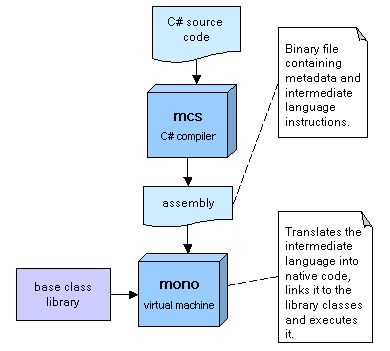
First, we will create a simple C# source program (the classical "Hello World!" couldn't be missing). Type the following program using your favorite text editor and save the file as hello.cs:
class Hello {
    public static void Main() {
        System.Console.WriteLine("Hello Mono World!");
    }
}
This program is composed of a class named Hello which contains
a method called Main. This method establishes the program entry
point, in the same way that the main function is the start of a
C/C++ program. In this example, the Main method prints to the
standard output the message "Hello Mono World".
We can now
compile the program using the Mono C# compiler, called mcs. At the
shell prompt type:
mcs hello.cs
We now should have a file called hello.exe in the current directory. But don't get baffled about the .exe file name extension. It is not a Windows executable file, at least not in the way we're used to. Contrary to what happens when we compile a program written in languages like C or C++, the C# compiler does not generate a machine-specific object file (for example a Linux ELF x86 object file), but instead generates a special binary file called an assembly, which is made up of metadata and intermediate language (IL) instructions. These two together represent a platform-agnostic translation of the program source code. This means, of course, that when we actually run the program contained in the assembly, its intermediate language code has to be translated to the native code of the computer where the program is being run. This last translation phase is carried out by a virtual machine, whose behavior is defined by the Common Language Infrastructure (CLI) specification. The CLI defines an object oriented runtime environment that supports a base class library, dynamic class loading and linking, multiple thread execution, just-in-time compilation, and automatic memory management. The Microsoft implementation of the CLI specification is usually referred as the Common Language Runtime (CLR). We say that the CLR is a superset of the CLI because the CLR contains some extensions that are not part of the CLI.
To execute our assembly, we must invoke the program called mono,
which is the Mono virtual machine. Type at the shell prompt the following:
mono hello.exe
The output should be:
Hello Mono World!
Lets see how to examine the contents of our assembly. The program monodis
(Mono disassembler) reads the binary information of an assembly and
produces a textual representation of its contents. Type at the shell prompt:
monodis hello.exe
The disassembler output should be something like the following:
.assembly extern mscorlib
{
  .ver 0:0:0:0
}
.assembly 'hello'
{
  .hash algorithm 0x00008004
  .ver  0:0:0:0
}
  .class private auto ansi beforefieldinit Hello
        extends [mscorlib]System.Object
  {

    // method line 1
    .method public hidebysig  specialname  rtspecialname
           instance default void .ctor()  cil managed
    {
        // Method begins at RVA 0x20ec
        // Code size 7 (0x7)
        .maxstack 8
        IL_0000: ldarg.0
        IL_0001: call instance void valuetype [corlib]System.Object::.ctor()
        IL_0006: ret
    } // end of method instance default void .ctor()

    // method line 2
    .method public static
           default void Main()  cil managed
    {
        // Method begins at RVA 0x20f4
        .entrypoint
        // Code size 11 (0xb)
        .maxstack 8
        IL_0000: ldstr "Hello Mono World!"
        IL_0005: call void class [corlib]System.Console::WriteLine(string)
        IL_000a: ret
    } // end of method default void Main()

  } // end of type Hello
The first part of this output corresponds to the metadata. It contains
information about the current version of the assembly, any optional security constraints,
locale information, and a list of all externally referenced assemblies that are
required for proper execution. The rest of the output represents the IL code. We
can spot two methods in this code: the default class constructor called .ctor,
provided automatically by the compiler, and our Main method. As
described before, when the virtual machine is asked to run this code, it uses a
just-in-time (JIT) compiler to translate the IL into the native machine code of the
hosting environment. The native code is not generated until it is actually
needed (thus the name just-in-time). For our example, the following is the native x86
machine code (in AT&T assembly language syntax) that gets generated for the Main
method:
push   %ebp
mov    %esp,%ebp
sub    $0x30,%esp
push   $0x80c9eb0
mov    0x805462c,%eax
push   %eax
cmpl   $0x0,(%eax)
mov    (%eax),%eax
call   *0x94(%eax)
add    $0x8,%esp
mov    0x805462c,%eax
push   %eax
cmpl   $0x0,(%eax)
mov    (%eax),%eax
call   *0xb4(%eax)
add    $0x4,%esp
leave
ret
Mono also comes with an interpreter called mint. If you use this
program, the IL instructions are interpreted instead of being compiled to native
code by the JIT. Actually, our simple program might be a little bit faster when
run under mint because the JIT compiler will take some time to
compile the code of our program and store it some where in memory. Of course,
subsequent execution of the native code already in memory is definitely faster
than interpretation. Currently the Mono JIT compiler is only available for x86
machines. The Mono interpreter must be used in any non-x86 machine. To see the
interpreter running, type at the shell prompt:
mint hello.exe
If you're familiar with Java, you might be thinking that all this technology sounds pretty much like the way that the Java platform works. And this is indeed so. The CLI virtual machine is the key factor for platform independence. This means that I can write and compile a program in Linux using Mono, and then run it in a Windows computer with the .NET framework. There is no need to rewrite or recompile the source code. But in contrast to the Java Virtual Machine, which is tightly coupled to the Java programming language, the CLI specification not only allows platform independence, it also allows language independence. Windows has compilers that target the CLR from a number of languages. The most important ones are part of Microsoft's Visual Studio .NET development environment: Visual Basic .NET, JScript .NET, Managed C++ and C#. Other languages supported, from third party vendors, include APL, COBOL, Eiffel, Forth, Fortran, Haskell, Mercury, Mondrian, Oberon, Pascal, Perl, Python, RPG, Scheme and SmallScript. The Mono project only has a C# compiler at this time, but we will probably see in the near future other languages being supported.
Another important element of the CLI is the Common Type System (CTS). The CTS fully describes all the data types supported by the virtual machine, including how these data types interact with each other and how they are represented as metadata inside the assemblies. It is important to note that not all languages available for the CLI support all data types in the CTS. So there is a Common Language Specification (CLS), that defines a subset of common types that ensure that binary assemblies can be used across all languages that target the CLI. This means that if we build a CLI class that only exposes CLS compliant features, any CLI compatible language can use it. You could create a class in Eiffel, subclass it in C# and instantiate it in a Visual Basic.NET program. Now this is real language interoperability.
Using a CLI compliant platform, such as Mono or the .NET framework, has some important advantages:
C#, as a programming language, has also some important features:
I will discuss these and other C# issues more thoroughly in later articles.
|
...making Linux just a little more fun! |
By Jon "Sir Flakey" Harsem |
These cartoons are scaled down to fit into LG. To see a panel in all its clarity, click on it.
![[cartoon]](misc/qubism/qb-commandline.jpg)
![[cartoon]](misc/qubism/qb-poe.jpg)
All Qubism cartoons are here at the CORE web site.
|
...making Linux just a little more fun! |
By Rob Tougher |
I use the Debian GNU/Linux operating system. I use Debian for the following reasons:
I install Debian software using APT, the Advanced Packaging Tool. With APT I can install Debian software from either a CD-ROM, an FTP server, an HTTP server, or my local filesystem. What's even better is that Debian provides their software archives on freely-accessible FTP and HTTP servers. Installation is as simple as pointing APT at one of these servers and telling it to run.
The purpose of this article is to give you an overview of APT and describe the basic commands for using it. My hope is that this article will show you how easy software installation can be using APT.
The main concept in APT is the package. Every software application that
Debian provides has a corresponding package. A package is a file
with a *.deb extension and includes these items:
All operations in APT deal with packages. When you want to install a software application, you tell APT to install that application's package. When you want to remove a software application, you tell APT to remove that application's package. Even if you only want information about the software application, you need to ask APT for the information using the application's package name.
Another important concept is the package cache. The package cache is a complete list of available packages in the Debian distribution. The package cache is stored on your local machine, and you are responsible for keeping it updated. A later section deals with updating your package cache.
Before you can use APT you have to tell it where to look for package files. Each location you specify is called a source. A source can be a CD-ROM, an HTTP server, an FTP server, or an archive on your hard drive.
APT looks in /etc/apt/sources.list for your list of sources.
The following is my sources.list file:
deb http://security.debian.org/ stable/updates main
deb http://http.us.debian.org/debian stable main contrib non-free
deb cdrom:[Debian GNU/Linux 3.0 r0 _Woody_ - Official i386 Binary-6 (20020718)]/ unstable contrib main non-US/contrib non-US/main
deb cdrom:[Debian GNU/Linux 3.0 r0 _Woody_ - Official i386 Binary-7 (20020718)]/ unstable contrib main non-US/contrib non-US/main
deb cdrom:[Debian GNU/Linux 3.0 r0 _Woody_ - Official i386 Binary-5 (20020718)]/ unstable contrib main non-US/contrib non-US/main
deb cdrom:[Debian GNU/Linux 3.0 r0 _Woody_ - Official i386 Binary-4 (20020718)]/ unstable contrib main non-US/contrib non-US/main
deb cdrom:[Debian GNU/Linux 3.0 r0 _Woody_ - Official i386 Binary-3 (20020718)]/ unstable contrib main non-US/contrib non-US/main
deb cdrom:[Debian GNU/Linux 3.0 r0 _Woody_ - Official i386 Binary-2 (20020718)]/ unstable contrib main non-US/contrib non-US/main
deb cdrom:[Debian GNU/Linux 3.0 r0 _Woody_ - Official i386 Binary-1 (20020718)]/ unstable contrib main non-US/contrib non-US/main
Adding HTTP, FTP, and local file archives to sources.list is simple -
you can add the entries into the file using a text editor (Debian keeps a list
of mirrors on their web site).
To add CD-ROMs you have to use the apt-cdrom command:
prompt$ apt-cdrom add
You are responsible for keeping your local package cache updated. Every time you want to install or upgrade a software application, you should update your package cache first. This ensures that you have the latest information about the software you are installing.
Run this command to update your package cache:
prompt$ apt-get update
The apt-cache utility allows you to search the local package cache for packages with certain text in it.
For example, you might want to install the Apache HTTP server on your machine. You could search for the Apache package using the following command:
prompt$ apt-cache search apache
This command returns 119 packages on my machine. Instead of reading
through all of the entries, you could filter the output using
grep:
prompt$ apt-cache search apache | grep "^apache"
This command generates the following:
apache-doc - Apache web server docs
apache-dev - Apache web server development kit
apache-ssl - Versatile, high-performance HTTP server with SSL support
apache-common - Support files for all Apache web servers
apache - Versatile, high-performance HTTP server
apache-perl - Versatile, high-performance HTTP server with added Perl support
After having searched for a package, you might want to view the
information for that package. The apt-cache utility takes
a show command, like the following:
prompt$ apt-cache show packagename
For example, If you wanted to view the information for the apache
package, you would type the following at a command prompt:
prompt$ apt-cache show apache
This returns the following:
Package: apache
Priority: optional
Section: web
Installed-Size: 748
Maintainer: Matthew Wilcox <willy@debian.org>
Architecture: i386
Version: 1.3.26-0woody1
Replaces: apache-modules
Provides: httpd
Depends: libc6 (>= 2.2.4-4), libdb2 (>= 2:2.7.7.0-7), libexpat1 (>= 1.95.2-6), mime-support, apache-common (>= 1.3.26-0), apache-common (<< 1.3.27-0), perl5 | perl, logrotate (>= 3.5.4-1), dpkg (>> 1.9.0)
Suggests: apache-doc
Conflicts: apache-modules, libapache-mod-perl (<= 1.17-1), jserv (<= 1.1-3)
Filename: pool/main/a/apache/apache_1.3.26-0woody1_i386.deb
Size: 352814
MD5Sum: 728257f5de8d71e0d00701bdca9d452d
Description: Versatile, high-performance HTTP server
 The most popular server in the world, Apache features a modular
 design and supports dynamic selection of extension modules at runtime.
 Some of its strong points are its range of possible customization,
 dynamic adjustment of the number of server processes, and a whole
 range of available modules including many authentication mechanisms,
 server-parsed HTML, server-side includes, access control, CERN httpd
 metafiles emulation, proxy caching, etc.  Apache also supports multiple
 virtual homing.
 .
 Separate Debian packages are available for PHP3, mod_perl, Java
 Servlet support, Apache-SSL, and other common extensions.  More
 information is available at http://www.apache.org/.
Task: web-server
Installing a package is achieved using the apt-get utility.
The following will install a package:
prompt$ apt-get install packagename
Typing the following at a command prompt would install the Apache HTTP Server on your machine:
prompt$ apt-get install apache
You can remove packages from your machine with the following command:
prompt$ apt-get remove packagename
For example, if you wanted to remove the Apache HTTP Server from your machine, you would use the following:
prompt$ apt-get remove apache
It's good to keep your system updated with the latest (stable) versions of software. Doing this using APT is a simple two-step operation. You have to do only the following:
prompt$ apt-get update
prompt$ apt-get upgrade
The first command updates your local package cache (we saw this in a previous section). The second command upgrades any packages installed on your machine that have newer versions available.
In this article I described the basic usage of APT. You should now be able to use APT to install Debian software on your machine.
|
...making Linux just a little more fun! |
By Vinayak Hegde |
One of the biggest problems faced by a linux user is the problem of estimating and allocating enough disk space to partitions when setting up a linux box. It does not matter much whether he is a system administrator looking after a server farm or an intermediate/power user of linux who has realized that he is going to run out of disk space. Sounds familiar doesn't it? Then starts the struggle to overcome the problem. Aha, the user has a brain-wave and problem is solved (after some sleepless nights) by using some non-elegant methods (read dirty hacks) like symlinks spanning partitions or using some partition resizing tools like parted. But these are only generally temporary solutions and we are faced with the same problem again.
How you wish that this problem could be solved!! The hacker in you wishes that you had a system on which you can experiment freely regardless of disk space and you could add or delete disk space as and when required. If you are a system administrator of a site with a number of servers which are always connected to the Internet, the stakes are all the more higher. Each minute of downtime causes losses. Even the danger of customers going away from your site. You can ill afford to reboot the server after you make changes to the partition table every time this scenario arises. LVM can be a lifesaver in such situations.
The Linux LVM can make your life a little easier. LVM takes a higher level view of storage space as compared to that of partitions and hard disks. Read on to discover how. LVM was introduced into the main kernel source tree from 2.4.x series onwards. Before we move on to LVM, let us have a look at some of the concepts and terminology that will be used.
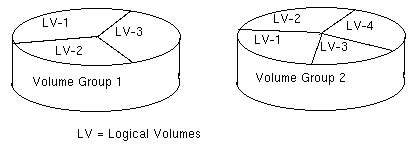
Now that we have got a grip on the terminology of LVM, let us see how it actually works. Each physical volume is divided into a number of basic units called as Physical Extents (PE) . The size of a physical extent is variable but same for physical volumes belonging to a volume group. Within one physical volume, every PE has a unique number. The PE is the smallest unit that can be addressed by a LVM on a physical storage.
Again each logical volume is divided into a number of basic addressable units called as Logical Extents (LE) . In the same volume group the size of the logical extent is same as that of the physical extent. Obviously, the size of LEs is same for all the logical volumes of a volume group.
Each PE has a unique number on a physical volume but not necessarily for a logical volume. This is because a logical volume can be made up of several physical volumes in which case the uniqueness of PE IDs is not possible. Hence the LE IDs are used for identifying the LE as well as the particular PE associated with it. As has been noted earlier there is 1:1 mapping between the LEs and PEs. Every time the storage area is accessed the address or the IDs of the LE is used to actually write the data onto the physical storage.
You might be wondering by now, where all the meta-data about the logical volume and volume groups is stored. As a analogy, the data about the partitions is stored in the partition table in non-LVM systems. The Volume Group Descriptor Area (VGDA) functions similar to the partition table for LVM. It is stored at the beginning at the beginning of each physical volume.
The VGDA consists of the following information :-
When the system boots the LVs and the VGs are activated and the VGDA is loaded into memory. The VGDA helps to identify where the LVs are actually stored. When the system wants to access the storage device, the mapping mechanism (constructed with the help of VGDA) is used to access the actual physical location to perform I/O operation.
Let us now see how to use LVM :-
Before we begin to install LVM there are some prerequisites:-
your kernel should have the LVM module configured.
	This can be done as follows:-
	# cd /usr/src/linux
	# make menuconfig

	under the Submenu:-
	Multi-device Support (RAID and LVM) -->

	enable the following two options:-
	[*] Multiple devices driver support (RAID and LVM)
and
	<*> Logical volume manager (LVM) Support.
This can be done using the following command:-
# df -h
Filesystem            	Size  	 Used   Avail  	Use% 	Mounted on
/dev/hda1		3.1G     2.7G	398M	87%	/
/dev/hda2		4.0G	 3.2G	806M	80%	/home
/dev/hda5		2.1G	 1.0G	1.1G	48%	/var
Use fdisk or any other partition utility to create the LVM partitions. The partition type of linux LVM is 8e.
# fdisk /dev/hda
 press 	p (to print the partition table)
 and 	n (to create a new partition)
After the creation of the Linux LVM partition. Print the partition table. It will look something like this:-
 Device Boot      Start       End    Blocks   Id   System
/dev/hda1   *         1       506   4064413+  83  Linux
/dev/hda2           507       523    136552+   5  Extended
/dev/hda5           507       523    136521   82  Linux swap
/dev/hda6 	    524       778   2048256   8e  Linux LVM
/dev/hda7           779      1033   2048256   8e  Linux LVM
# pvcreate /dev/hda6
pvcreate -- -physical volume "/dev/hda6" successfully created

# pvcreate /dev/hda7
pvcreate- -- physical volume "/dev/hda7" successfully created
The above command creates a volume group descriptor at the start of the partition.
Create a new volume group and add the two physical volumes to it in the following way.
# vgcreate test_lvm /dev/hda6 /dev/hda7
vgcreate- -- INFO: using default physical extent size 4 MB
vgcreate- -- INFO: maximum logical volume size is 255.99 Gigabyte
vgcreate- -- doing automatic backup of volume group "test_lvm"
vgcreate- -- volume group "test_lvm" successfully created and activated
This will create a volume group named test_lvm containing the physical volumes /dev/hda6 and /dev/hda7. We can also specify the extent size with this command if the extent size of 4MB is not suitable for our purpose.
# vgchange -ay test_lvm
# vgdisplay
--- Volume group ---
VG Name test_lvm
VG Access read/write
VG Status available/resizable
VG # 0
MAX LV 256
Cur LV 1
Open LV 0
MAX LV Size 255.99 GB
Max PV 256
Cur PV 2
Act PV 2
VG Size 3.91 GB
PE Size 4 MB
Total PE 1000
Alloc PE / Size 256 / 1 GB
Free PE / Size 744 / 2.91 GB
VG UUID T34zIt-HDPs-uo6r-cBDT-UjEq-EEPB-GF435E
# lvcreate -L2G -nlogvol1 test_lvm
Now you need to build a filesystem on this logical volume. We have chosen to make the reiserfs journalling filesystem on the logical volume.
# mkreiserfs /dev/test_lvm/logvol1Mount the newly created filesystem using the mount command.
# mount -t reiserfs /dev/test_lvm/logvol1 /mnt/lv1
Add the following entry to /etc/fstab so that the filesystem is mounted at boot.
/dev/test_lvm/logvol1 /mnt/lv1 reiserfs defaults 1 1copy the recompiled kernel if you have not replaced your original kernel with it yet so u have the option of using LVM or not using it.
  image   = /boot/lvm_kernel_image
  label   = linux-lvm
  root    = /dev/hda1
  initrd  = /boot/init_image
  ramdisk = 8192
After adding the above lines reinstall lilo by using
# /sbin/lilo
# lvextend -L+1G /dev/test_lvm/logvol1
lvextend -- extending logical volume "/dev/test_lvm/logvol1" to 3GB
lvextend -- doing automatic backup of volume group "test_lvm"
lvextend -- logical volume "/dev/test_lvm/logvol1" successfully extended
Similarly logical volumes can be reduced by using the following command
# lvreduce -L-1G /dev/test_lvm/lv1
lvreduce -- -Warning: reducing active logical volume to 2GB
lvreduce- -- This may destroy your data (filesystem etc.)
lvreduce -- -do you really want to reduce "/dev/test_lvm/lv1"? [y/n]: y
lvreduce- -- doing automatic backup of volume group "test_lvm"
lvreduce- -- logical volume "/dev/test_lvm/lv1" successfully reduced
As we can see from the above discussion LVM is quite extensible and pretty straightforward to use. After the volume groups have been set up. It is pretty easy to resize logical volumes as per requirements.
|
...making Linux just a little more fun! |
|
The mirrors took a bandwidth hit this month as the files were moving around, but the files have all settled down now. There will be another big shuffle sometime when we convert the 649 old GIFs to PNG/JPG, but that's such a big job I don't know when we'll be able to do it. Not just to convert the files -- that can take five minutes with ImageMagick's convert program, find and a small shell script -- but we also have to (1) decide whether image.png or image.jpg is smaller/looks better for each image, (2) change the IMG links in all the HTML files, (3) not use transparency, and (4) look at all the pages on various browsers. Any volunteers?
For next month, I want to refine the navigation links between articles and between the global pages.
There is one change which will affect only a couple mirror administrators. Next to the existing search links, there is a commented link the mirror site can replace with a link to their own search engine. The comment format has changed, and I noticed one misspelling in it ("ENDN" instead of "END"). So mirror administrators with local LG search engines will have to adjust their scripts. There may be further adjustment when the navigation links get refined.
---
key:     arndt
author:  arndt
title:   Office Linux -- Feedback
---
key:     bradley
author:  bradley
title:   Adding Plugin Capabilities To Your Code
"key" is a unique (within the issue) identifier for the article. "author" is a link to their Author entry, which is a file in rfc822 (mail message) format. (I could use YAML for it, but rfc822 is really convenient for this particular object.) "title" is, um, I think you can guess what that is....
The article header/footer, TOC, Front Page, Site Map, etc, are generated from Cheetah templates. Cheetah is a free software project I've been a developer on for the past 1 1/2 years. It's a string template system for Python. Cheetah has been generating the LG Mirrors page for several months.
There's a shared "lg" module that reads all the configuration files into a data structure and pickles it out to a cache file for fast reading. (Or actually cPickles it, which is a thousand times faster.) Then the script "article" takes the article entry and author(s) entry and puts the header/footer in the HTML file in place, deleting the previous header/footer if present. The "authors" script is more complicated because it has to make each Author's page as well as the author index, TAG bios index, and previous/next links for each. It also searches through the articles data to generate the links to all the articles published by each author.
I'm close to having TWDT automated, which I'm very happy about. No more
manually creating that d*%n thing manually and then having to edit three files
(the original, TWDT.html and TWDT.txt.gz) when an article needs a correction.
Soon I'll be able to change just the original and then run twdt and
have it automatically regenerate those two files. Well, almost. Heather
generates the TAG column lg_answer and TWDT.lg_answer.html simultaneously from
her mailbox files, and she tells me 'twould be difficult to generate
TWDT.lg_answer.html from lg_answer. So for TAG corrections I'll still have to
edit three files.
You step in the stream,
But the water has moved on.
Your penpal is gone.
Error messages
Unfold across the monitor.
Glist'ning like the snow.
From From: Mike Orr
I'm writing a script for school and I'm having a bit of trouble. The problem
is as follows: it must accept a from a user and display the squares of all
the numbers starting from 1 to that number, as follows:
1 square = ___
2 square =___
n square = ___
You didn't mention which programming language you're using, but it doesn't matter. We're unlikely to answer questions that can be discovered by simply reading a tutorial for that programming language.
See http://www.linuxgazette.com/tag/ask-the-gang.html for the kinds of questions we're willing to answer.
See now... I answered a sendmail question! Smile
That tells you I do lurk, until I see a message I can answer!
From: Iron
Aww, somebody's trying to crack my Webware site. Sorry I don't have any files for you, buddy.HTTP404: /favicon.ico HTTP404: /_vti_bin/owssvr.dll?UL=1&ACT=4&BUILD=2614&STRMVER=4&;CAPREQ=0 HTTP404: /MSOffice/cltreq.asp?UL=1&ACT=4&BUILD=2614&STRMVER=4&;CAPREQ=0
From From: "Benjamin A. Okopnik" <fuzzybear@pocketmail.com>
On Tue, Jun 11, 2002 at 05:14:29PM +0200, denis k?llner wrote:
Hi
i've download your software (lcdproc) and buyed me a display,
i've connect the display to my LPT-Port how it is in your picture, but it doesn't work!!
Oh, of course we instantly recognize the exact problem! Thank you for such a precise description.
what is a Linux kernels?
what function do they perform?
If you crack a Linux shell you can eat the kernel. Also you can grow new Linux trees from it.how important are they?
They are very important if you're stuck on a desert island and they are your only source of food.P.S. We don't do your homework for you.
I learned that stuff in school; with a lot of Russians of the previous generation (mine was already too cynical), it was an article of faith.
LATIN CAPITAL LETTER O WITH STROKE
LATIN SMALL LETTER O WITH STROKE
These symbols are familiar to us Scandihoovians, and are used to signify "This word cannot be pronounced by Americans."
CAPITAL LETTER NOT PRONOUNCEABLE BY AMERICANS
SMALL LETTER NOT PRONOUNCEABLE BY AMERICANS
Not that this has much to do with Linux of course.... but there are a lot of Linux users in Brazil; IIRC Conectiva is quite popular.
I don't think Yahoo has a mirror of Linux Gazette, but searching there for "Brazil" would net you a better chance of good information than visiting Linux Gazette would, anyway.
Every program is different. I have no idea what *that* program does, whatever it is. I can guess from the word "view" that it's a database application, but that's only a guess. Why don't you tell us?
-- Breen, without quite the high notes to sing that baritone line.
Subject: The Punk Kittens Have A Song For You! *LOL*
Punk Rock Kittens *NEW* LOL!!
I can just see Heather editing TAG with punk kittens wandering around the room....
Content-Type: text/html; charset="iso-8859-1"
Content-Transfer-Encoding: base64

PFRBQkxFIGNlbGxTcGFjaW5nPTAgY2VsbFBhZGRpbmc9MCB3aWR0aD03MjUg
Ym9yZGVyPTA+DQo8VEJPRFk+DQo8VFI+DQo8VEQgc3R5bGU9IkZPTlQtU0la
[Looks like a Klez worm to me. -Iron.]
--------------------------------------------------------
DOWNLOAD THIS WHITE PAPER AND LEARN...
--------------------------------------------------------

*  The Hacker Profile

*  Common Hacking Tools - The Hacker's Toolkit

*  Top 10 Ways to Secure Against Attack

*  Seven Questions to Test Your Security
What you should expect from this mini-course...
Today we'll give you the single, *most powerful* element in the ebook writing process...
Then we'll send you 3 more emails (one every 2 days) where we cover:
Email 1 - Creating an Idea and Writing your eBook quickly
Email 2 - Publishing Your eBook so *everyone* can read it
Email 3 - Selling Your eBook and making money!
So you see Answerguy we have a lot of ground to cover... let's get started!
[The interesting thing about this scam is not the measly amount they're offering ($33,000 instead of $33,000,000 -- as the message just before this offered), but the fact that it comes with a text attachment containing 1230 e-mail addresses, several being Linux Gazette authors and other famous Linux personalities. Oops, I think their harvesting software made a mistake. Did they run it in reverse? The funniest address is "billsux@microsloth.com"; I bet he's just waiting to invest. Here's an excerpt: -Iron.]
Email
gazette@ssc.com
linux-questions-only@ssc.com
Heather Stern <star@starshine.org>
Michael Conry <michael.conry@softhome.net>
tag-request@ssc.com
Shane Collinge <shane_collinge@yahoo.com>
Matteo Dell'Omodarme <matt@martine2.difi.unipi.it>
Paul Evans <pevans@catholic.org>
Mark Nielsen <info@gnujobs.com>
Ben Okopnik <ben-fuzzybear@yahoo.com>
billsux@microsloth.com
sponsor@ssc.com
webmaster@linuxgazette.de
ftp@be.easynet.net
Doc Searls <doc@ssc.com>
Contact Us <info@osdn.com>
ShadowDragon <brian.smithSPAM@SUXshadoweb.net>
ASCIIMan <jsaNOSPAMboe@artifexREMOVETHIS.org>
linux-questions-only@ssc.com
postmaster@aol.com
Username@Host
needbulkisp@yahoo.com
MAILER-DAEMON@aol.com
550MAILER-DAEMON@aol.com
gnu@gnu.org
email us <weblocal@linux-mandrake.com>
click here <tony@eastmont.net>
Ben Okopnik <fuzzybear@pocketmail.com>
marketing@elinux.com
you@email.address
info@suse.com
support@suse.it
suse@suse.de
announce@en.tldp.org <announce-subscribe@en.tldp.org.NOSPAM>
-unsubscribe@en.tldp.org
esr@thyrsus.com
debian-user@lists.debian.org
mirrors@debian.org
security@debian.org
sales@nostarch.com
webmaster@kernel.org
ftpadmin@kernel.org
Happy Linuxing!
Mike ("Iron") Orr
Editor, Linux Gazette, gazette@ssc.com