
 |
|||||||||
|
|
Table of Contents:
|
|||||||
|
|||||||||
|
TWDT 1 (gzipped text file) TWDT 2 (HTML file) are files containing the entire issue: one in text format, one in HTML. They are provided strictly as a way to save the contents as one file for later printing in the format of your choice; there is no guarantee of working links in the HTML version. | |||
|
|||
 , http://www.linuxgazette.com/ , http://www.linuxgazette.com/This page maintained by the Editor of Linux Gazette, gazette@ssc.com
Copyright © 1996-99 Specialized Systems Consultants, Inc. | |||
|
|||
Write the Gazette at gazette@ssc.com
|
Contents: |
Answers to these questions should be sent directly to the e-mail address of the inquirer with or without a copy to gazette@ssc.com. Answers that are copied to LG will be printed in the next issue in the Tips column.
 Date: Fri, 23 Jul 1999 14:21:44 -0700
From: jason@anemone.tenhand.com
Subject: You to can be a secret agent
I need help in setting up web kiosks for a free-net I'll be setting up in rural Nicaragua this September. When I took on the job, I didn't have a day job at a startup company. Now I do, and I haven't had any time to actually do the programming. What I need is help writing 2-3 system and mail admin programs with a cgi front end. The tools should be in PHP3 & or perl, and be set up so they can easily be localized. I'm willing to pay for the work, and the final web kiosk distribution will be released under a combination GPL/artistic license.
An example of what I need done is to have a cgi for sneakernet delivery of mail. The CGI should scan a list of qmail maildirs, figure out which ones have mail & provide a list to the user. The user can then click on a link, and the maildir will be re-delivered to a new maildir on floppy disk. The script needs to be able to handle checking for floppy/ formatting floppy/ spanning the maildir accross multiple floppies.
I can be reached at myles@tenhand.com, or at +1 (206) 399-9668.
myles
Date: Fri, 02 Jul 1999 11:06:14 -0700
From: Victor Richardson <darkmoebius@earthlink.net>
Subject: Linux server, Mac & Win clients
Recently, I acquired the job(pro bono) of consolodating a small(12 clients) non-profit's networks. Currently, they have two seperate networks, one using Appletalk with 7 Macs sharing a printer and the other NT 4.0 w/ 4 PC's and 2 Powermacs doing file and printer sharing. All the CLients have seperate dial-up internet accounts except one PC which has a cable modem(don't ask me why they don't all use it). I suspect the former tech pushed them into NT w/o informing them of the need and cost for Microsoft Outlook and Exchange.
I would like to consolodate them onto a single linux server doing email/file/printer sharing and connect theough a shared DSL line. I purchased Red Hat 6.0 for the task. Unfortunately, I have never used Linux before so when it scomes to altering config files I get lost. I have read alot of How-to's on setting up Samba and Netatalk seperately, but never have come accross an article about setting them up together. Is ther fine tuning invovled to get them to work together? Is there a simple answer to this with walk through help? Also, they all currently use Netscape browser, what software should I use to transfer email internally and externally?
Any help would be greatly appreciated.
Victor
Date: Fri, 2 Jul 1999 19:31:07 -0700
From: "Todd & Missy" <tmjenn@earthlink.net>
Subject:
I have used and installed windows for years and decided to try Redhat because I hear good things about it but i can't get it to install. I can't get the harddrive right to get it to install I have tried everything but I just can't get the partition right so it will let me install it. I am about to give up but I will give it one more shot if I can please get some help. You can e-mail me at goodtogo45@hotmail.com I run windows98 have a amd300 and a 3 gig harddrive thanks Todd
Date: Sat, 03 Jul 1999 17:44:38 +0800
From: wei <cyberwei@ms12.url.com.tw>
Subject: search for some software !
Dear sir :
Sorry to bother you ! I am a rookie in linux system and now I have
a project to do .
It need a software to plot gray-scale plot of geographic data to present the 3-D data!
I have tried pgplot 5.2 etc., but I can't compile it correctly ! Could you introduce me a appropriate software to do this ? Thanks a lot ! Cheers !
Wei
Date: Sat, 03 Jul 1999 17:55:42 +0000
From: Wolfrider <wolfrdr@famvid.com>
Subject: Request for Ethernet on Linux instructions
Currently I have two computers; one I would like to set up to use as a squid proxy server connected to Internet via modem.
I have tried using direct-connect twisted pair as well as a cheap 5-port hub and can't get telnet or ping to work, although both devices now ' ifconfig ' Ok.
I couldn't find anything in LG related to Ethernet / TCP/IP setup; could someone write a step-by-step on this or point me to something I've missed? (I've checked some of the HOWTOs.) Thanks in advance
--
==WolfriderV6, VROC #59(R)
Date: Sun, 04 Jul 1999 23:48:12 -0500
From: vwbuggy@viagrafix.net (Steve Hatheway)
Subject: Linux
Hi my name is Steve from Tulsa Ok.
Iam sick of windows 95, 98 and Gates, and the way he has control of every thing makes me sick. If he had a good product I might feel different. At first I could not under stand how he has control of the market with a piece of junk, but now I know why. I know, and alot of other people know that UNIX is a very good system. Not every body knows that Linux is a newer Versions of UNIX made for PC's. And with more investigation you find out there is about twenty different brands of Linux all looking like they are better than each other.
Which one is the best, who is biggest, who has been around longest, who has the most support, who is the most stable, I think REDHAT is maybe? Then every brand has several Versions out there , with in a small time frame ,to many too choose from, why some many versions. That tells me that the early Versions must be bad to have to make a new one so quick. Then you find alot of patches for different brands, and versions ? (I don't mean to sound bad, but which one do I use.) I think every body would like a stable and fast system with the least amount of overhead that has alot of support and programs will run on then bye bye windows95,98,??. It seems like to me that all the Linux people are after each other instead of windows95,98,?? Then there is Freebsd that says they are best because they dont have all the bugs.
I am so confused that maybe I should stay with windows 95,98,?? and install and time delay relay to cycle the power to it every hour, so it can reboot like it wants to. Please tell me more about Linux like. Who has the most support, whos is most stable, bottom line the best one?
Thanks for your time. Steve
Date: Mon, 5 Jul 1999 19:17:16 +0100
From: "Edward Andrews" <EAndrews@aldreth.free-online.co.uk>
Subject: Setting up mouse
I've just installed Red Hat 6.0 Linux and cannot configure my mouse. Mouseconfig cannot find my mouse when probing for a mouse and trying to set it up as a generic or a microsoft compatible mouse does not work either. The mouse works under Windows as a standard serial mouse using COM1, but does not work as a Microsoft compatible mouse using dev/ttyS0. The setserial command reports that the dev/ttyS0 port uses the same IRQ and addresses as COM1 uses under windows.
Any ideas?
Edward Andrews EAndrews@aldreth.free-online.co.uk
Date: Thu, 08 Jul 1999 08:35:11 +0200
From: jan johnsen <janjohnsen@get2net.dk>
Subject: gcc will not work !!
With my red hat 6.0 , just installed, I can not get the gcc to work. When I have downloaded a program, and what to run ./configure the test goes allrigt just until it gets to gcc - it finds gcc but the it writes something lig ' gcc not working - can not make exec."...
I have installed both gcc, egcs, egcs++ and egcs......
Anyone know if its a problem with red hat 6.0 or is it the programs
Jan Johnsen
Denmark
Date: Fri, 9 Jul 1999 18:01:12 +1000
From: "Jeremy OHara" <Jeremy.OHara@petos.com.au>
Subject: Need as much info on how to Setup a dial-in server
Hi all
I was wonder if anyone could have me? I was wonder if anyone could give me as much info on how to setup a dial-in server? I'm planing to setup a Dial-in server An ISP.
Thanking you
Jeremy OHara
Date: Sun, 11 Jul 1999 12:23:55 +0200
From: "F. Biondi" <biondif@creso.off-on.it>
Subject: E-mail receiving question
Hello. When I try to receive an e-mail via POP3 server by Netscape Communicator, it doesn't show any error message but it doesn't find anything and tells that there are no messagges on the server. However, when I try using Windows98 (by OutLook), all the messages are found.
Obviusly, out going e-mails work fine. Can you help me?
(I am using Linux Red Hat 6.0, with kernel version 2.2.5)
Filippo Biondi (Italy)
biondif@creso.off-on.it
Date: Mon, 12 Jul 1999 02:40:45 -0000
From: "denver" <revned@gis.net>
Subject: Installing a linux workstation onto a Windows based LAN that uses DCHP
I am having problems adding a linux workstation onto a LAN that is all windows based and uses a Windows NT server as the DCHP Server. Every time I boot up the machine, the linux workstation gives me this error saying that eth0 was unable to find it's address or basicly it cannot connect to the network. It would be nice if someone can either tell me step by step on how to setup the linux workstation or give me a link(s) to documents that can help me solve this problem.
Date: Sun, 11 Jul 1999 23:24:04 -0700
From: cc246 <cc246@gateway.net>
Subject: How to access and download printer software
I need help with my HP 882C, I can not print MSDOS work.
Date: Tue, 13 Jul 1999 10:32:51 +1000
From: Andrew H Edmonds <40009722@snetbr.cpg.com.au>
Subject: Linux on Notebook.
I hope someone has some advice...
I am looking to buy a Pent 90 or higher, Notebook that has an internal
CD-Rom drive, so that I can load OpenLinux Caldera 2.2,
which I have just instaled on my desktop.
I am a student in Brisbane Australia, learning Basic Microcomputing.
Can anyone recomend a brand or model of notebook, I have been to the Linux on Laptop page 'Texas site' but none look any more appealing or stable than the others.
Thanks,
Andrew H Edmonds
Date: Tue, 13 Jul 1999 05:13:13 -0700 (PDT)
From: Markus Laumann <basikx@yahoo.com>
Subject: windows inside linux
Dear Whoeveryouare,
I'm trying to find someone who knows how to run windows 98 inside linux. I've seen it before, but I can't seem to find it when I want to. If you could point me in a direction and kick, I would be very thankful.
Markus
Date: Tue, 13 Jul 1999 12:32:32 -0400
From: "Michael A. Lurie" <the_one@mindspring.com>
Subject: ppp connection
I have an internesting problem. I have configured ezppp, kppp, and gnome-ppp to connect to my mindspring account, and all three seem to be doing so just fine. However, when I startup netscape or any other internet application, I can't access the internet. It just sits there trying to lookup the host. No error message. No nothing. I am completely stumped. Any help would be appreciated.
Date: Tue, 13 Jul 1999 12:32:32 -0400
From: "Michael A. Lurie" <the_one@mindspring.com>
Subject: ppp connection
I have an interesting problem. I have configured ezppp, kppp, and gnome-ppp to connect to my mindspring account, and all three seem to be doing so just fine. However, when I startup netscape or any other internet application, I can't access the internet. It just sits there trying to lookup the host. No error message. No nothing. I am completely stumped. Any help would be appreciated.
Date: Fri, 16 Jul 1999 07:13:15 -0500
From: "Brian B." <ixnay@warp9.lagnet.hb>
Subject: setting up mail for a home network.
Ok either there is an error in this article or Im a complete dolt
I went step for step through tis article but my outgoing mail is not getting my return address changed from my local domain to my isp email account.
I keep getting a sender domain non-existent error from my isps mailserver.
any help would be appreciated
Brian B.
Date: Fri, 23 Jul 1999 12:43:35 -0700
From: Helen Carley <HelenC@shoretel.com>
Subject: Archives
How do I get to them? I'm looking for the original article on multi-threading. Thanks!
[http://www.linuxgazette.com contains links to all the back issues. A link to the search engine is near the middle of the page.There is also a page containing the table of contents for all issues at http://www.linuxgazette.com/lg_index.html. Here you can use your browser's Find dialog to search for titles or authors.
The article "Thoughts on multi-threading" was in issue #15 (March 1997). -Ed.]
Date: Sat, 17 Jul 1999 15:36:09 +1000
From: "Danny Ross" <dross@netspace.net.au>
Subject: Missing Mouse
I've just installed Linux (6.0) and during the installation I specified a PS2 mouse type. However, the first time (and every time since) I logged into the system and received my Login box, the mouse doesn't move. I have a dual boot system (Win 98) and the mouse works fine in everything but Linux. I have searched through the FAQs and tried booting with bmouse=3D3 at the LILO prompt but to no avail. I think I know which file I need to edit to configure the mouse, but how do I get to the Linux files without a mouse?
Anybody got any ideas?
Danny Ross
Date: Sat, 17 Jul 1999 22:05:41 +0700
From: Ruangvith Tantibhaedhyangkul <ruangvith@linuxfan.com>
Subject: It's all in a Linux's works.
Dear Linuxinans,
I'm having a couple of problems using Linux. My system is now Mandrake 6.0, which is claimed to be 99% compatible with RedHat 6.0.
Thanks for your help.
Date: Tue, 20 Jul 1999 12:00:00 +0100
From: "Andrew Mott" <andrew.mott@geharris.co.uk>
Subject: setting up a dial-in box
I'm looking to set up a dial-in box for use at work and I was wondering if anyone would be able to answer a couple of my questions.
If anyone can help I'd be very grateful.
Cheers,
Andrew Mott
[Yes, all distributions allow you to repartition your disk after installation. However, you can't delete a partition without losing the data in it (except maybe with third-party "resize-in-place" utilities). Linux requires a separate partition except in the case of the now-obscure UMSDOS filesystem. I have not heard of any problems with PPP security. Market share changes quickly, but people's perceptions of it don't change quite so fast. So whatever anybody tells you now will change in six months.Red Hat has for years been consideredthe biggest by far . However, SuSE now claims to be roughly the same size as RH, both in terms of sales and employees. Caldera has traditionally been much smaller, but have been very successful with their current 2.2 release, in part because RH raised its price and so for the first time, Caldera is actually cheaper than Red Hat.
After years of there being only three major distributions (RH, Debian and Slackware), suddenly distros are exploding from the seams. SuSE made it big in the US last year. Caldera and TurboLinux this year are now seen by many as "major" distributions. (Especially since TurboLinux is outselling Win98 and MacOS in Japan right now.) I'm still not sure what to think about Linux-Mandrake: we'll see whether it gathers long-term momentum.
Distributions keep moving up and down the latter, and they will continue to do so.
Delving into more ancient history, Slackware was the biggest distro before Red Hat, and SLS before Slackware. Each became the biggest because it was perceived as easier to install, more bug-free, and better supported than the previous standard.
Disclaimers: I haven't listed non-Intel platforms (MkLinux) because I don't know enough about them. These opinions are solely my own and what I remember from news stories. If anybody has hard-and-fast numbers about the relative market share of several distributions, and how they've evolved send them in and let us
Gazette readers know. -Ed.]
Date: Wed, 21 Jul 1999 22:59:37 -0400
From: "MK" <mkrygier@softhome.net>
Subject: I have an Interesting Network problem...an NT SERVER!!!
Dear Linux Geniuses!
I was wondering if you could help me and my school solve out linux/Nt networking headache.
The school is running a NT4.0 server that has four network cards that are connected to hubs that are located in the school. its IP is 10.15.16.1 and the other cards IP's are 10.15.64.1, 10.15.48.1, 10.15.32.1, etc. The Nt server acts as a gateway for traffic from these subnets. We are all using DHCP assigned addresses but I reserved one for the linux box 10.15.64.7. What I can ping is 10.15.16.1 the Server and the computers on the subnets because I passed this route command "route add default gw 10.15.16.1" and the it goes! The Ntserver is connected to another server running WinProxy and it has 2 network cards, this computer handles the internet. I cannot ping It! It's address is 10.15.0.1 the windowz boxes on the subnets can but I cant! (dont worry my DNSes are set and everything) this Proxybox is a router to the net it's other Ethernet card is connected to the net (complex 100mbit stuff, not important) it's IP is 10.15.88.1. I need to figure out how to set my route in linux to be able to ping the ProxyBox and then travel to the internet. Can you offer any advice? Also the Proxybox is running WinProxy for web and ftp transfers...do I have to worry about it? any thing that I am required to set?
I am using RedHat 5.2 with kernel 2.0.36 and an eepro100 network card on a pentium pro.
Thank-you in advance!
Michael Krygier
Jr. Unix network admin wannabe
Date: Thu, 22 Jul 1999 10:20:10 +0200
From: Laurent Mulot <Laurent.Mulot@anp.lip6.fr>
Subject: Could you solve my problem, too?
This is not a suggestion, nor a comment so I don't know if you'll answer me. Let's try anyway.
I'd like to truncate a 3MB file so that I can put it on floppy disks. The file is already compressed. Is there a Linux instruction or a software that can do such a thing ?
I can also present it that way : I suggest you could explain how to truncate a file (just kidding)
thanks in advance
Laurent
Date: Thu, 22 Jul 1999 06:07:21 -0400 (EDT)
From: sandeep kohli <fuhrer6mill@yahoo.com>
Subject: VERY BIG PROBLEM with Video Card
Hello there,
i am sandeep from india and i have recently Bought a azza MainBoard with Built in Sound Card (Avance Logic 120) and Video Card (SiS-530(but chip is SiS-5595 (AGP with shared Ram ))) there is a very big problem Linux couldnot recognise the VRAM on the shared Sdram MOdule originally allocated by Award Bios.
The sound card also was not recognised by the new Linux 6.0 version but by 5.2v ver of Red Hat it was recognised as Sound Blaster not as my original card as u guys have bveen doing great work i thought that u would be able to
solve my problem or direct me to those who can
thankiing u guys. u r really doing a great work!
bye
My email address is fuhrer6mill@yahoo.com
(i am calling from a cafe so please do not reply to any other e mail
address than given above(fuhrer6mill@yahoo.com)
Date: Thu, 22 Jul 1999 18:17:16 CST
From: Jim Bradley <jbradley@msc.net>
Subject: DNS on the fly???
I have my laptop configured to plug into the network of my employer. At home, I plug my laptop into my home network, and dial out from another machine setup for dial on demand. Unfortunately, if it takes forever waiting for the two timeouts when trying to connect to the employer's DNS servers from home, and if I change the DNS order, it takes just as long for the timeout error when attempting to connect to my ISP's DNS from my employer's network. Is there an easy way to change the DNS servers when needed? It's easy enough to change IP addresses with the ifconfig command, is there a similar means for changing the DNS? Or, should I just bite the bullet and setup BIND on the laptop?
Jim Bradley -- Maryville, MO USA (jbradley@msc.net)
Date: 22 Jul 1999 21:40:02 -0700
From: <murad@123india.com>
Subject: Re : Problem installing StarOffice
Hi, I am really sorry if this mail has reached the wrong plcae, but I desparately need help. I have installed Red Hat Linux 6.0 ( Kernel 2.2.5-15 ). I am unable to install StarOffice 5 Personal Edition. I have followed all the steps given for StarOffice installation. I have a file named 'libc.so.6' in my '/lib' directory which is a link to 'libc-2.1.1.so' in the same directory. When I run the ./setup for the StarOffice installation it gives an error saying that the installation requires glibc2.0.7 ( which is available on the CD ). So I copy this lot of library files in to the '/lib' directory. After that when ./setup is run, it accesses the CDROM for around 5 seconds, then the hard disk for 10 seconds and then it just comes back to the prompt, without ANY error message. I am really frustrated with this. Be my saviour and answer my query. I f you are not the right person to answer the query, atleast guide me by pointing me to the right person.
Thanx & Regards,
Murad Wagh
Date: Sat, 24 Jul 1999 10:15:01 -0500
From: "Tom Trucco" <ttrucco@orchardpro.com>
Subject: help
I recently installed RedHat 6.0 on an Intel box so I could inexpensively test Apple's QuickTime Streaming Server. The installation of RedHat went smoothly and seems to be working quite well on the box (a consumer Compaq Presario). I downloaded QTSS, configured it and proceeded to run it. It worked immediately. I am having a problem that I would like to know if any others have had. I can directly access a streaming movie using its true file name but I can't get it if I use the name of the reference movie. I should be able to access the reference movie and have the server and the QuickTime plug-in on the client machine negotiate the correct version of the movie to serve based on the client's QT plug-in's "Connection Speed" setting. Based on the setting, the server chooses the appropriate movie for the bandwidth and serves it up.
That is how it is supposed to work. When I attempt to connect using the reference movie the client connects and then reports "415 - Unsupported Media Type". Does anyone have a clue what is happening?
Date: Sat, 24 Jul 1999 17:29:34 +0200
From: "werner duplessis" <wdplessis@yebo.co.za>
Subject: newbie userMIME-Version: 1.0
i am trying to configure my video card need a driver thats compatible for a sis 5598 or i need to download it from somewhere? please help
Date: Sat, 24 Jul 1999 12:59:40 EDT
From: TLA9904@aol.com
Subject: trying to load hp 722c into windows 98..
I had a friend install my new copy of windows 98 after he cleaned off everything and started with a clean hard drive..... it took everything but the printer setup... it keeps saying I have problem 10.... I am not even good at any of this.... what can I do... or dooing wrong....
[Since this is a Linux ezine, we usually don't publish questions about other operating systems. I'm running this one because the number of non-Linux questions coming in has not been enough to warrant concern. But please, find appropriate forums for your questions. -Ed.]
Date: Mon, 26 Jul 1999 15:54:37 -0500
From: Randy Copeland <ccu@ipa.net>
Subject: Websites with free downloads!
I am running Windows 95 on my good computer which is a Pentium 100. But I have an old 486 DX4 in another bedroom that nobody uses and I ask my dad if I could run Linux on it. I have searched for a couple of days and still can not find a website that I can get a free download from. The computer tech guy at my dads store thinks that I might have to start with UNIX and then go to Linux if I can't find a site that has a free download. I would greatly appreciate it if you would e-mail me back with a couple of websites if you know of any! E-mail it to me at mhs-trainer@excite.com.
Thanks for the help.
Richard
[Debian is a totally free version of Linux made by volunteers. It is available via FTP, and more importantly, the installation program supports FTP-via-PPP modem installs. See www.debian.org, "Installation Instructions" and "Download FTP". Choose the "stable" version; "unstable" is a pre-release.HOWEVER, if you've never used Linux or Unix before, $50 spent for the distribution of your choice with a good reference manual and tech support is well worth it, especially if you have a newer PC to run it on, because it will be much easier to install and you'll be able to take full advantage of Linux's capabilities.
On the other hand, if the 486 is the only computer available and it has no CD-ROM, FTP'ing a distribution may be your only choice. Install a small number of packages at first, and then gradually add more. -Ed.]
Date: Tue, 27 Jul 1999 21:08:47 +0800
From: kaoc@ever.com.tw
Subject: Booting problem (can't mount root fs)
There's two situation:
One: If click The other: If I clicked nothing when LILO showed up, and let LILO select Linux
to boot automatically by default...
My Redhat always goes dead while it is trying to mount root fs.
The problem message is as following:
VFS: Cannot open root device 00:30
Kernel panic: VFS: Unable to mount root fs on 00:30
Does anybody have the same trouble as I ? and Pls, help me to solve the
problem.
I am looking for voice recognition software for a LINUX slackware
system. Also software and hardware for a video camera.
Thank You,
Hello, my question is about the g++ compiler.I want to know if is able
to link files that use templates and then aren't included in the main
program (they are in different files, and only the header files are in
the main program). I have try as:
Juan J.Alejandro (jac@speedcom.es) Girona (Spain)
I've recently installed Redhat 6.0 on a Sharp Widenote after swapping
the factory 1 GB drive for a more suitable 6.4 GB drive purchased over
the web.
... Now if I can just get my ppp to my MCI ISP account (which was sold to
Cable and Wireless and is now being sold to Prodigy) working. They appear
to do some sort of Challenge Response Authentication in addition to
the usual CHAP ie.: there's a prompt of "(IH08011)" (number changes session
to session) which seems to be a combined login identity request and
password challenge which is then followed by the prompt "password"
which presumably requests the password transformed by the number in
the first prompt. If I set the pap-secrets or chap-secrets file then
pppd expects to have established a ppp connection in which to encapsulate
the authentication protocols but I seem to get this challenge in a
prompt before ppp starts up so I suspect it's not just the regular CHAP.
Note a generic MSDUN has no problems with the prompt, but of course M$
doesn't have any useful documentation about what they are doing. Any
ideas? I'll probably solve the problem by switching ISP's but if anyone
has the answer, I'd like to hear it.
Regards,
Hi. I am having problems with my current installation of ghostscript.
I have a 9-pin dot-matrix Epson FX800 which worked fine under ghostscript
3.33 but now refuses to work under 5.10. I also have an Olivetti JP170
monochrome inkjet in the same position. I have checked the versions of files
installed, and everything seems correct, but I cannot understand how the
ghostscript writers have added my printer into the uniprint driver.
All the help files I have come across describe help for a 3.33-based
installation, and I haven't found much specifically for 5.10. Even some of
the files supplied with 5.10 still refer to files that were around in 3.33!
These files aren't around any more (at least I can't find them).
If you have any ghostscript experience, could you please help with a
walk-through on how to print a page on my dot-matrix printer under ghostscript
5.10? I would be very appreciative.
Also, thanks to the AnswerGuy for explaining in issue 42/43 about library
conflicts - it explained some possible conflicts I had in my system, and I
have repaired some (but not all) of my problems as a result.
By the way, to Heather and the team, thanks for continuing to put out a
great e-zine. It's well worth the download 8-).
Hi, Gazette:
I am installing frontpage98 extentions on my Linux Server(Redhat5.2a).
Installing root web was successful, but the problem occurred when I install
virtual web. When I use the previous version of Linux(Redhat5.1), there was no
problem. The list of virtual webs appeared, and I could select one of them. But
now, the list shows infinitely like following.
Please help me. Can you tell me what the problem is?
It seems that most of the mail you get seems to be somebody with some
kind of problem. while I guess it's to be expected, it sure makes for
boring reading.
Anyway, I think it might be a good idea to pick an application field,
say, Word Processing, or perhaps communication clients, (ICQ clones,
perhaps) or stuff like that.
Review products with a fairly standard configuration, and rate the
applications on useability, stability, features, easy of installation,
etc. Perhaps even go so far as to have an editors choice?
It would certainly get my rapt attention, and it's something you'll find
in just about every computer magazine worth any salt.
-Benjamin Smith
UserFriendly is a nice little site devoted to an online comic strip
documenting some of the nuerotic characteristics of the Unix community.
While they have their own site
www.userfriendly.org with all of the
usual amenities, someone there has decided to do some "retro computing".
Someone found BBS software that runs under Linux, and has setup an old
style BBS that you log onto via telnet. (T1 line, 64 lines max) Text or ansi
interface, game doors (Trade Wars, for example [!]), etc., with lots of new
stuff Coming Real Soon Now (tm).
Apparently this has struck some sort of chord, because they have had
hundreds of new users on the first day, with lots of people mentioning how much
they miss this stuff, etc. People who ran one line or two line BBSs in the old
days two or three or four years ago. Looks like this is going to be very
popular once the word gets out....
[NOTE, they have just sailed past 1000 users signed up after a day and a
half, and still cruising strong]
For a quick link, check out bbs.ufies.org.
You have to have a telnet client to actually log onto the BBS at
telnet://bbs.ufies.org
compared to the old neighborhood BBSs I knew just a few years back, this is
mind bogling....
There are so many people there who seem to miss the old style BBSs...
i'm amazed....
My name is Berry Sizemore and I am a member of Tacoma Linux Users Group
(TACLUG). Our organization is going to participate in the international Linux
Demo Day Project. ["Tacoma" is Tacoma, Washington, USA. -Ed.]
"The purpose of the Linux Demo Day project is to provide a concurrent
worldwide demonstration of the Linux Operation System to the "average" consumer
who may only have heard of Linux but has never seen it, and to those that are
not even aware that there is an alternative to running a Microsoft operating
system."
We are reaching out to our community partners and businesses that may have
an interest in sponsoring the event. For general information about the event,
please point your browser to
http://www.linuxdemo.org/ . We are
currently seeking a location for our event and exposure by the local press. We
are eager to promote Linux friendly businesses and organizations in exchange
for promotion of our organization and events. The likely location for our
demonstration will be in a high profile mall, local community center or school.
We plan a Linux installation workshop, a chess competition, a Quake
competition and a tour of the XWindows interface. We are also going to answer
the community's questions about the operating system and promote our
organization as a resource for budding Linux professionals and hobbyists.
If your company can in some way help us raise the awareness of Linux
Demo Day, find
or offer a location for, or promote the event please contact me at:
webmaster@taclug.org
Thank you!
I have tried all three available versions of LINUX and can get none of
them installed.
REDHAT will recognize the mouse but not the video (SIS6326 AGP);
SUSE won't even start; I cannot figure out what it wants in the way of
disk-formatting;
Caldera just will not boot.
I have a Pentium III 450 mH; 128 Meg RAM; and 8.4 gig disk...
LINUX ain't something "Slick Willie" GATES is going to lose any sleep
over...
Bob Hamilton; Mail@bobh.to www.bobh.to
Hello. Quite good article about playing video files. Just one remark.
You said you weren't able to find videos which xanim wasn't able to
play. Unfortunately one rather popular movie, the second Star Wars -
Episode 1 trailer, comes in Quicktime format and uses a Sorensen codec
which is not supported by xanim.
--
in lg 43 Jim Dennis writes:
I don't think so. To me the Bench Mark is the "Broad Arrow" stamp used as
the symbol of the British Courts ("Queen's Bench") and the crown. This is most
familiar in old British films where convicts are shown in clothing with bench
marks on the cloth. The bench mark is also found on many buildings in the
British Isles (and probably the commonwealth?). These bench marks have a line
above them and are miade by Ordenance Survey (now a company, but previousl part
of the Army).
The height of the line above sea level is known to an acuracy of less than
1mm. They are points from which measurements are made during map making and
building works, and would have had a role similar to GPS in the modern
millitery has Britain been invaded after the Ordenance Survey was started at
the begining of the Napoleonic Wars.
Yours
Hi Ian! If I compare Linux to OS/2 or Windows, it's much more command-based.
This can make it a bit harder to use in the beginning.
Especially to _configure_ different things in Linux can be difficult.
So my conclusion is that you'll have to have some patience when learning
Linux. I have heard that Caldera should be the easiest Linux
distribution to install (I'm using SuSE so I haven't tried it myself.
However, I think that when more and more "normal" (i e non-technical
people) start using Linux we'll see a shift towards a more user-friendly
Linux. And there seems to be a really friendly atmosphere on the
Internet where you can get high-quality Linux help
Yours,
Good day.
One thing I know that's been a bit of a barrier to people moving to
Linux are applications that they're using written in a Microsoft
development package and threfore, of course, using all Windows-relevant
functions, calls, etc. If Linux is to move off the server and on to the
desktop, in my opinion, functional development apps that can start with
Microsoft based code, translate it to an XWindows GUI,
and then run the programs under Linux. A tall order, I admit, but
necessary to move the small ISV's and the people who use their programs
over to the Linux camp. Otherwise it's going to be stuck like OS/2 was -
sometimes the same software, but versions that were always feature-poor
compared to their Win 'cousins.'
Something to think about.
Best,
Mark, You write:
There is really no need for that as for years there exists 'sfdisk'
(probably short for "scriptable fdisk" :-). It is a part of util-linux
package although Red Hat apparently only recently started to include
binaries in their rpm archives. Sources were there "for always".
It has somewhat spartan user interface, although in some situations is
very capable and I used it interactively without any problems. It is
also very simple to script, to embed that into "disk cloning" scripts,
and unbeatable in that. Its documentation includes examples of such
usage. I have seen once in Linux Journal somebody bragging that they
fed fdisk commands from stdin (doable but scary :-) to automate mass disk
partitioning and I was always scratching my head why they work so hard.
A reluctance to peek into docs, I guess.
I have no idea how to shoehorn that into kickstart operations
without modifying the installation program itself. The later is
always possible as Red Hat supplies all sources for installation
utilities on their CDs.
I also have an impression that your Perl script at the bottom
of the article tries hard, but not entirely correct, to emulate
the following command:
Beside this list which you are after is basically ready in
RedHat/base/comps on CD.
If you wonder what tags you can use in a format try to type
'rpm --querytags'; even 'rpm --help' says so. :-)
Regards,
The September issue of Linux
Journal will be hitting the newsstands in mid-August.
This issue focuses on "cooking with Linux": fun things we can do with Linux,
or how we can achieve our computing goals while still having a good time.
Linux Journal now has articles that appear "Strictly On-Line".
Check out the Table of Contents at
http://www.linuxjournal.com/issue65/index.html for articles in this
issue as well as links to the on-line articles.
To subscribe to Linux Journal, go to
http://www.linuxjournal.com/subscribe/ljsubsorder.html.
For Subcribers Only: Linux Journal archives are now available
on-line at http://interactive.linuxjournal.com/
My name is Karl Pena
jackal@raptor.slc.edu.
I am an athlete. I've been addicted to linux for two years or more now.
I want to invite you to share in my project. I just graduated Sarah
Lawrence College (where my colleagues and I learned linux to set up a
student-run server:
http://raptor.slc.edu). I am deeply involved
in the non-profit ideals, and have coordinated major special events for various
different organizations.
Linux Demo Day is coming up in September. This is a very exciting time
for me and for linux, and I am going to give something back to the
community.
I am planning a special journey, on bike, to spread the word on the beauty
of Linux.
I would love to post something on your site, or advertise a paragraph in
your magazine. I am low on cash, so I can't pay you right now.
I just need a few sentences to invite any riders/hackers who want to be
part of my epic journey, to come along. I can use donations, team-members,
PR volunteers, co-grant writers, and sponsors.
Amiga's CEO announced that the next generation of the Amiga Operating
Environment (OE) will be based on the Linux kernel. In other words, the Amiga
is about to become a Linux box. But it will have special drivers for the
Amiga's multimedia hardware. Soon afterwards, the Transmeta logo was spotted at an Amiga conference.
Rumors are flying about a possible Linux kernel-on-a-chip (allowing e.g., the
entire kernel memory in cache). Of course, Transmeta continues to keep mum
about what its plans are.
"TOKYO, July 27-In a mark of the rising open source-code
movement, TurboLinux has outsold the upgraded version
of Microsoft's Windows 98 operating system and the Mac
OS in Japan for the past three weeks, according to a
market research company..."
Read the entire story at
http://www.cnn.com/TECH/computing/9907/27/linux/index.htm
The rest is from a TurboLinux press release:
SAN FRANCISCO, Calif. - July 26, 1999 -TurboLinux, the leader in
high-performance Linux, today announced that its newly released TurboLinux
Workstation J 4.0 product was the best selling operating system in Japan,
beating Microsoft Windows 98 and all other Linux operating systems in retail
sales. In results released by Business Computer News, a market research
company that analyzed sales at over 200 major computer stores throughout Japan,
TurboLinux J 4.0 outsold every other individual OS product in the Japanese
retail channel in its first week, including Windows 98 and other commercial
Linux packages.
TurboLinux continues to consolidate its dominant position in the Pacific ic
Rim, and the success of our TurboLinux J 4.0 product is indicative of our
commitment to being a leading provider of high-quality Linux solutions,=94 said
Cliff Miller, president and CEO of TurboLinux. The new TurboLinux J 4.0,
launched the first week of July, gathered an impressive 24.09% market share,
outstripping Windows 98 (9.15%), Macintosh OS 8.5 J (10.23%) as well as other
commercial Linux distributions by a resounding margin, according to Business
Computer News. In addition to the impressive sales totals for its first week,
TurboLinux J 4.0 recently received a rare five-star rating in a review from PC
Computi ng Japan, the publication's highest possible "extremely outstanding"
rating. While the combined sales of all Windows 98 products including upgrades
ee below) topped TurboLinux J 4.0 sales, the numbers clearly highlight
TurboLinux's impressive presence and acceptance rates in the Japanese OS
market.
Results from Business Computer News are as follows:
TurboLinux is currently ramping up its U.S operations at its San Francisco
headquarters and has, in recent months, forged key alliances with IBM and
Computer Associates in a bid to extend its reach beyond the Pacific Rim
into
the North American Linux market.
English web site:
http://www.turbolinux.com
SAN FRANCISCO, July 1 -- Penguin Computing announced today that it has
become the first company to offer Quad Xeon systems utilizing Intel 550 Mhz
Processors. The Quad Xeons, like all Penguin Computers, run only Linux and are
now the fastest Quad Xeon systems available.
http://www.penguincomputing.com
Chicago, IL -(June 1999) - Neal Nelson, benchmark guru and founder of the
world's largest independent client/server testing facility, has extended an
invitation to Microsoft and Red Hat to participate in an open, public
performance comparison between hot operating system rivals Windows NT and
Linux.
Nelson issued the invitation as a result of a recently published study
sponsored by Microsoft.* One of the conclusions of the study is that
"Microsoft Windows NT Server 4.0 is 2.5 times faster than Linux as a File
Server and 3.7 times faster as a Web Server."
*Study conducted by Mindcraft, Inc., a software testing
company based in Los Gatos, CA.
Many have questioned the test results because different tuning levels were
used for NT than those used with Linux. For example, NT was tested with NT
tuning, benchmarking and technical support from Microsoft, as well as
Internet Information Server 4.0 tuning information from the Standard
Performance Evaluation Corp.
Linux however, received almost no additional tuning, support or involvement
from Linux-based technical sources. The testing lab cited difficulty in
obtaining tuning information from Linux knowledge bases, and a query with
Red Hat ended up going through the wrong channels.
(From a story by Stephen Shanklan, CNET News.com, July 6, 1999)
Ebiz Enterprises and its Linux Store unit have released what they call the
Pia, a $199 device that will be marketed through Internet service providers.
Prodigy, one of the Internet's oldest service providers, has already signed up
to promote the Pia, which stands for Personal Internet Appliance.
The online service sees Linux, a rebel open-source operating system, as a
good way to power either cheap Internet appliances or servers at the center of
high-speed home computer networks, Prodigy chief technology officer Bill
Kirkner said today. "This provides a very effective, low-cost alternative,"
Kirkner said....
In the longer term, Ebiz is planning to sell its Pia device bundled with
Internet access for about $20 a month for two years, Rassas said. Prodigy
wouldn't comment on whether it was pursuing such a deal with Ebiz, but a
spokesman said the company is "working on expanding the relationship."...
The article also says sources have reported that America Online is
evaluating a cheap Linux computer.
Sebastopol, CA--O'Reilly & Associates announces the keynote speakers
for the Open Source Software Convention, to be held in Monterey, CA, August
21-24. Keynoters are:
"The Open Source movement is clearly at a turning point. The question
is which way will it turn--toward mass acceptance or toward a more
limited impact. Our convention keynoters are in unique positions to
comment on this turning point, offering insights on where Open Source
has been and where it needs to go," said Joseph McIntyre, O'Reilly's
Director of Conferences.
The Open Source Software Convention is a landmark gathering of the open
source community. It features six concurrent technical conferences,
covered under one registration fee. Participants may stay within a
single conference to get maximum exposure to a technology, or they may
attend any combination of presentations throughout all six conferences.
The conferences include:
The Open Source Software Convention features over 120 presentations and
40 tutorials spanning four days, led by luminaries of the Open Source
community such as Larry Wall, Guido van Rossum, John Ousterhout, Eric
Allman, Eric Raymond, Kalle Dalheimer, Matt Welsh, Michael Tiemann, Tom
Christensen, Randal Schwartz, Lincoln Stein, Doug MacEachern, David
Ascher, Dick Hardt, Nancy Walsh, and Simson Garfinkel.
Further information and registration is at
http://conferences.oreilly.com or
1-888-844-7024. For exhibition opportunities, contact John Dockery at
john@oreilly.com.
Durham, N.C.--July 13, 1999--Red Hat, Inc., a leading developer and
provider of Linux-based operating system (OS) solutions, today announced that
Global Knowledge, the world92s largest independent IT training company, will
provide Red Hat92s hands-on, real-world training and certification nationwide
for Red Hat Linux, including the Red Hat Certified Engineer (RHCE) program.
Taught by RHCEs with considerable internetworking experience, Red Hat92s
certification program offers more than traditional, multiple-choice written
exams and paper certifications.94 RHCE Certification requires success on
performance-based practical exams, in which users actually demonstrate the
ability to: install and configure Red Hat Linux, set up common network (IP)
services, perform essential administration, diagnostic tests and
troubleshooting, among other internetworking and systems administration tasks.
Red Hat courses are available for the entire RHCE certification track, at
levels appropriate for both beginners and networking professionals looking to
migrate to open source solutions and build or expand their experience with
Linux-based operating systems.
Under the partnership, Global Knowledge will begin offering Red Hat Linux
courses in 15 cities nationwide. The first courses will be available
starting in September 1999. Information on these courses, which are the
same highly successful offerings currently taught at Red Hat92s North
Carolina headquarters, is posted at
http://www.redhat.com/corp/products_training.html and
http://www.am.globalknowledge.com.
Boulder, Colorado USA July 13, 1999 -- Eklektix has announced their
September 93Linux Training for Professional s94 public class schedule.
Building on successful classes since 1998 and a sell out public class in June
Eklektix delivers Linux training for professions taught by engineers with real
operating experience.
Eklektix92s first "Linux System Administration for Unix Administrators"
classes will be taught in Boulder, Colorado USA September 20-21, 1999 and
Septemb er 22-23, 1999. By assuming familiarity with the basic material, this
course is able to delve deeply into the issues that are truly Linux-specific in
just two intense days.
Eklektix92s weeklong "Linux System Administration" class is offered Sept
ember 13-17 in Boulder, Colorado USA. This hands-on course covers all aspects o
f the management of Linux systems, with an emphasis on the integration of Linux
systems into larger, heterogeneous networks.
Full information for Eklektix92s public and on site classes including de
tailed class outlines, prices, faculty biographies and more are available
through http://training.eklektix.com.
COMDEX, Toronto, ON - July 14, 1999 - Rebel.com Inc., a leading supplier of
Linux, UNIX and Windows NT enterprise solutions, today unveiled the
NetWinder(tm) Office Server, the newest addition to their suite of NetWinder
Internet server appliances.
"The NetWinder Office Server is an office-in-a-box for small and
medium-sized companies requiring secure Internet and in-house network
services such as Web site hosting, Web access, file sharing, printer sharing
and e-mail," said Michael Mansfield, president, Rebel.com. "With its
straightforward set-up and ease of use, the Office Server provides all the
tools required to ensure effective communications throughout an
organization, in one affordable and high-performing package."
The NetWinder Office Server provides a full suite of Internet and intranet
network services, including:
July 14, 1999 Garbsen, Germany HELIOS Software GmbH announces its
network and prepress server software now fully supports multiple processors
running the Linux operating system on Pentium-based computers.
HELIOS already supports single-processor computing with its currently
shipping CD014. This version contains a bootable Linux runtime based on
RedHat 5.2 using the Linux Kernel 2.0.36 to support the HELIOS software
applications as well the Linux TCP/IP, NFS, FTP and Web services to
serve Macintosh, Windows, UNIX and Internet clients.
For U.S.-based sales information, contact: European Mikrograf
Corporation, HELIOS Software GmbH.'s U.S. distributor, located at 269
Mt. Hermon Road, Suite 100, Scotts Valley, CA 95066; 831-461-6061
(voice); 831-461-6056 (fax); Internet: info@ugraf.com,
http://www.ugraf.com.
Westboro, MA, July 15, 1999 -- Applix, Inc. (NASDAQ:APLX), a leader in
applications for Linux and UNIX markets, announced today that the company
has launched a new web site,
http://www.SmartBeak.com, to bring
together the support and collaboration needs of Open Source Software developers
and users.
"We created the SmartBeak.com website to address the need in the Linux and
Open Source Software community for a more structured approach to providing
knowledge and managing support issues," said Jit Saxena, Chairman and CEO of
Applix. "We are seeking to position SmartBeak.com as the website that brings
users and developers together in one place and helps them to work together
in a collaborative fashion. Futhermore, we believe that usage of this
website will help foster the development of Open Source Software
applications."
SmartBeak.com users are able to search a knowledge base for documents
containing information for solving their issues. The information is made up
of How To, Frequently Asked Questions, HTML, and support database texts
which SmartBeak.com automatically updates and indexes.
According to Michael Prince, Chief Information Officer, Burlington Coat
Factory, "We are preparing to roll out a distributed network of Linux
workstations and this project provides us with the challenge of obtaining
support for certain components of our solution." He continued,
"SmartBeak.com will be a valuable resource for us and our vendors to use as
a knowledge base, support and collaboration mechanism."
LinuxPPC, Inc., the leading provider of the Linux operating system for the
Macintosh platform, will be the site's first signed software partner. Jason
Haas, Webmaster and technical support supervisor at LinuxPPC said,
"SmartBeak.com represents an opportunity for us to manage our users'
questions and problems, and gives us the ability to route and escalate
issues to the developers in the community, many of which are geographically
dispersed. In short, we expect that by using SmartBeak.com we'll be
significantly improving the support and development of our Linux
distribution."
Unlike many other web-based support sites for Open Source Software products,
SmartBeak.com provides a problem report entry and tracking system to enable
users to post questions or log issues and track their progress. Developers
worldwide, responsible for products represented on the SmartBeak.com site
are able to access these items, assign or escalate their priority and using
SmartBeak.com's workflow engine, assign issues to the appropriate developers
within their communities.
For each posted question or problem report that a user creates, a message
board system allows other users and developers to collaborate on the
resolution of the issues. A user customizable section of the site, called
my.SmartBeak.com provides an instant update of the progress of their own
issues.
[note: This announcement was written by Linux Laptops Ltd.]
San Jose, CA, June 30, 1999 -- The Debian Project has claimed another
hardware vendor commitment, this time from Linux Laptops Ltd.
Linux Laptops is the only hardware vendor devoted exclusively to
delivering portable computers with Linux software installed and
ready to use.
Linux Laptops Ltd. is the Debian Project's second public "win".
The first was Corel Corporation's choice in April of the Debian
GNU/Linux distribution as the basis of their Corel Linux Desktop.
"We chose the Debian distribution both for its great reliability
and for the huge number of application packages the project
maintains," says Nathan Myers, Linux Laptops Ltd.'s president.
"Our customers leave installing to us, and a graphical installation
tool would just get in our way. The Debian Project has concentrated
its efforts on reliable operation and easy, safe upgrades, because
you only install once, but you live with the software for years after."
Laptops with Debian GNU/Linux pre-installed can be ordered via the
company's web site, .
32BitsOnline.com today announced that it has renamed recently acquired
Bleeding Edge Magazine to 0x20.com. Press Release to follow:
Vancouver, BC July 27, 1999 - Medullas Publishing Company, parent company
of 32BitsOnline Magazine (www.32bitsonline.com), Linux Applications
(www.linuxapps.com) and Linux Talks (www.linuxtalks.com) today announced that
it has renamed recently acquired Bleeding Edge Magazine to 0x20.com.
""32BitsOnline Magazine needed a developer site", said Ronny Ko,
Editor-in-Chief for 32BitsOnline Magazine, ""and 0x20 fit the
requirements well." 0x20.com will serve as not only the Linux
community's centre for information exchange but follow 32BitsOnline's
vision, 0x20.com will also provide information about programming on
other operating systems such as BeOS, OS/2 and all the Unices, added
Ko.
""While focused on furthering development of Linux, 0x20.com's main
goal is to further the development of Open Source software and cross
pollination of freely available source code across all platforms to the
BeOS and visa-versa", "said Derek Barber, site administrator for
0x20.com.
0x20.com will be launched early this Fall along with LinuxTalks.com.
0x20.com welcomes developers to contribute. Interested persons should
contact Ronny Ko at ronnyk@medullas.com.
Medullas Publishing is the parent company for 32BitsOnline Magazine
(http://www.32bitsonline.com/) and Linux Applications
(http://www.linuxapps.com/).
Framingham, MA, July 1999 - Antarctica IT, Inc. announces the first
consulting company in New England dedicated to service and support for the
Linux operating system and related Open Source software.
"Linux is already in use in many organizations", says Scott Shaw,
CEO of Antarctica IT, Inc. "Now IT managers are looking for
professional support. We are there to help these businesses with
on-site service and with the skills needed to develop custom solutions
on the Linux platform."
To learn more about what Linux means to your business,
call Antarctica IT at 1-877-DO-LINUX,
or visit their web site at www.antarcticait.com.
Pacific Grove, CA - July 26, 1999--Moreton's chief software wizard, Greg
Ungerer is presenting a technical paper at the Linux World Conference in San
Jose CA on August 11th 1999. In Greg's paper, Building low cost embedded
network appliances with Linux, he presents Linux as the new standard for
embedding in internet appliances and internet devices.
The embedded market includes all intelligent electronic appliances that
use a microcontroller or microprocessor. There are already ten times
more embedded appliances than desktop personal computers in use today,
and this number is projected to grow substantially. According to IDC,
the global market for information appliances will grow at a 76% compound
annual growth rate from 1998-2002.
After the Linux World Conference, Greg will return to Australia to
present his Embedded Linux experiences to local linux community at Open
Source - AUUG'99 in Melbourne on September 9th 1999.
Linux and GNU certification exams by Sair Linux and GNU and Sylvan
Prometric:
http://www.linuxcertification.com
Bay area recruiter looking for somebody to develop a 2-3 day Linux
training course outline: Ziatech Corporation is offering the source code for its multiprocessing
drivers:
http://www.compactnet.com/
(Ziatech will showcase the New CompactPCI Linux(tm) Development Platform at
LinuxWorld Expo in San Jose (August 1999).
IBM DeveloperWorks new Linux Zone for developers:
http://www.ibm.com/developerWorks
Debian now available on Indybox hardware:
http://www.indybox.com/
LinuxPR contains case studies of how Linux is penetrating into the
business community:
http://linuxpr.com/releases/118.html
News.com article
about how Microsoft is evaluating Linux the way it evaluates other competitors
O'Reilley: new edition of the "Webmaster in a Nutshell" book
http://www.oreilly.com/catalog/webmaster2/
Software and hardware reviews (including games) for alternative OSes.
The site is looking for reviewers.
http://www.reviews-r-us.com/
Vancouver, Canada - July 6, 1999: Stormix Technologies announces the
alpha version of a new Linux distribution called Storm Linux. Based on the
Debian GNU/Linux distribution, Storm Linux is designed to be easy to use and
simple to install. Its target market is both the server and the desktop market.
The Debian distribution is already stable and secure, says Kevin Lindsay,
project leader and developer for Stormix. By using Debian as our starting
point, we can bring Linux to new levels of excellence and user accessibility.
All development for Storm Linux will be Open Source. We believe that
the Open Source model is a strong one, Lindsay says. We will be using
the GPL or a related license for all of our products.
For administrators, a key feature of Storm Linux is the Storm
Administration System (SAS). Designed for local and secure remote
administration, SAS features a single code base for all administration
modules, which reduces the number of bugs. By separating the
application from the client interface, SAS also improves remote
connectivity and allows the quick creation of graphical and text
interfaces.
For end-users, Storm Linux includes a choice of:
Depending on the install choices, a new user can be running Storm
Linux in as little as fifteen minutes.
The final release of Storm Linux is expected for the fourth quarter of
1999.
Stormix Technologies was founded in February 1999 with the goal of
providing the tools and applications that Linux needs to enter new
markets. Initial investors include David Talmor, NetNation
Communications Chairman and CEO, and Joseph Kabul, NetNation
Communications COO.
After using the Linux operating system to build a world class web site
hosting service, we were convinced that Linux has huge potential, Mr.
Talmor says. As a result, we decided to establish a new company that
focused specifically on the creation of a powerful and user-friendly
distribution of the operating system. That distribution is Storm
Linux.
Stormix Technologies is an independent company, and not directly
affiliated with NetNation Communications.
Copies of the alpha version of Storm Linux are available via FTP at
ftp://download.www.stormix.com
or from the company web site at
http://www.stormix.com.
We welcome detailed feedback from alpha testers, Lindsay says. We're
looking for users with the enthusiasm and commitment to take part in
an exciting new direction for Linux.
SAN FRANCISCO, Calif. - June 29, 1999 - TurboLinux, the leader in
high-performance Linux, today announced it is shipping its newest English
language offering, TurboLinux Workstation 3.6.
Based on the 2.2.9 Linux kernel, TurboLinux Workstation 3.6 retails for
$49.95 and is currently available from the company's web site at
www.turbolinux.com. It will be available in North America through retail
outlets and resellers later this summer.
"TurboLinux is best known as the Linux leader in the Pacific Rim through our
Japanese and Chinese language products," said Cliff Miller, president and
CEO of TurboLinux. "TurboLinux Workstation 3.6 is the first of a series of
forthcoming Linux offerings that are designed to meet the needs of high
performance Linux users in North America and illustrate our ongoing
commitment to this market. On TurboLinux Workstation 3.6 we've also improved
the installer that Forbes Online and other reviewers described as the best
in the market."
TurboLinux, formerly called Pacific HiTech, is quickly emerging as a
dominant, global player in the Linux industry with offices in the U.S, Japan,
China and Australia. It recently announced major alliances with IBM, Computer
Associates and Hewlett-Packard. The company has shipped more than two million
units of its Linux products in the past 18 months. After TurboLinux 3.0's
December 1998 introduction in Asia, it rapidly outsold Microsoft's Windows NT
(2000) at Japanese retail point of sale outlets, according to the Asia-Pacific
high technology analyst firm, Computer News. Further, the product was voted
"Editor's Choice Best Software Product for 1998" by Byte Magazine in Japan.
Active Tools is pleased to announce that beta version of Clustor 2.0 for
Linux Beowulf clusters is available for download from
http://www.activetools.com
With Clustor, existing applications can be rapidly adapted for
execution on a Beowulf type computing clusters. Clustor can
also be used to utilize idle computing power of other networked
computers.
Clustor provides an easy and intuitive environment to build
distributed compute intensive applications, which offers significant
time and money savings. Unlike other tools for development of
distributed and parallel programs, no reprogramming of existing
applications is required.
Caitoo ( formerly known as KGet ) is a download manager similar to
Go!zilla(tm) or GetRight Download(tm).
It keeps all your downloads in one dialog and you can add and remove
transfers. Transfers can be paused, resumed, queued or scheduled.
Dialogs display info about status of transfers - progress, size, speed
and remaining time.
Program supports drag & drop from KDE applications and Netscape.
Magic Software has formed an Australian subsidiary for the e-commerce
market in the Asia-Pacific region.
Magic also offers Magic 8.20 for
developers deploying enterprise database applications (traditional or
web-based). The current Linux product supports only Oracle and Informix
databases, but others are supported on their other platforms and are
expected to be ported to Linux in the future. COME MEET MEL, Magic Software's LIVE Magic for Linux Really Cool PENGUIN at
the LinuxWorld Expo. MeL, along with Jack Dunietz (Chief Executive Officer
of Magic) and MAD DOG HALL (a founder of the Linux movement), will host a
PRESS CONFERENCE on TUESDAY, AUGUST 10, 1999, at 9:00a.m. in Meeting Room K
at the San Jose Convention Center to introduce eMerchant for Linux, Magic's
new b2b e-commerce solution for the Linux patform. In addition, MeL will
introduce Magic's new president of U.S. operations, Rephael Inbar., while
Mad Dog will discuss new developments regarding Linux.
Loveland, CO, July 14, 1999 Terra Soft Solutions and Loki
Entertainment Software announce a strategic alliance to bring best-selling PC
games to Linux on PowerPC computers -- in some cases before those same games
are available for the MacOS.
Loki Entertainment Software has become a strong force in the gaming
industry, licensing MacOS and Windows games and porting them to the Linux
operating system. Terra Soft Solutions has quickly established itself as
a leader in the Linux for PowerPC arena. Through the partnership, Loki
and Terra Soft will combine their efforts to bring Linux games to PowerPC
computers.
In addition to working with Loki to bring Linux games to the PowerPC,
Terra Soft will soon offer game bundles with its Yellow Dog Linux Gone
Home distribution. Retail versions of Loki's games, which will include
both the i386 and PPC versions, will be available as stand alone products
for sale directly from Loki, Terra Soft and other software retailers.
Loki plans to bring a wide variety of games to Linux, including the most
popular action, adventure, and educational titles. Loki's current product
line includes Civilization: Call to Power, Myth II: Soulblighter,
Railroad Tycoon II Gold Edition, and Eric's Ultimate Solitaire. A total
of 8 titles are planned for release in 1999.
http://www.lokigames.com.
Based in Loveland, CO, Terra Soft is the developer of Yellow Dog Linux
for Apple Macintosh G3 and PPC computers. Champion Server, their flagship
product, is a highly professional distribution geared toward a wide range
of network applications such as ISPs, corporate intra/extranets, web and
network servers. Terra Soft recently introduced Black Lab Linux, a
parallel computing system for research and development facilities. For
more information about Terra Soft Solutions, visit their website at
www.terrasoft solutions.com.
SourceGear Corporation announced today that it has acquired Cyclic
Software. We are looking forward to the opportunity to be involved in the
support and development of CVS, and we hope to carry on with Cyclic Software
now that its previous proprietor, Jim Kingdon, has moved on to another
position.
SourceGear is a new identity for an existing company, and I'd like to
take this opportunity to tell you who we are.
First of all, SourceGear is the founder and sponsor of the AbiWord
project. (AbiWord is a cross-platform word processor being developed
by individuals here at SourceGear as well as many others in the
broader community. It is distributed under the GNU GPL, the same
license as CVS.) We are active participants in the free software
world. Our experience in leading the development of AbiWord has
taught us a great deal about community-developed projects. We intend
to serve the community as active maintainers of CVS and provide
leadership in the ongoing development of this important tool.
SourceGear also sells a line of developer tools for users of Microsoft
Visual SourceSafe (Microsoft's version control tool). Our products,
including SourceOffSite and SourceSurf, are used by thousands of
customers all over the world. Our experience in the development and
support of these products, including version control technology and
customer support, gives us great confidence in our ability to service
the needs of Cyclic's existing customers.
We are very pleased to be involved with the support and development of
the most popular version control tool in the Open Source world. We
ourselves are active users of CVS, and it is important to us that it
continue to grow and be maintained proactively.
Oakland, CA -- July 21, 1999 -- On August 9th, SuSE Linux 6.2 for x86 will
be released worldwide, and, like its predecessors, boasts a host of new and
interesting packages. The new release will make its public debut at Linux
World Expo in San Jose, CA, when SuSE demonstrates its features at their booth,
August 10 - 12 at the San Jose Convention Center. Highlights include:
SuSE Linux 6.2 includes the latest Linux kernel, 2.2.10, with
markedly improved performance under high loads.
The 1300 applications in the distribution include updates of applications
previously released on SuSE Linux, such as StarOffice 5.1, KDE 1.1.1,
Apache 1.3.6, GIMP 1.1.4 and sendmail 8.9.3. There are also many "firsts"
such as VMware and RealPlayer 5.0.
According to SuSE Inc. President, Marc Torres, "This distribution
includes many features that will be of interest to IT professionals.
System administrators benefit from the state-of-the-art drivers in 6.2,
such as for SCSI controllers by Adaptec and Tekram as well as for Megaraid
controllers from AMI. Administrators of heterogeneous networks will
appreciate the support for NIS, NIS+ (with Secure RPC) and smb, as these
facilitate user administration on the network."
Macmillan Computer Publishing announced
the UK release of two LINUX products in July featuring Linux-Mandrake:
"The Complete Linux Operating System 6.0" and "The Complete Linux( Deluxe
Operating System 6.0". Both are based on Red Hat 6.0 with enhancements from
Mandrake. The enhancements include:
Macmillan also announced the forthcoming UK release of Quake The
Offering and Quake II Colossus for the Linux
operating system, the first in a range of `classic' games due for release on
Linux from Macmillan Digital Publishing this year.
Digital Image Professional 3.0 by Power Quest Corporation: clone another
computer, remote configuration, backups for several OSes including Linux.
http://www.os2.co.za/software
PHP4 version 4 beta 1 has been released. PHP is a
server-side web scripting language, much like MS ASP.
http://www.php.net/version4/
Stalker announced the LinuxPPC Version of its CommuniGate Pro mail server.
A free trial version available at
http://www.stalker.com/CommuniGatePro/.
Open source disk partitioner from Linux-Mandrake:
http://www.linux-mandrake.com/diskdrake/
Cygnus to deliver GNUpro software for Solaris. This provides a common
development environment for Solaris and Linux across SPARC and Intel platforms:
http://www.cygnus.com/gnupro.html
Giganet extends cLAN interconnects to Linux platform. The company also
announced a commitment to the Open Source movement and will make cLAN for
Linux software available to all Linux designers and developers.
http://www.giganet.com/
Loki Games new web site:
http://www.lokigames.com
Well, the book is done at last. It's off to the publishers and
beyond our control. Naturally M and I are are already thinking
about things to improve for the second edition.
Meanwhile in "Answer Guy" land I was a bit surprised by the
reaction to my comment on Bernie's "parenting" from last month. I
expected a few flames, and maybe one or two notes of agreement.
Naturally I hesitated to even respond to the question at all.
I figured someone would toss the old "what do you know about being
a parent?" bomb at me. Of course, I don't know anything about
"being a parent;" not first hand, so far. However, that's not the
reaction I got. I had several people drop me notes and come to me
in person to say how much they agreed with me. At least one was a
grandparent.
However, I did neglect to add one thing to my flame. Normally when
I "flame" someone (in my column or in e-mail/netnews) I also answer
their question. In this case the answer to Bernie's question came
within a couple of weeks after I wrote my response to him.
This package, a freeware (and open source) product of the cDc (Cult
of the Dead Cow) offers just the features that Bernie was looking
for. Using it you can perform keystroke logging, take screen shots
of your victim's work (or play), redirect their TCP/IP traffic so
that it all goes through your system, play with their filesystem
(almost undetectably) and (of course) surreptisiously install any
other software you like.
The BO2K server runs on NT, Win '95 and Win '98 (and on the most
recent betas of Win 2000, from what I hear). There are clients for
Win32 (of course), and command line clients for Linux and other
forms of UNIX. Since BO2K is open source it can probably be ported
to as many other UNIX-like operating systems as you like.
It might be interesting to see what happens when some programmers
start combining features of BO2K with VNC (Virtual Network
Computing) a package which provides GUI remote access to Win32
and MacOS platforms. VNC clients are available for Linux, Win32,
and Java (among others).
Both VNC and BO2K are released under the GPL, so they should be
license compatible. We don't run into the sort of problem one
would face when trying to mix BSD and GPL code (for example).
Of course BO2K was released after my message to Bernie. However
it is an upgrade (a complete re-write, from what I've read) to the
original BO. BO was released last August. The fact is that I
didn't know much about BO. I'd heard about it, of course.
However, I don't administer any Windows systems and I have no
interest in using trojan horses. So I simply filed it away as
evidence of vulnerabilities in "that legacy operating system from
Redmond."
UNIX and Linux are riddled with vulnerabilities. We find new
buffer overflows and race conditions every week. Most are simple
programming errors that are fixed as quickly as they are found.
Occasionally we find exploitable flaws in the kernel (like the LDT,
local descriptor table, bug that Linus found a couple of years
ago). Those are also fixed quickly.
This suggests that the design of UNIX is relatively sound with
respect to security, since the bugs are at an implementation level.
They are easily fixed.
It also suggests that the design is limited. It is very difficult
to write "secure" code for Linux and UNIX. In particular it seems
that the standard C libraries are a poor base for writing robust
applications code. The most straightforward ways to accomplish
many operations in C through the standard libraries (scanf(),
printf(), system(), popen()) are simply
inappropriate for working with untrusted data or being run in any
security context other than that of the user who is executing it.
In other words, SUID and SGID programs, and daemons should eschew
many of the standard library functions. The programming expertise
required to distinguish between the "safe" practices and those that are
exploitable provides us with a severe limitation to the security of
our systems.
I asked a programmer and design engineer (the major force behind
the design of the Corel Netwinder) about the sorts of bugs that are
exploited by BO2K to gain full control of NT and W2K systems.
Basically I asked if the released version of W2K could fix these
holes to prevent BO2K from being used as a trojan. He said that
the nature of these bugs is far too pervasive to be fixed by
Microsoft in the remaining time before their final release. The
APIs used by BO2K are apparently also used by many other products
and parts of the OS.
I'm not a programmer. However, that does sound like a design level
problem. It suggests that no amount of implementation effort will
"fix" the problem. This is consistent with other things I've heard
and read about NT since before version 3.0 (the first release).
So, I'm glad I invested the time to learn UNIX and Linux rather
then spending the time in the rat's wheel to learn the guts of NT.
The important things that I learn about Linux are applicable to
other forms of UNIX, and will be around for as long as these
operating systems exist. The few things I learn about NT and
other MS operating systems are going to be obsolete within one
or two future releases of the system.
The whole issue of BO2K as a "trojan horse" is interesting.
Naturally Microsoft would like everyone to focus on the "hacker"
(cracker, actually) image of the cDc. They characterize BO2K as
purely malicious. The cDc makes this easy with their irreverant
attitude and provacative "marketing." I personally don't like
the name of the group or their product. However, it would be
shooting to messengers to discount the value of the package based
solely their name.
BO2K is just a tool. It has no ethics. It has legitimate uses.
It can be put to unethical uses. The exploitable flaws that allow
it to be used perniciously should be fixed.
A Melissa or WinExplorer.zip style delivery of a BO2K derived
trojan is a major security risk for all organizations that rely on
Win32 based systems (NT, '9x, and W2K).
We can be thankful to the cDc that they chose to publish these, so
that everyone including Microsoft has a chance to address the real
problem --- and we can only wonder how long these bugs have been
secretly exploited by more clandestine groups and individuals.
In last month's blurb I talked about the Linux reaction to an
"offensive" messenger (Mindcraft). My point was that the Linux and
Apache developers didn't ignore the message while discrediting the
messenger. We'll see if Microsoft can learn from that example.
Meanwhile, Bernie, if you're reading this, feel free to
use BO2K. I'll let you wrestle with your own conscience and come
to your own conclusions about the ethical implications and
practical repurcussions of *how* you use it.
In the past I've occassionally tried to honor a "tech of the
month." Unfortunately I haven't had the time to maintain that as a
tradition. This month, for variety, I'll point to a "link of the
month:"
Meanwhile, if you haven't had enough of my writing for one month,
look to the Linuxcare Inc. web site
in coming weeks. I may be writing to a more "corporate" audience there
on a regular basis.
From Jason Holbrook on Mon, 19 Jul 1999
Hello Jim,
I like the look of your web site. Very unique. Well to the
point. I know you guys make money on consulting so, I will ask
you to help me later when I get ready to setup. But for now, I am
curious about the Windows 95 programs and the operating system
Linux (preferbly RedHat Linux 5.1) I was wondering if it was
possible with a emulator or to edit the kernel to run some Windows
95 programs in Linux or to run Windows 95 as a shell? Any
references or books you could refer me to, I would appreciate it.
[ I'm the one who did the new styling for the starshine.org
site. This seems very appropriate since it's the home site for my
consulting business. It's my belief that every company should have
something that's a little unique about their site. Everyone's welcome
to come take a look at mine [ Translations listed on the mirror sites page:
French, Chinese, Italian, Russian. I seem to remember something
about Hungarian too, but I could be mistaken. -- Mike Orr ] [ Drop me a line at consulting@starshine.org when you're ready to spin up
your website, whatever your products happen to be.
-- Heather ] From Timmy Douglas on Sun, 18 Jul 1999
I have a question that has been bugging me. I have read your PPP disconnect
page but I am just using minicom to try to establish a connection and I am
disconnecting right after it starts PPP.
do you know how I can get rid of the no carrier thing? You said you had a
similiar experience so I thought you might be able to help. Thanks!
From Timmy Douglas on Mon, 19 Jul 1999
Thank you for all the info. I guess I will have to learn how to mess with
those scripts and that pppd thing. Originally I tried to stay away from them
because the seemed a pain to mess with.
From Timmy Douglas on Mon, 19 Jul 1999
Thanks you sooooo much!!! I GOT CONNECTED WITH VWDIAL!!!!!!!!!! The first
time I was so happy i didn't edit the resolv.conf file so it had like
"<setup here>" or soemthing in it. Then I connected with my
windows computer to find the dns server stuff with winipcfg.exe.
From Luckyshot on Mon, 19 Jul 1999
I got Open Linux and then discovered that the version of Partition
Magic that comes with it assumes you only have one partition. It
ignored my empty 5 gig drive, so I aborted. Caldera support sent
me a couple of useless one line answers, but luckily their
customer service people are knowlegable in Linux. One told me to
use the bootdisk and the "Expert" option (the one that threatens
to eat newbies when you click on it) when it came time to
partition. The expert level was a bit intimidating, but I got
Linux installed without touching my Win98 partition (applause!).
[ Even if the Answer Guy turns out to be wrong he usually has
good details in his rambles. No one-liners here. -- Heather ]
I thought everything was dandy.
Then I tried to open Windows Explorer the next time I was in
Win98. System freezes up. I reboot. I then discovered that any
program that tries to look at the entire contents of my physical
drive now does this. Small programs like WinZip or Notepad can be
exited with ctrl+alt+del, but large ones like WE and "My Computer"
make a reboot necessary everytime. I've got shortcuts on my
desktop fr the C: drive and other files (like Dial-Up Networking),
but that's only a temp solution. Caldera Support has been
laughable thus far. Can you help?
Chris Jones
[ You might also try having the Linux side of your system mount
your DOS filesystems, with a command like:
If you do end up reinstalling Windows, it'll probably
take out the multiboot loader, so you'll want to follow Caldera's
instructions for making a rescue disk, so that you can boot into your
unharmed copy of Linux afterwards. -- Heather ] From Ron McKown on Mon, 19 Jul 1999
i have a question for you, and this question has been everywhere.
no one seems to be able to answer it.... let me explain what i am
trying to do:
is this a umask issue?? if so, what should i set my defumask to
in my /etc/ftpaccess?
thanks james,
Ron McKown
From Ron McKown on Tue, 20 Jul 1999
howdy!
again, thanks for the excellent reply!
Ron McKown
From Hal Pomeranz on Mon, 26 Jul 1999
Jim--
I admit that I'm being lazy and not searching for the answer in a FAQ,
but could you tell me the right incantation under Linux to disable IP
forwarding on multi-homed machines. Thanks muchly in advance!
--Hal
From Lawrence Tung on Sun, 04 Jul 1999
I have only one registered IP address (let say 24.1.2.3) and I have a server
that run as a firewall and use IP masquerade to serve a couple of other
workstations (by using private 192.168.x.x).
Let say:
I've tried to use ipfwadm but it doesn't work. Any idea? Or maybe I must
have typed the ipfwadm command incorrectly.
Thanks.
Lawrence
From Lawrence Tung on Thu, 22 Jul 1999
Thanks for your help. The "redir" works pretty good but I guess it only
support TCP but not UDP. Do you know any package that support UDP too?
Lawrence
From denis miller on Thu, 08 Jul 1999
Even a "altry" month from you is better than 10 full offerings from the
mainstream big budget computer mags.
Keep up the excellent work.
Denis Miller
[ At press time for the Gazette, all the edits for LSA are supposed
to be in. So, whatever typos have made it past the professional proofreader,
all 3 authors, me, and whatever other technical editors stuck it out to the
end, well, they're stuck like flies in amber now. Some of you out there may
find these two portions to be worth the price of the entire book. And, in
case anyone's coming to this late, thinking "what book?" -- that's Linux
System Administration, due out very soon from Macmillan
(www.mcp.com) -- Heather ] From denis miller on Fri, 09 Jul 1999
Even a "altry" month from you is better than 10 full offerings from the
mainstream big budget computer mags.
Keep up the excellent work.
[ That's about 6 hours on improving the preparser each month
(which I've named lgazmail), then whatever it takes to lace the threads
together. Really tricky ones I may push to the next month, and then I
complete them after the pub deadline. I do tend to sleep some. I already caught a few typos this time around. -- Heather ] [ I need a pink smily so it can blush?
From denis miller on Sun, 11 Jul 1999
Denis
[ I would definitely need to update the wizard graphic.
-- Heather ] [ How about, the querent's mail arrives, one of the Gang
fields it, everyone else polishes and tweaks afterwards, for
instance with extra URLs, or a clarification. We already have
a very minimal form of this, when you copy a maintainer on a
reply; this might just formalize some extra eyes that should
always see it. It should, however, be a limited crew. I'm kinda
thinking it would be good to come up with different bubbles for
everyone, and I don't want too many of them.
-- Heather ] [ Any non-PC Linux experts out there want to join? Curmudgeonly
nature a plus From Jeff Jourard on Thu, 01 Jul 1999
Sorry, can't help it,
Jeff
From Eric H. Matlis on Wed, 14 Jul 1999
Hi jim- I'm having a problem with my ppp/modem connections. I've recently
added a voicemail service to the phone I use for ppp. When a new message
is left of the system, the phone "beeps" several times when it is picked
up. This beeping is interfering with my ppp scripts. I would like to
know if there is a workaround for this- either to make pppd ignore the
beeps, or to institute a time delay before dialing out, or something like
that.
Thanks for you help
From WELLSCARGO on Wed, 14 Jul 1999
Jim,
Thanks for info on the minicom switching to the VC did the trick,
all the hascii characters look just fine. I have one more for you
if you have time. I have a customer that sends me gerber data for
pwb designs on a 3.5" diskette.
The diskette labels say UNIX BAR FORMAT. They are unreadable on a
DOS machine and I thought maybe they could be mounted with
linux.
I tried mount -t auto and the path, but would not mount. Normally
I have to to use a program from sydex called anadisk to do a
sector dump and separate each file with a word processor. These
files are nothing but ascii text, vector data. Was wanting to know
if you have ever run across this type of format, others say they
have heard of "TAR'" format but not BAR. Would like to send you a
diskette to look at if you have time. If so please let me know
where to send it.
Thanks a Bunch,
Don Wells
From WELLSCARGO on Mon, 12 Jul 1999
I am new to linux but very familiar with dos and windows. I use
procomm quite a bit for BBS conections. I am running a procomm
host at work (ansi) that displays extended ascii characters on the
front page (972-641-8069). When I log on with procomm everything
looks ok but when I log on with minicom the characters are messed
up. I have everything set correctly as far as I can tell. Any
suggestion would be greatly appreciated.
Thanks,
Don Wells
From Gregory Smith on Fri, 09 Jul 1999
Hi,
I was hoping you could help. I have a Gateway P6-200 With an
Adaptec 2940 SCSI card. The trouble is upon boot I receive timeout
errors from the controller. I installed an IDE drive on a second
system pulled the SCSI cable off the disks (ST32155W little SCSI
cable,effectively disabling the drives) and was able to install on
an IDE drive from the SCSI CD (SCSI-2 I think old style cable).
Greg Smith
Hope you don't mind a syslog from the RH5.2 boot dump detailing
the errors (it is sort of long).
From Gregory Smith on Mon, 12 Jul 1999
Hi again,
Thanks for your advice. It was indeed the "Plug & Play Scam" causing the
problem. Once I disabled it the system wouldn't correctly scan the SCSI IDs
from within the BIOS (or boot NT (of course)). So I shutdown the system
configured on of the HDs to be SCSI ID 1 and powered back up. I was able
to boot into NT then, I put the RH6.0 CD in and once it scanned the SCSI
busses I knew it was going to work.BTW "Plug & Play Scam" is the actual
name within the Adaptec BIOS, I guess that should have tipped me off
Thanks again for the help,
Greg Smith
From Gregory Smith on Wed, 14 Jul 1999
Hello again,
WOW that was fast, you know what's funny I've been using Linux for about 6
years and never expected any "real" help especially this fast (I
originally used TAMU distribution because I was able to download it onto
1.2 Mb floppies w/o X11). And other than a question I had about 1 1/2
years ago I never really got info by asking around (I would fumble around
till it worked or I gave up.) I don't think I ever got this response time
from my own company (I also used to be a field service rep fixing
mini-computer systems). I can't thank you enough for the generosity or time.
Greg Smith
From Ed Damvelt on Mon, 19 Jul 1999
I saw your answer to a question regarding Desqview386 and your
recommendation of Linux.
From 1985 until eight years ago, when I moved from Europe to Mexico, I
made industrial automation programs (assembler for all routines and MS-C
just to compile it, because my data base/index file software is in C)
and complete hardware, running, if necessary, under Desqview386. Since I
am here I have not been active in this field, so I lost a bit the
thread.
Nevertheless, recently I started engineering in automation again, and
want my programs to run in ASM again. I thus need a multitasking
environment and Linux seems to be the proper choice nowadays; I am one
of the Windows-haters, but forced to use it still. For me the questions
now are: What conventions must the assembler file answer to in order to
run under Linux? Search as I did, I only found info about how to run
existing programs, not how to program myself. Can you tell me where to
find this info? Are there ASM- and C-compilers to have for Linux? Yes,
where? What is there to do to run multiple programs? Etc. I guess you
got the gist of my needs. I do hope that I do not have to re-write my
whole ASM-library; it cost me a lot of time to write identical
procedures to MS-C and, where convenient, Turbo-Pascal in such way, that
they are much more efficient, practically insensitive to type/pointer
mix-up and much faster.
I really would appreciate getting some pointers to search variables from
you.
Regs,
Ed Damvelt.
From Mike Green on Mon, 19 Jul 1999
Hi Dennis,
Just wondering if you know where I could find some information on
DESKView 386's Y2K compatibility?
[ His name's Jim... Dennis is his last name. -- Heather ]
Thanks,
From HThorne328 on Sun, 11 Jul 1999
Can you please help me. What is the difference between silver, gold, blue,
etc., on the CDR disks? Also what does matte mean? Thank you. I'm very
confused.
From HThorne328 on Mon, 12 Jul 1999
http://www.fadden.com/cdrfaq
From Richard Marsh on Mon, 26 Jul 1999
Hi good day I would line to download the linux program please let
me know where and how to download and install this program. and
what file I need to have. I want to get to know that operating
system. everyone is talking about it and I want it to be my main
operating system
Thank You..
From Larry Snyder on Thu, 22 Jul 1999
Hi Jim --
thanx!
From pavlin on Mon, 19 Jul 1999
Hi Answer Guy
I'm using RedHat 6.0 and I can not run a fine X session with my LG
Studioworks 44i monitor.
It does not run well with the standard timings, xvidtune did not help.
I've tried to calculate the video timings as is described in Video
timings HOWTO, but it's still bad
So can you help me with the correct video timings for this monitor, or
where I can find them?
[ Allow me to pipe in. Each distribution seems to have a different
set of preferred modelines - you may find that the modelines provided by
SuSE or TurboLinux are more helpful to you. In particular TurboLinux 3.01
had a much longer list of possible monitor types - yeah,
that's right - real listings of monitors, not just a few generic entries
to pick among. They're up to 3.6 now (based on a 2.2.9 kernel) so you
might want to look at them anyway. FreeBSD also had a much broader list
of modelines than I have seen out of Red Hat, last time I looked. Perhaps
you can fetch a package for X prepared for one of these others, and extract
the modelines you need from it. Where you have multiple modelines offered for a particular
resolution, try commenting out all but one at a time so you can see what that
particular line looks like.
-- Heather ] [ You may find it worthwhile to follow Eric's more detailed
instructions in the Video Timing HOWTO, and create a brand new mode
for your monitor, instead of trying to modify one that is present.
Whether it comes out a "standard" resolution is probably not as important
to you as whether it looks crisp and readable, without "ghosts."
-- Heather ] From mike on Mon, 19 Jul 1999
I'm at my wits end and just wondering if you could help me with this:
I ran out of ip's for my network so I wanted to set up a private
10.0.0.0 network. I wanted to use a Linux box to connect this 10 network
to my other network. I have 10 network using IP Masquarding to access
the network through the Linux Box and I can get to the outside network
from the 10 network, but I can not see the 10 network from the outside.
The linux box has 2 ethernet cards , but I don't think the packets
know how at go from eth0 to eth1. Any help or a point in the right
direction would be great.
Michael Collins
From Chris Mikkelson on Mon, 19 Jul 1999
In your "answer guy" column, you made the following off-the-cuff comment:
Well, this reminded me instantly of a research paper I had recently read,
called "Eliminating Receive Livelock in an Interrupt-driven Kernel."
It is available online at
http://www.research.digital.com/wrl/techreports/abstracts/95.8.html
The problem with interrupt-driven processing is that the high
overhead (and priority) of servicing an interrupt can starve the
machine under high load. That is, not only does latency increase,
but throughput can drop to practically zero under high load (this
will be particularly evident on a gigabit-range network, 100baseT
maybe, 10baseT -- a 486 can keep up with that
The solution implemented for the paper was as follows -- when receiving
a network interrupt, start a polling task and disable that interrupt.
When the polling task doesn't find significant new traffic for some number
of cycles, stop the polling task and re-enable interrupts.
The platform this was implemented on was BSD (but I don't know if it
made it into *BSD), but it could just as easily be done on Linux. It
is also a rather simple and elegant solution, and drastically improved
the behavior of the system under high loads.
From leslie on Mon, 19 Jul 1999
Hi wondered if you can help me I'm thinking of putting win98 on my
computer will dao work on it or do I have to stay on win95.
[ Could this person mean disk at once CD recording? We had a
considerable discussion about that several months ago... but this
request is too vague to tell if it applies. -- Heather ] From george samuel on Mon, 19 Jul 1999
Dear James,
I find that the amount of memory free decreases after copying
large files. --(I have a PII 300 with 128Mb ram kernel 2.2.10-ac10
). the amount of free memory as shown by free becomes ~6Mb even
after doing a sync and verifying that there are no dirty blocks.If
I again do some copying - swap out happens and the amount of free
memory decreases. The amount in buffer used increases.I read in
kerneltraffic that memory allocated for caching filesystem
metadata is not given back but is kept for future use --that
happens only when I mount some filesystem and later unmount it.I
am ignorant .Please elaborate on this
Thank you,
Love,
From the Linux User Support Team (L.U.S.T) List
on Mon, 19 Jul 1999
I have a disk in a Redhat Linux 6.0 machine that has developed some
bad sectors, about 200 meg's worth. Everything seems to be working
but I would like to replace the disk. Is there a way I can copy the
whole partition to another disk and then just swap them. I suppose I
can do something like mirroring the disks but I haven't a clue where
to start.
Thanks for any help.
boot with boot stiffy & rerun lilo
all done
From Victor Renteria on Mon, 19 Jul 1999
I have Red Hat 5.2 and Window 98 installed on a partitioned 6
Gig disk (each OS has 3 Gigs). After I boot and log onto
Linux and type "startx" I get a blue screen with a thin
vertical line from top to bottom. This vertical line moves
from left to right only; no desktop, no icons, nothing but
this line. I have an PC100 mainboard with an onboard SiS 6326
display adapter and a Sound Pro sound card. When I type
Ctl+Alt+Backspace on the keyboard it takes me back to the
shell without any error messages. What is the matter?
From what I read the generic VGA driver will not work. I can
verify this because I have tried it. What in the world can I
do? If available, where can I download a driver from and how
do I install it. Remember I am new and don't know the
commands to access the A: drive. I know a few basic commands,
very few.
Any advise would be helpful thanks.
From balou nguyen on Wed, 14 Jul 1999
I recompiled my kernal 2.2.9-19 to use my cd-writer as per the
cd-writer howto. I had to enable scsi-emulation in the block devices,
and enable scsi support for cdrom in the scsi. Now xcdroast works
great, but I can't mount my cd, and I can't use cdplayer.
I can still play the cd if I go through xcdroast though.
Commands I have tried include:
From Teemu Pentinsaari on Wed, 28 Jul 1999
hi,
I'm having alot of trouble getting LILO off my MBR, it stays like
glued and I don't know what to do anymore.
I had fully workin Linux Redhat and everything was going fine, but
then I tryed to get lilo off the mbr and the sunshine stopped. My
computer hangs up in booting showing only first two letters of
lilo, then whatever you do, it hangs up. I have wiped out my hd
using Linux-fdisk, dos f-disk, partition magic 3 and NT40
installation partitioning tool, I have convertted my hd to ntfs
back to fat and again to ext2 but LILO is still sitting on my
MBR. I have spent last 26 hours trying to get it off the MBR from
running Linux , I have tryed to use lilo -param -param commands
but they wont resolve my poblem.
Is there a handy way to read MBR in binary ?
From Josh Stewart on Mon, 12 Jul 1999
From John Covici on Sun, 11 Jul 1999
Hi. I found your link at linuxhq.com
and I would like to ask a question to which I have not been able to get an
answer after much looking.
Where can I look at changelogs for recent kernels (2.3.x and maybe
2.2.x)? I looked in the patches themselves, at linuxhq.com, at
freshmeat.net (which has so much
that I may not have completely searched it) and Linux Documentation Project.
I hope you can answer me individually -- thanks so much for your help.
John Covici
From Steve Gunderson on Sun, 11 Jul 1999
Hi Answer Guy,
I have several (shotgun approach) questions which I would like to
present you with. If you could shed some light on any or all of
them, I would appreciate it.
[ For one thing, ZipSlack
(http://www.slackware.com/zipslack/)
would fit in 100 MB. -- Heather ]
Thank you in advance for your help.
From Terry Allan on Fri, 09 Jul 1999
Dear, mr. answerguy. I am consulting with a movie rental
store. There current computer system is running on a menu driven
operating system called PC-MOS. I know what your thinking, that I
mis-pelled PC-MOS and it should be PC-DOS. Unfortunately, it
really is PC-MOS.
-James
From nguyen kim thai on Thu, 08 Jul 1999
How are you? I'm Writing to ask you How can I using my hdd with
track 0 bad? Please reply me as soon as you can. yours
LinhNGO
From Andreas Kupries on Mon, 05 Jul 1999
The sentence
"There are lies, damned lies, and benchmarks"
(from http://www.linuxgazette.com/issue42/lg_answer42.html)
is incomplete. The completed sentence is:
(Not my invention, saw it as sig somewhere on usenet).
From Willy B Mac on Sun, 04 Jul 1999
Hi, hope you can help me. I've looked through your site and
couldn't find the answer, even though it might be there. I have
doslinux installed and it works great. The problem is that it
won't detect my modem - a Lucent Win Modem. Another problem I am
having is When I get a file for linux, like the pcmicia ( prob not
exactly what it is, but you get the idea) I can't find it when I
get Unix fired up. I put it in the doslinux folder, but can't
find it then. Thanks for any help you might be able to give me
From Leon Vismer on Sun, 04 Jul 1999
Howdey James,
I know that you have answered the question regarding how to get
Linux see 128M RAM before, however I still just get linux to see
about 13M of RAM (13M is what the command top and procinfo
display) where I have 128M installed on the machine.
Some machine details: Pentium II 350 with an EPOX motherboard and
128M 100MHZ RAM, running Redhat 6.0 with kernel 2.2.5. I use lilo
to boot and I include a snippet from the lilo.conf
Any ideas from your side would be greatly appreciated.
From Worldwide Ad Network Customer Service
on Sat, 03 Jul 1999
Subject: A Fair price for CD duplication
Hi,
I was wondering who you use to get your CD's duplicated and if you
are happy with the service they provide?
I have a CD duplicator which makes 7 copies every 10 minutes. I'm
not sure what to charge for this service. My thought is very
simple, find out what everyone else is charging to duplicate CD's
and then offer better service at a lower price!
I get jewel cases and blank media from overseas. I buy in volume
so they cost me pennies each!
Thank you for taking time out of your day to reply.
Britt
[ If so, it's less than likely to get you positive clicks.
For one thing, I clean off sigs, unless Jim specifically refers
to them, and I reduce the sender's name to the actual name rather
than any extra fluff, in an effort to keep the bylines short and friendly.
On the plus side, at least the message itself was short.
-- Heather ] [ But I'm glad that he did all these things before he gave it
back to me. When I began consulting years ago, I'd never bothered to
get even as much as a DBA. If this business is the only income for you
and your family, you also need to make sure that your utility and other
regular bills have some regular way to get paid, even while you're
starting up. It might even require some government funding or a business
loan, which are a lot more paperwork. Also, in my case, I sell knowledge, and
my own time and experience to crystallize it into usable form for small
businesses. The first already has its storage space, and the latter is
somewhat easier than many products to keep inventory of. For yours, even
at minimal levels of success, you need some physical place to keep CDs
and shipping packages. -- Heather ] From Figueroa Alfonso on Sat, 26 Jun 1999
When you run X in 1024x768 or 1200x1024 you might notice that
a typical xterm comes in a font that's just a bit too small to
read.
Of course you can use a [Ctrl]+[Right Mouse Click] to bring up
a small menu of alternate fonts (ranging from "Tiny" to "Huge")
to interactively change these to a more (or less) readable
setting. However, that gets old after awhile, and it's irritating
to have to teach that to every new user as we migrate more people
from those "legacy" systems like MS Windows.
So, here's how you can change the default font for your xterms.
Basically all you have to do is add an entry to your "X resource
database." The "X resource database" is sort of like your shell
environment.
Just as the environment contains a list of values associated
with names. In the case of the environment you have names
like PATH, TERM, HOME, etc. The X resource db contains
patterns like XTerm*foreground: X applications (clients)
query the X server and get the patterns that most closely
match the names of the settings that they are looking for.
Thus the resource pattern XTerm*foreground: matches
XTerm.menu.foreground, XTerm.terminal.foreground and
XTerm.anything.else.foreground. So, whatever value this
resource pattern has (a color, for example) will be used
for any settings that don't have a more specific match.
If you had XTerm*foreground: Cyan and an XTerm.main.foreground
of Wheat then the "main" windows would be set to "Wheat"
(an off white color) and all of the others would have a
"foreground" color of cyan (a bright bluish green).
(I'm just making up some of these names, by the way --
I don't know if xterm looks for any XTerm.main* or
XTerm.terminal* etc.
Just as the programs you start under a shell may take
settings and options from environment variables, so an
X client can take settings from the X server's resource
database.
When you start your X server, one of of the things the
typical xdm, xinitrc, ~/.Xclients, or ~/.Xsession will do
as part of the process is to invoke the xrdb command. So
you can set these resources by editing files and restarting
X. By default the system will look for a file named ~/.Xdefaults
and merge those into any settings that are compiled into
the server. In fact you can change your resources without restarting
X by using a command like:
So, to change your "normal" font size for your xterms you can
use a setting like:
... there are many other settings (like X XTerm*VT100*font1: through
XTerm*VT100*font6: (which correspond to the tiny, through the
Huge settings).
You can get a list of (some) resources using the appres command.
Some can be found in the man pages. There is no comprehensive list
of these that I know of. I suppose is all in the source code,
somewhere!
Hello
I've recently installed Redhat 6.0 on a Sharp Widenote after swapping
the factory 1 GB drive for a more suitable 6.4 GB drive purchased over
the web.
The interesting thing about the Widenote is that the display is a
letter box format (16 x 9) screen which has a resolution of 1024x600.
It works just fine at the default 1024x768 settings except that the
lower 168 lines are not visible hence the command panel for the
enlightenment GUI is not easily used.
Various websites on the Internet had proposed XF86Config files but all
of them tried to combine the horizontal modeline arguments of the
1024x768 settings with the vertical modeline arguments of the 800x600
settings. This approach does not work and admittedly, the web pages
advocating those settings stated that they still could not get them
working.
Well, the solution is far more simple. the display is a 1024x768
display in every respect except that only 1024x600 is visible so you
actually want to keep all the timing sections of the 1024x768 modelines
the same, except for the 768 which indicates what can be displayed. So
just use the LCD 1024x768 XF86Config file except change the one 768 to
600 in each modeline for each 1024x768 setting ie.:
Note there are multiple Modeline's for the 1024x768 setting, I changed
all of them to be on the safe side though presumably only one need be
changed, I'm just too lazy to figure out which one. Of course, it does
mean that if you wish to use the full 1024x768 on the external monitor
port, you'll have to swap XF86Config files.
This solves the problem without having to rewrite the XF86Config file
from scratch. I thought I would email the Gazette since I'm too lazy to
mess with authoring web pages at the moment.
To get the suprasonic II modem to function properly, try the following
steps:
0) Set modem to jumpered config, boot, and back to PNP (this resets PNP
config) (step zero is if you are having problems with getting the modem to work
in win9X)
I also have information on getting the modem to work in windows 98 SE. I
found that all I had to change was one registry key, and shotgun shows up under
the DUN modem types.
Computer Science Student at Indiana University, Hi everybody,
I want to contribute with a small but very useful tip. I'm not a
programmer, so I'm quite
disinterested in linux core dumps and I wondered how to remove them. I
found out
that this worked. Put it in .bashrc or in a .login script.
Enjoy, The system partition should be about 2G. That's because if you decide to
take the easy route and install everything from a RH distribution you', they
get automatically shoved into the system partition.
That said, you should understand I'm talking about KDE and GNOME system
libraries and environment files - the core bits of these two. An application
written for GNOME or KDE can be installed under /usr/local later, after you
download from the net and build it yourself. But the KDE and GNOME environment
and development files are likely to go under the system directories during
installation. There's really no reason to change this.
Only the apps *they* install will go there. Don't bother trying to
separate out the applications to another partition during installation (in
fact, I doubt you can do so). What you're separating with multiple partitions
is
Over time, you end up replacing the tools on the CD with newer versions you
download from the net. In most cases, you'll build and install them under
/usr/local, then use rpm to remove the original version you installed with RH
6.0. In cases where using rpm to remove the original will break many
dependencies (Perl is a good example of this), you can just install the new
version, they get automatically shoved into the system partition.
That said, you should understand I'm talking about KDE and GNOME system
libraries and environment files - the core bits of these two. An application
written for GNOME or KDE can be installed under /usr/local later, after you
download from the net and build it yourself. But the KDE and GNOME environment
and development files are likely to go under the system directories during
installation. There's really no reason to change this.
Thanks again, Best of luck to you. You should sign up for the Boulder Linux Users Group
mailing list. There is always some help there. I still learn things from
the folks on that list, but they manage to help just about every level of
user.
-- Just discovered a neat trick to using ssh-key authentication in a nice way,
this will let you connect to remote hosts without typing in your password
all the time. It's also very convienient to make (perl) scripts connect
to remote hosts without using scary .rhosts/rsh combinations.
To use this just do the following:
Tom Wyrick (twyrick@paulo.com) wrote:
After I used Linux for several days on the notebook, I encountered
a situation where it didn't unlock the hard drive for read/write usage
after it finished performing a disk check with fsck, and subsequent
reboots failed due to the file system being stuck in "read only" mode.
At this point, I decided to reformat and do another install from
scratch. This time around, the only changes I made were #1, not to put
the system in runlevel 5 so it started in X immediately upon boot-up,
and #2, enabled the apmd service for advanced power management. When
this install completed, I had problems right away where Linux would
boot - and then I wouldn't be able to type on the keyboard at all.
(Every so often, I was able to get control of the keyboard back - but
only after multiple reboots by hitting the power button on the
notebook.)
Has anyone else out there had any luck running Linux on a Tecra
8000?
Thanks, Tom.
I had the same problem on my old notebook (digital Hinote) and Redhat 6.0.
Now I've just installed Linux Mandrake 6.0 on My Tecra 8000 and every thing
works perfect. Mandrake has:
You can try to update these or simply get Mandrake..
Just an extra note. On my Hinote I solved the Keyboard problem by
connecting an external PS/2 mouse. So this might also be true in your case.
Cheers Hasse
You can find information about Linux on the Toshiba Tecra 8000 at:
http://www.shroom.com/linux/laptop/8000.html.
Also take a look at:
You can find information about Linux on the Toshiba 4030CDT at:
http://www.gumbley.demon.co.uk/linux-tosh-4030-cdt.html -- For graphical FTP, I like IglooFTP:
http://www.littleigloo.org.
For keeping my webserver, renaghan.com, in
sync with the changes I make in my local development area, I like sitecopy:
http://www.lyra.org/sitecopy/.
Sitecopy doesn't really synchronize ftp.server1 with ftp.server2 as it
replicates changes you make on source.ftpserver to
destination.ftpserver.
-- Someone sent me a solution to my problem. I was sure it would be
something simple and it was. The solution is listed below. The
original problem is listed below the solution.
The solution:
hey, about your mouse problem in X windows. You probably have
/dev/mouse linked to the wrong address. Make sure that ls -l /dev/mouse
produces this output:
I have a Dell OptiPlex GX1, Pentium II w/64 MB RAM and I'm trying to
get X Window up and running but when I run startx, I get no response
from the mouse. Has anyone ran into a similar problem? If so how did
you fix it? I tried changing the mouse settings in the X86Config file
but it didn't seem to help. Any comments or suggestions will be greatly
appreciated.
Thanks, I just got a new PC and it came with Win 98 (and FAT32)
pre-installed. I also recently read an article saying that Linux does
not get along with FAT32. =&gr; LILO can;t be loaded on FAT32. Is this
correct ?
I plan on installing Red Hat Linux 6.0 on a seperate slave drive,
and having a dual boot. I need to keep my Win98 as well as everyone in
the family uses it, and likes Games. Has anyone had any problems with
Win98 and Linux ? Is there anything that I have to watch out for ?
Thanks Gone are the days when Linux did not support FAT32. AFAIK, the last version
of the kernel that DIDN'T support FAT32 was 2.0.32 and since then, FAT32 has
been a part of the vfat fs. Since, RH Linux 6.0 has a 2.2.x kernel, there is
absolutely no problem with making it co-exist with Win98 or using LILO.
Akshat
In reply to your question how to get scrollbars in xterm under fvwm95:
It's not that difficult as you think it is. Under SUSE you probably have a=
.fvwm-whateverfile in youre home directory, otherwise use the
system.fvwm-whatever-rc file commonly located= in /usr/X11R6/lib/X11/fvwm..
Now look for xterm startup instructions (Exec xterm ......) and make sure=
switch "-sb", wich enables the scrollbar, is included. By the way press
CTRL+Middle mouse button on an xterm, and= first function you can set/reset is
"enable scrollbar" no matter what kind of window manager you are using.
Greetings, About the inverted images you get back from Kodak:
You must remember that the image you see through viewfinder of your
camera is actually projected and recorded upside down on the film (just
like it is on your retina) and that's why Kodak stores them that way.
Just kidding... I've been getting pictures on Kodak's floppies and have
wondered about the inverted images as well. (The camera /does/ record
them upside down, though.)
Seriously, you can use "xv", which should be available on your RH5.1
CD-ROM, to invert the upside images that you receive on the Kodak disk.
At least that's what I've used. It may be possible to pull this off
using the GIMP but I've yet to find such an option among the gazillion
other things it can do.
BTW, I've heard that "xv" may not be part of the newer RH
distributions. I hope that's not true; I've been using "xv" since I was
running Consensys SVR4.2 on my old '486 and have gotten so used to it.
I still use it to load JPEGs on my root window and haven't found a
substitute that can do that yet.
If I understand you correctly, the pictures you load from the photo CD
are upside down and you simply want to correct that, i.e. turn them around.
To do that, you can use the 'rotate' function from the 'Transform tool' in gimp.
In principle that lets you do rotation by any angle you want, but by holding
the Ctrl-key, it lets you select the rotation angle in 15-degree steps.
Just rotate the image by 180 degrees, and it should be 'right-side-up'.
As an alternative, consider using the ImageMagick tool (available from just
about any Linux ftp site, and a part of most distributions). The 'display'
program (part of ImageMagick), has a function to rotate an image by 90 degrees
(key / ), you would just have to do that twice to get the desired effect. If
you want, you can also automate the process with the 'mogrify' program (also
part of ImageMagick). To rotate the file picture.jpeg in your currnent
directory, just enter: mogrify -rotate 180 picture.jpeg The advantage of this
is that the process works automatically. mogrify -rotate 180 *.jpeg for
example, would rotate ALL jpeg-pics in your current directory. That's probably
easier than doing it by hand for every picture. You should know, however, that
mogrify overwrites the original picture file with the transformed version, so
if you want to keep the original file, you should copy it first before using
mogrify. (If the files are directly from the CD then you have the CD anyway, so
then you won't need to make a copy).
I hope that helps. I'd like to know whether those tips did the job for you,
maybe you could send me a short mail telling me whether it worked or not.
Greetings, Kedric,
The default xterm does not include scrollbars when you run it.
You can fix this manually for each xterm by bring up the "VT Options"
menu by holding down "Ctrl" and clicking the middle mouse button (or
chording the left and right buttons if your a two-button mouse user).
You should see listed as the first menu item "Enable Scrollbar" which,
in your case, is probably unchecked. Turn it on and you'll get a
scrollbar.
If you always want a scrollbar you'll need to get into the menu
definitions for fvwm95 and fix the command for launching an xterm.
You'll probably want to include some xterm options so your xterm command
will look something like:
These options mean:
See the xterm(1x) for other useful options that you could specify.
I have had similiar problems with Windows98 and Linux with FAT32
partitions. What I chose to do was to first install Windows98 with FAT32
partitions on the entire drive. Then use a 3rd party software such as
Partition Magic 4.0 to cut the hard drive in half both at FAT32 and
preserveing my Windows games,...er I mean data. Then Install Linux,
using disk druid on the unused partition, and completely reformatting it
over to LInux partitions. I have had no problems doing that and have
installed many dual boot systems that way. If you need some more help
feel free to contact me.
Ted23
http://www.asenteck.com/~ted23
As far as I remember from setting up a friend's machine, you would need to
compile or install the module for the TI thunderLAN cards. I hope this is
a step in the right direction for you although I can't remeber the module
name itself.
John Vincent
In Issue 43 of the Linux Gazette, the following appeared in the Mailbag:
I just tried, and those sites worked fine from my Win98 box which is
proxied to the Internet via a RH6 box.
I think perhaps you are missing a few important rules, such as rules to
allow DNS replies. My own script for enabling masquerading and
firewalling is available at the URL below, in the "scripts" section.
That script is quite a bit more complicated than yours, but it offers a
much tighter firewall. Plus, it's very well commented, so you should
have no trouble modifying it to meet your needs. You should only have
to modify the variables at the top of the script and leave the rest
alone.
You should still read through the rest of the script, however, to ensure
that its actions are acceptable to you. For example, it opens inbound
Web access. This may be harmless, but if your webserver holds private
documents, you'll want to comment that rule out.
Good luck.
Your 2-cent tips column in issue 43 contained an answer to a question
about using inetd to bind a given server to a particular address on a
server with several virtual IPs. While the solution will work if you
just want a given server to work on _one_ of those IPs, you can't, for
example, run two different FTP daemons, each configured differently, and
have inetd choose which ftpd to use depending on the requested IP
address.
The correct answer to the original question is that inetd is not
terribly useful for virtual hosting. Virtual hosting requires servers
that know how to bind to a single IP address on their own. You then run
multiple copies of that server, each configured for a different IP
address.
I suppose it's possible to change inetd to allow what the original
poster wanted, but so far as I know none of the alternative inetds does
this. If you're _really_ interested in this feature, you might want to
join one of the alternative inetd development projects (xinetd looks
closest) and add your feature. There's a pretty good chance that the
regular inetd people won't be interested in your patch because it would
require changes to the inetd.conf file format. xinetd has already
changed that format, so they should be open to other changes.
Just been browsing the magazine for the first time today and thought I'd
respond to the question of using large hard drives.
It's not a tip just an observation that I've installed Suse 6.0, RH 5.2 and
then RH 6 on a 10.2 gb drive with now problems at all. The linux partition
was on the last 2 GB of the drive, well outside the 2 gb maximum. The RH
manual states that it's down to the bios as regards whether this will work
or not so I would guess that it's possible on the mojority of new(ish) PC's.
Mine is a year & a half old but worked ok.
The only problem I had was that when I tried to compile a new kernel and
update lilo using yast with suse 6 it then reported the error of the kernel
lying outside the 2gb limit.
sincerely Concerning your error:
Errno 2 means "no such file or directory" (see
/usr/include/asm/errno.h).
The file /etc/X11/X which shoud be a symbolic link to the X server,
does not exist. It implies that your X installation is not complete,
the configuration program has not made the correct link. Most of the
time this is the last thing the configuration program does.
If you know which X server you should use, do the following:
(supposing you use the XF86_S3 server, like I do)
"ln -s /usr/X11R6/bin/XF86_S3 /etc/X11/X"
Now X should start if correctly configured.
Regards, Roland
you sent an e-mail to the Linux Gazette asking about FAT Compatibility:
Maybe I can help here. The Linux kernel has built-in FAT support. All you
need to do is to mount the disk (hard disk or floppy disk, it doesn't really
matter) with a FAT filesystem. Then you will be able to access it just like a
Linux disk.
How you do that depends on your system setup. You could either add an
entry to your /etc/fstab file or mount 'by hand' using the mount
command.
This is explained in detail in the 'DOS-Win-to-Linux-HOWTO', which can be
found at any site of the Linux Documentation Project. A list of
mirrors is at
http://metalab.unc.edu/LDP/mirrors.html.
Use any mirror and to go the 'Howto' section.
I hope that helps. I'd be interested to know whether you've been able
to solve your problem, maybe you could send me an email if you've found
your solution. Otherwise, feel free to mail me for more info.
Greetings,
Last month
I wrote about the evolving AbiWord word processor. Another similar effort
called Ted is being developed by Mark de Does, a programmer in the Netherlands.
Rather than attempting to emulate the features of the ubiquitous MsWord, Mark
has settled on a more modest goal (but a goal more likely to be achieved by a
single developer): a word processor analogous to WordPad, a small application
bundled with Windows. The idea is to facilitate document exchange with Windows
users, using RTF (Rich Text Format) as the compatible file format. Both
MsWord and WordPad can read RTF documents created with Ted, though for various
familiar reasons the opposite won't always be true. But if you would like to
be able to send documents formatted with your choice of fonts and even
including embedded images and hyperlinks, Ted is well worth trying.
Mark de Does' motivation for starting this project two years ago were
threefold:
Ted is primarily a one-man project. The graphics and regular-expression
code and the spelling dictionaries were borrowed from other free software
projects, but the bulk of the code is Mark's. Feedback and suggestions from
users have been important; Mark writes:
The Ted ftp site, hosted
by a Linux user's group when Mark's site was unable to handle the load, is the
place to visit for the latest binary packages as well as source code (Ted is
licensed under the GPL). The binaries are statically linked with the Motif libraries and
are packaged in RPM as well as tar.gz files. Static linking means that it
isn't necessary to have the proprietary Motif libs in order run Ted. I've
found that the source distribution compiles easily using the freely available
Lesstif libraries and headers, and the resulting binary is much smaller due to
its use of local shared libraries. In order to successfully compile Ted you
will also need to have the development packages for the libtiff, libgif, libjpeg,
libpng, and libxpm graphics formats. These should be included on just about
any Linux distribution CD.
After installation you will find the executable, Ted, in /usr/local/bin, a
dictionary file in /usr/local/ind (a three-megabyte binary database derived from the
ispell dictionary), and a sample RTF file (TedDocument.rtf, located in
/usr/local/info) which is simultaneously a demonstration of Ted's capabilities
and a help file. Dictionary files are available for a growing variety of languages.
To get an idea of what Ted can do, try loading the above-mentioned
file in Ted; just type Ted /usr/local/info/TedDocument.rtf at a
shell prompt.
Here is a screenshot of the first page of this file.: Mark maintains a
web site devoted to information and news
about Ted.
As in most word processors, tab-stops are visible above the text window and
can be adjusted with the mouse. Ted has its own font directory,
/usr/local/afm, with a few basic Postscript fonts installed. More
fonts can be added, though the procedure sounds a little tricky. In the
Font menu, below items which toggle bold and italic, is an entry which
will invoke the Font Tool, a small separate window which allows changing the
font of a selected region. At first I assumed that setting the font in the
Font Tool window would change the font for subsequently typed text, but it
only works for selected text. The default font is ten point Helvetica; this
can be changed by creating a file in your home directory named Ted. The
following line in this file will cause new documents to use 14 point Times New
Roman rather than Helvetica:
Ted.defaultFont: Times,,,14
Tables are well supported. A simple four-cell table can be inserted by
selecting Insert Table from the Table menu; additional rows and
columns can be added using the same menu. The table cells dynamically expand
as they are filled with text. A window called Table Tool can be summoned from
this menu. The Table Tool allows fine-tuning of margins, row and column size,
and style of cell. The cells can be freely expanding (the default) or of a
fixed or minimum size.
The image-insertion capabilities are one of Ted's strong points. Images
in any of the common image formats, including JPEG, GIF, TIFF, and PNG, can be
inserted into a document, then positioned and resized. When a file is saved
in the RTF format, the image is converted to a Windows MetaFile, which is
basically a wrapper for a BMP bitmap image. Save the file as an HTML file and a
copy of the image file is created in a subdirectory of the parent document's
directory. An image link is created which points to the new image file.
There is one disadvantage to RTF documents with images: the files can be very
large. The images within the document are necessarily in a bulky and
uncompressed form. Image-laden files saved as HTML tend to be much smaller.
I tried opening several RTF files including embedded images using MsWord and
they were all displayed properly.
Another impressive pair of features are the ability to place hyperlinks and
bookmarks in a file. The hyperlinks, either referring to local files or
remote URLs, are set by entering the information in a dialog box. Bookmarks
are defined in a similar manner. If a document is saved as an HTML file these
links become "<a ref>" or
"<a name>" HTML tags. These references
can be accessed from a file saved in RTF format by means of the same dialog
boxes used to set them.
The HTML tagging produced by Ted is rather unusual, though Netscape can
interpret it just fine. The intent is for the browser-rendered HTML to
reproduce as accurately as possible a document's appearance in RTF format.
This necessitated extensive use of the "<font>"
tag, as well as use of the "<div>" tag rather than
"<p>" to separate paragraphs.
Ted should be useful to users communicating with the mainstream
Windows-centric world, but I've found it to be a valuable piece of software in
its own right. Using Ted is an easy way to create nicely-formatted documents
with in-line graphics without having to deal with HTML or LaTeX tagging,
and without needing to fire up a bulky browser in order to view them.
[Graphics
Mews][WebWonderings][Musings][Resources]
This month is a slightly
abbreviated version of the Muse. Although I do have a decent discussion
in Web Wonderings, I didn't have time for any of my normal Musings.
That means there won't be any discussion on 3D Modellers as I had planned.
I'm going to work with Ivan Reyes over at LinuxArtist.org to try to bring
that discussion to you in September.
Things are very busy right
now. I'm chairing a committee which is planning a Linux expo in Colorado
next year and I just started my own business. That latter bit of
news will become more apparent to my regular readers in the fairly near
future. In fact, because of the work I'm doing to get my business
started, there won't be any Graphics Muse column next month. Sorry,
but I need to find a way to pay the bills. Even I can't go more than
a year without a job.
The gd library has been temporarily
removed from circulation. We will at some future date, make a new version
available that either (a) does not contain any GIF-related code or (b)
is offered only to parties holding a license from Unisys to use the LZW
compression algorithm. The Apple Open Source Streaming
Server code has been updated to support Linux on Intel-based systems. Developers
can now create Linux-based streaming server products without making additional
modifications to the source code.
We've been hinting that something
big is on the horizon -- and if you haven't already heard the buzz
that's swept through the IMAGE conference, have we got something exciting
to tell you!
Yesterday, SGI announced
that work is underway to make IRIS Performer available for the Linux platform.
The project (codenamed 'Mongoose') is based on the existing IRIS Performer
API and targeted for release before the end of 1999. Results are already
very
promising.
We anticipate you'll have
many questions about availability, platforms, compatability, distribution,
beta copies, etc -- we'll announce more details during the Friends of Performer
meeting at SIGGRAPH.
For comments, feedback, or
question you'd like addressed at the meeting please send email to mongoose-feedback@corp.sgi.com.
See you at SIGGRAPH!
Allan
http://reality.sgi.com/performer/perf-99-07/0103.html
Hollywood, MD (July 16, 1999)
-- Easy Software Products today announced the first beta release of ESP
Print Pro, a completely new printing solution for UNIX®. The
new product is based on the company's Common UNIX Printing System technology
and supports Digital UNIX, HP-UX, IRIX, Linux, and Solaris.
comp.os.linux.announce
posting
COMPUTER GRAPHICS FORUM is
the journal of Eurographics, the European Association for Computer Graphics.
Each year we have the opportunity to change the picture appearing on the
cover of the journal. We therefore organize a competition for a new cover
picture. The first prize winner gets 300 Swiss Francs, but the biggest
prize is of course the fact that your picture will appear on all the 2000
issues, including the conference issue.
IT IS SUFFICIENT TO SEND
IN IMAGES VIA EMAIL AS ATTACHMENTS, OR TO UPLOAD THE IMAGE(S) VIA ANONYMOUS
FTP TO: ftp.cwi.nl/incoming/CC99
To give you an idea what
we are looking for, visit our Web page, http://www.cwi.nl/~behr/Covercompetition.html.
This page also gives you the information about this competition.
Apart from sending in images
via email, or uploading them to our ftp-site, you can also send mounted
slides, or drawn or scanned images, to the address below.
Information about EUROGRAPHICS
can be found at: http://www.eg.org/
Prize Coordinator:
- Free T shirts!
Blender 1.65 out
- Plugins freeware
- Python scripting
-Ton-
In an effort to help the
Linux operating system break into the mainstream corporate computer market,
a Denver-based company is packaging the free operating system with a commercial
quality GUI, or graphical user interface.
With its new maXimum(TM)
cde for Linux, Xi Graphics, Inc. (www.xig.com) is offering Linux desktop
and laptop users a powerful graphical user interface -- one that's already
an industry standard for UNIX workstations offered by IBM, HP, Digital,
Sun and others. The fully integrated package includes Motif and CDE built
on the Accelerated-X Display Server and running on the Linux operating
system.
Xi Graphics has also completed
updates adding new desktop support for the Matrox G400, 3dfx/STB Voodoo3-2000
and 3000, the Diamond Viper 770 Ultra (nVidia Riva TNT2) and Diamond viper
550 (TNT) and adding the portable computers HP Omnibook XE, Hitachi M120D,
CTX EZBook 700G. comp.os.linux.announce
posting
Thanks to Matthew R. Pavlovich
for this announcement.
The goal is to bring support
for video capture, tv out and dvd playback to Linux. The primary focus
will be with Matrox products, but as the project grows, so will the supported
hardware. The Marvel, Rainbow Runner, TV Tuner and DVD module are
all prime targets.
First order of business will
be the DVD support, because we have docs and its the coolest. Also
on this site, there is very pre-alpha work being done for the MJPEG encoder
found on the Matrox Marvel and Rainbow Runner. Its in cvs, module mgavideo.
It is the same chipset found on the LM33 module, so a lot of the driver
can be reused.
I need lots of help. If you
want to contribute, please contact me.
...there is a Perl module
for generating 3D Pie charts? Look on the CPAN
mirrors for "ThreeD-Chart".
John Vincent <john@lusis.org>
wrote
You said you weren't able
to find videos which xanim wasn't able to play. Unfortunately one rather
popular movie, the second Star Wars - Episode 1 trailer, comes in Quicktime
format and uses a Sorensen codec which is not supported by xanim.
Cort <ccww@cyberway.com.sg>
wrote
As for playing VCD, I use
Lorenzo Del Pace <pa0214@panservice.it>
wrote in with this important question:
I wonder wether is the case,
for the medium Linux user as I am, to buy a good graphics card (such as
the TNT fron nVidia, with OpenGL hardware support), or to spend my money
for a commercial X server, given tyhe fact that I cannot afford them both!
This is not a silly question
for me, for I am still a bit confused on when is good (or even necessary)
sacrifice some money to get commrcial products for Linux and when it is
not. If you can only spend money
on the hardware OR the software (but not both), and you REALLY need
3D graphics, then spend the money on the video card. But, do you
REALLY
need 3D graphics? What tools do you use that require it? Are
you doing graphics development? Is it 3D graphics development and
do you have to have a 3D, interactive modeller (like Side Effects Houdini)?
The only other big need for 3D graphics are games, and right now there
aren't many that require 3D video cards for Linux.
Most end users have no need
for 3D - even most games on Linux don't make use of hardware acceleration
yet. If you're not doing 3D work, then you just need a fairly fast
2D card, and most of the cards available today handle 2D drawing quite
well. Spend a little extra on extra memory on the card so that you
can have high resolution running with a Truecolor visual (ie 16 million
colors).
Of course, high end users
- like the folks at Digital Domain trying to do effects for films - really
do need that hardware acceleration. I don't often get asked by those
folks what I recommend. They know what they need, and are even in
a position to help push the advancement of 3D support for Linux better
than I am.
As to which commercial X
server, I'd recommend Xi Graphics. There are only 2 commercial X
servers for Linux currently: Xi and Metro Link. Metro Link's
servers are fairly good, but I wasn't impressed with their installation
tool. X servers are a strange bit of software - end users only deal
with them once and seldom have to muck with them after that. So the
installation tool is one of the most visible aspects of the product.
Being able to select a video card or monitor by name makes life easy.
All of the X server configuration tools (including XFree86) allow this,
but I like Xi Graphics the most. I especially like the text based
installation tool - none of the X based tools (for any of the X server
vendors) is very easy to use.
Still, the decision on which
to use should depend on how well that product supports your hardware.
You need to be able to try it out - both Xi Graphics and Metro Link allow
you to try demos of the server to see if it will work with your hardware.
But you should also check to make sure they have money back guarantees
that extend at least 30 days beyond the date of purchase - preferrably
60 days. Sometimes it may take a while to find strange behaviours
in the server until you get the right combination of applications running
at the same time.
Yours
P.S.
The "News" part of the Muse's
columns is fantastic: lots of people (me too) have discovered products
freely available they only dreamt of before!
Well, that was my dilemma
originally. I knew that many of the popular Linux sites (freshmeat
and slashdot, for example) have much of their data in standard text files
that can be parsed manually. And I knew that there were some tools
available for parsing those files. Perhaps those tools could be extended
for parsing Web pages. So, my first step was to start looking for
these site-specific tools over at Freshmeat.net.
Most of the tools at freshmeat
were perl or python scripts, and many were capable of processing various
popular sites. The tools included names like sitescooper, pagesucker,
as-news, etc. One wonders what people drink before naming their projects.
One of the tools I found
was called DailyUpdate,
a perl based parsing system. DailyUpdate was originally a free package
but now has been renamed NewsClipper,
a commercial open source product. The product's open source version
is free, with personal versions running $29.95US and corporate versions
running $299US.
NewsClipper is rather slick.
It's a perl script that makes use of a series of existing Perl modules
(the complete list of dependencies is provided in the README and can be
downloaded via the automated CPAN archives).
A template file is created of an HTML output file that includes NewsClipper
command embedded in HTML comments. NewsClipper reads the commands,
fetches and parses the specified sites on the Internet and replaces the
commands with appropriate HTML in an output file. You can specify
the name of the input template and output HTML files on the command
line as well as have NewsClipper download updates to any existing handlers
you might have that have recently been updated.
The trick to NewsClipper
is it's use of three types of handlers: acquisition, general, and
output. There are over 190 handlers available from the NewsClipper
site. Handlers are just perl scripts that filter the data either
as it is retrieved from the remote site, after it's been retrieved but
before output to HTML, or as it's being output. By far the majority
of handlers are written for acquisition - the retrieval of data from Web
sites. A few stock general and output handlers are provided as well.
As you'll see, I was able to use these latter filters without modification,
allowing me to focus on the acquistion filters completely.
General Web Sites
Some of the Mailing Lists
and Newsgroups I keep an eye on and where I get much of the information
in this column
Let
me know what you'd like to hear about!
AutoTrace transformation
plug-in (Alpha Version 0.025)
A new very high quality interpolator
(Lanczos windowed sinc) has been added. The program can now also be used
for high quality general image manipulations (enlargements, rotations,
skewing etc). The existing standard interpolator (Polynomial) has been
reworked to closely resemble the bicubic interpolator of Photoshop. A comparison
with test images is available at my site: http://www.fh-furtwangen.de/~dersch/interpolator/interpolator.html
A gamma/degamma correction
algorithm with settable gamma value is included. This allows the user to
internally linearize the images prior to transformation, and later automatically
gamma-correct them again.
The Gimp version is now compiled
with the current gtk-version 1.2.3, and runs under the current stable Gimp
release 1.0.4. Also, the Makefile has been changed to the standard Gimp
format, and compiling on other platforms should be simple.
See the Readme at http://www.fh-furtwangen.de/~dersch/Readme
for general features, and download a copy at my site.
Helmut Dersch
Joffer's old Linux RIVA128
Xconfigurator Guide is back online, now going by a new name: Linux SVGA
Guide. Are u having problems getting your graphics card to work with
X Windows in Linux?
The solution isn't far away...
http://joffer.dhs.org is
the clue. Check out Joffer's completly rewritten SVGA Guide!
Get your RIVA128, TNT, G100
and G200 up and running with lots of colors using 1024x768 or higher resolution!
It's not as hard as you think!
The address is: http://joffer.dhs.org
- just click on LINUX in the menu!
This tutorial shows how you
can do vignette effects using a new feature of GIMP called QuickMask.
QuickMask is a convenient
way to modify selections using pixel-changing tools such as the paintbrush,
eraser, or any plug-in filter. It lets you make very precise adjustments
to your selections.
This tutorial doesn't use
QuickMask for complex masking; it's intended to show how you can use it
to create quick and easy vignette effects. It's even easier than my older
vignettes tutorial.
http://www.xach.com/gimp/tutorials/quickmask/
GIMP 1.1.7 is now available.
It has a boatload of cool
new features.
Date: Tue, 27 Jul 1999 10:09:30 -0400
From: Mark Cohen <mcohen@androiddomestix.com>
Subject: ASCII to Speech?
Mark Cohen
Date: Tue, 27 Jul 1999 17:09:14 +0200
From: "jac" <jac@speedcom.es>
Subject: Problems with my compiler
	gcc main.cxx libro.cxx
	* main: #incude "libro.h"...
	* libro.cxx: #include "libro.h"...=20
but the compiler of Red Hat 6.0 gives me an error. Could you help me?
Thanks.
Date: Wed, 28 Jul 1999 15:30:38 -0500 (CDT)
From: jwang@CS.UH.EDU (John I-Chung Wang)
Subject: Redhat 6.0 on a Sharp Widenote
[Part of this letter was a self-answered question regarding video
modes, so I put it in the 2 Cent Tips section. -Ed]
John
Date: Sat, 3 Jul 1999 21:40:11 +1200 (NZST)
From: Eric Gillespie <viking@flying-brick.caverock.net.nz>
Subject: Ghostscript 5.10
[Jim and Heather put in countless volunteer hours into The Answer Guy
column and certainly deserve a round of applause. Send them an
email of thanks at
linux-questions-only@ssc.com. -Ed.]
Date: Fri, 30 Jul 1999 09:23:32 +0900
From: Info <info@duri.net>
Subject: Re: Help me!
...
11014) virtwebs11014
11015) virtwebs11015
11016) virtwebs11016
11017) virtwebs11017
11018) virtwebs11018
11019) virtwebs11019
11020) virtwebs11020...
Thank you.
General Mail
Date: Sun, 25 Jul 1999 20:38:39 +0000
From: Benjamin Smith <bens@saber.net>
Subject: Suggestion for a column
Fri, 30 Jul 1999 09:59:10 -0400
From: "Michael Z." <michaelz@alphasoftware.com>
Subject: Retro Computing: User Friendly BBS
Michael Zawistowski
If builders built buildings the way programmers write
programs, then the first woodpecker that came along would have destroyed
civilization.
From: webmaster@taclug.org
Berry Sizemore
Webmaster of TACLUG
webmaster@taclug.org
Date: Fri, 2 Jul 1999 17:32:46 -0500
From: "bob hamilton" <mail@bobh.to>
Subject: Linux
Date: Sat, 03 Jul 1999 15:24:44 +0000
From: Moritz Bunkus <m.bunkus@tu-bs.de>
Subject: X-Anim etc.
Moritz Bunkus
Date: Sun, 4 Jul 1999 17:43:07 +0200
From: Ian Carr-de Avelon <ian@emit.pl>
Subject: Bench marks
Interestingly the term benchmark probably stems from physical
"marks" (scratches or grooves), in work benches used by
woodworkers and other craftsmen to provide handy measurements for
their productions.
Ian
Date: Mon, 05 Jul 1999 00:43:04 +0200
From: Thomas H <thomas@snt.nu>
Subject: Your question in LinuxGazette
These are my personal experiences with Linux - and how easy/hard it is
to learn using it.
Thomas H?jemo, Sweden
Date: Mon, 05 Jul 1999 07:34:58 -0400
From: "P. Garrison" <pgarris1@twcny.rr.com>
Subject: Moving to Linux
P. Garrison
Date: Sat, 17 Jul 1999 19:14:46 -0600 (MDT)
From: Michal Jaegermann <michal@ellpspace.math.ualberta.ca>
Subject: Kickstart Examples
two aside comments to your article "Mark's Kickstart Examples"
from issue 43 of Linux Gazette.
It would be nice if someone were to help make it so you can create a
script which would automate the commands for fdisk. Perhaps there is
and I just don't know about it.
rpm --queryformat '%{NAME}\n' -qp /home/ftp/RedHat60/RedHat/RPMS/*.rpm
Michal
"Linux Gazette...making Linux just a little more fun!"
Contents:
News in General
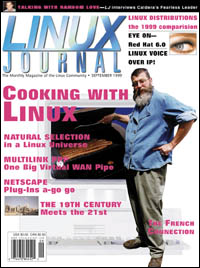
 September 1999 Linux Journal
Volunteer bike ride to promote Linux
September 1999 Linux Journal
Volunteer bike ride to promote Linux
[I sent him e-mail and it bounced. I hope he reads this and sends in a
contact address, and that he finds the support and sponsorship he
needs. Good luck, Karl. -Ed.
Amiga to use Linux kernel, rumors of Transmeta connection
http://www.amiga.com/diary/executive/tech_brief1st.html
http://www.metamiga.com
http://63.193.115.27/amiga/
TurboLinux outsells Win98 and MacOS in Japan
Product Marketshare TurboLinux J 4.0 24.09% MS Windows 98 Upgrade 13.25% MAC OS 8.5 J 10.23% MS Windows 98 9.15% Virtual PC 2.1 (PCDOS) 6.84% MS Windows 98 Academic 3.87% MS Windows 98 Academic Upgrade
3.63% RedHat J 5.2 2.64% Vine Linux 1.0 J 2.03% Virtual PC 2.1 (Win) 1.93%
Japanese web site: http://www.pht.co.jp
Penguin Quad Xeon Linux systems -- 550 MHz
Benchmark specialist invites Microsoft and Red Hat to a rematch
The Pia: a $199 Linux-based personal Internet appliance
Keynote speakers for the Open Source Software Convention
Guy Kawasaki, CEO and Chairman, Garage.com
"Rules For Revolutionaries--Some Practical Advice for the Open-Source
Movement"
Monday, August 23rd, 9am
Guy is the former chief evangelist of Apple Computer. He is a columnist
at Forbes Magazine and author of seven books.

Bill Joy, Chief Scientist, Sun Microsystems, Inc.
"From BSD to Jini: Adventures in Technology, Openness, and Community"
Tuesday, August 24th, 9 am
Bill is a co-founder of Sun and a member of the Executive Committee.
He was the principal designer of Berkeley UNIX (BSD).
Red Hat Announces Nationwide Training
Press release from Eklektix - those Linux Educators in the
Rockies
Rebel.com unveils the NetWinder Office Server
* Flexible Internet connection via an external dialup, cable or DSL modem,
or by a serial ISDN terminal adaptor. Web caching speeds up Internet access.
* IP Masquerading and Proxy Server features, which reduce ISP costs and
improve security, and Dynamic Host Configuration Protocol makes
administration easier to facilitate.
* Web authoring, hosting and publishing, with integrated support for
HTTP/1.1, Common Gateway Interface (CGI) and Perl Scripting.
* E-mail services supporting POP3 and IMAP4 mail protocols, including
automatic forwarding of messages and mail filter creation.
* Network Address Translation firewall, Port Forwarding and Virtual Private
Networking features as well as remote access via the Internet with optional
client software.
* Cross-platform file sharing and transfer between the NetWinder Office
Server and users of Linux, Unix, Windows and Apple platforms.
* Document indexing and searching capabilities enable users to organize
documents into categories and assign searchable properties, such as
keywords, to facilitate information access.
* Public and private threaded discussion, allowing workgroup communication
and collaboration.
* Print serving capabilities through the use of an attached printer that can
be used as shared network printer. Several hundred printer types are
supported.
* Detailed technical reporting quickly provides administrators with
statistics about uptime, memory total/used, swap total/used, load averages,
number of TCP connections, number of UDP connections, log files and Web
throughput.
HELIOS supports dual processing on Linux
Applix announces SmartBeak.com (a Linux support site)
Debian Available Preinstalled on Laptops
Bleeding Edge magazine renamed to 0x20.com
Linux is #1 in Antarctica
Morton Bay to discuss embedded Linux platforms at LinuxWorld
Linux links
Woody Garrett, Technical Recruiter, Bryson Myers Co., 2083 Old Middlefield Way
Suite 206, Mountain View, CA 94043 USA, 650-964-7600 x325, 650-964-7655 Fax,
888-774-3721 Pgr, wgarrett@hooked.net
Software Announcements
Stormix: an easy to use, Debian-based Linux distribution
TurboLinux Workstation 3.6
[Different-language editions of TurboLinux have different version
numbers. The current English edition is 3.6. The current Japanese
edition is 3.0. The Chinese edition is 3.0.2. There is also a
TurboLinux Server 1.0 Japanese. -Ed.]
Active Tools Clustor 2.0 for Beowulf
Caitoo 0.6.4 - Internet download manager for KDE
Title:          Caitoo
Version:        0.6.4
Entered-date:   7 July 1999
Description:    Internet download manager
Keywords:       KDE, QT, ftp, download, resume, queueing, kget, caitoo
Author:         koss@napri.sk (Matt Koss)
Maintained-by:  koss@napri.sk (Matt Koss)
Primary-site:   http://tux.kawo2.rwth-aachen.de/~caitoo
Alternate-site: ftp://ftp.kde.org/pub/kde/unstable/apps/network
Original-site:  http://tux.kawo2.rwth-aachen.de/~caitoo
Platforms:      Linux, Qt 1.42, KDE 1.1
Copying-policy: GPL
Magic Software news
http://www.magic-sw.com
Linux Games Coming to the PowerPC (Loki and Terra Soft)
SourceGear (AbiWord) acquires Cyclic Software (CVS)
SuSE Linux 6.2 debuts August 9
- Over 1300 applications and utilities on six CD-ROMs -- even more
software at the same price as the previous version

- Kernel 2.2.10 -- the latest Linux kernel

- Completely glibc 2.1-based (with continued support for libc5 programs)

- VMware (time-limited) -- run DOS-, FreeBSD-, Windows 3.x, 9x and NT
4.0-applications easily under Linux

- XFree86 (TM) 3.3.4

- Hardware accellerated OpenGL drivers for all 3D fx-based graphics
cards

- User authentification with PAM
Macmillan: UK release of Linux-Mandrake and Quake 1 & 2
Optimised for Pentium( class or compatible processors (AMD Kx, Cyrix,
Pentium) for faster running, this Mandrake version of Red Hat 6.0 is
built on the more recent kernel 2.2.9 (as opposed to 2.2.5) providing
better drivers and easier installation. The pre-configured K Desktop
Environment [KDE] is the latest version 1.1.1, and can be launched
under the Gnome interface and vice-versa for even more flexibility.
Several window managers are provided for maximum customisation to suit
the way you work. True desktop productivity allows you to drag'n'drop
files and access devices directly from the desktop.
Included is a range of desktop applications for graphics editing, word
processing, personal information and financial management. Special
versions of PartitionMagic and BootMagic are included for easy
install of Windows for dual boot options.
The deluxe version also includes:
... `StarOffice 5.1 Personal Edition', a complete office productivity
suite that can act as a fully integrated desktop. Includes word
processing, spreadsheet, graphic design, presentations, database
access, HTML editor, mail/news reader, event planner, and formula
editor. StarOffice features a very familiar and intuitive user
interface that allows experienced office users to be productive almost
immediately.
Other software
Contents:
 Linux and Windows 95 --or--
PPP disconnect --or--
Linux and Windows 95 --or--
PPP disconnect --or--
WvDial Success
Linux Partition conflicting with Win98 --or--
More complex than that, really.
ftpacess and the Incoming Conundrum
IP forwarding and Linux
IP forward --or--
This month's "paltry" offerings --or--
can't help it --or--
ppp & voicemail
Unsupported Floppy Formats: 'dd' Maybe
minicom --or--
AHA 2940 SCSI timeout errors --or--
Desqview/Linux --or--
DESQView 386 --or--
cdr's --or--
get to know --or--
quick swap Q --or--
video timings needed --or--
Help ! --or--
Linux gazette article, July 1999
Dao --or--
linux memory --or--
Copying boot partitiion
I am a begining Linux user, PLEASE Help! --or--
ide-cd module --or--
LILO problem.. again --or--
Question --or--
finding Changelogs --or--
Installing Win NT 4.0 Workstation and Dual booting Win NT 4.0 Workstation and Win 95 B
pc-mos --or--
Hdd track 0 bad. --or--
Benchmarks
DosLinux --or--
128M Ram question --or--
A Fair price for CD duplication --or--
Proxy server --or--
 Greetings from Jim Dennis
 Running Win '95 Apps under Linux
 I'm guessing that you've come across my website at
http://www.starshine.org. Actually I do very little work on
that these days. I spend far more time providing content to
the Linux Gazette (http://www.linuxgazette.com) where I
do the "Answer Guy" column. (No, I didn't pick the name.
Yes, your question and my answer are being posted there).
I'm guessing that you've come across my website at
http://www.starshine.org. Actually I do very little work on
that these days. I spend far more time providing content to
the Linux Gazette (http://www.linuxgazette.com) where I
do the "Answer Guy" column. (No, I didn't pick the name.
Yes, your question and my answer are being posted there).
 -- Heather ]
I answer general technical support questions (such as this
one) via e-mail and netnews. Some of them I cross-post to
my editors at LG, who gather them up, run them through a
custom mail2HTML filter (written by my wife, Heather), and
with a few manual touchups, post them to the web where
they can get indexed by Alta-vista, Yahoo!, Deja News, and
all the rest. LG is also widely mirrored and seems to get
translated into a few other languages (since I occasionally
see parts of my own writing popping up in various languages
that I don't speak).
Officially the Linux Gazette is part of the Linux
Documentation Project (LDP: http://sunsite.unc.edu/LDP) and
is released under a variant of the GPL (the GNU Public
License) --- in basically the same was as the Linux Kernel
and all of the GNU software which is used to build it and
the GNU software which runs under it.
In answer to your question:
In my past columns I've answered similar questions several
times. All of the back issues are available online so you
could check out:
Brief mention of WINE and
suggestion to just access your Unix/Linux systems from a "real Windows"
system over telnet. Back then I didn't know about MI/X
(http://www.microimages.com/freestuf/mix/index.htm)
a free X server for Windows and Mac platforms from
Microimages; and I didn't feel like mentioning the
multitude of commercial X servers for Windows.
Clarified and allayed someones concerns about
running WABI on Linux distributions other than
Caldera; mentioned WINE,
DOSEMU and others.
List of five alternatives for access MS mail from Linux).
Open letter to Insignia Solutions suggesting
that they port SoftWindows to Linux, written to
them when they sent me a postcard touting their
ports to various non-x86 Unix platforms. With
their response and a link to a "survey" and
(potential) customer comment form.
However, there are better sources of information on the
web, written by people who are actually involved in some of
these efforts. So far the best collection of links that
I've seen that related to running Windows software under
Linux and other forms of Unix is at the WINE Headquarters
(http://www.winehq.com) under their listing of "Other
Related Projects" (http://www.winehq.com/others.html).
A particularly promising package which was only released
fairly recently is VMWare. This seems to reliably run
Win '9x, NT and even Linux from within a virtual machine.
More info at: http://www.vmware.com
In issue 30 and again in 32 (above) mentioned the Microsoft
WISE offering (http://www.microsoft.com/win32dev/base/wise.htm).
WISE is a cross-licensing deal to allow vendors to port
Windows programs to RISC (non-x86) platforms. This is also
noted, by name, on the WineHQ page.
The purpose of this is obvious. Legitimize the use of
Windows products on "non-competing" versions of Unix (those
for non PC hardware platforms) in an effort to curtail the
groundswell of support for the PC Unix variants, particular
the free Linux and Unix systems. Microsoft also seems to be
releasing "Unix" versions of some of their products --- on
a few *non-PC* platforms (particularly ironic since they
still own a stake in SCO and they steadfastly refuse to
support ports of their own products to that platform).
It's impossibly to address this situation from a purely
technical point of view. The problems are political,
and have very little to do with technology or even
the finances of any particular product. Microsoft would
make plenty of money if they sold MS Office for Linux.
It would be far more profitable than any sales for AIX,
HP-UX, or Solaris, simply because the size of the Linux
market exceeds all of those combined (and we, as a whole
aren't the cheapskates that many in the press like to
portray). So, most of my thoughts on this subject are
unabashedly political.
Jason Holbrook
Holbrook Computer Systems (just started it
)
Elgin IL
Good luck on the new venture. Are you considering offering
pre-installed Linux systems through your business? Do you
have a URL, yet? (If so, I'd suggest putting it in your
.sig). I grew up in Chicago. However, I now live in the
Silicon Valley (the computer nerd's "Mecca").
PPP disconnect
When you exit minicom are you using [Ctrl]+[A], [X] or
[Ctrl]+[A], [Q]? When you use the latter of these, minicom
should ask you to confirm that you really want to "quit
without resetting the modem." Are you getting that? You
should be, otherwise minicom is resetting the modem as it
exits ([Ctrl]+[A], [X]) which disconnects the phone,
naturally enough.
Here is what the capture file (MINICOM.CAP) says:
Annex Command Line Interpreter   *   Copyright (C) 1988, 1998 Bay Networks
Checking authorization, Please wait...
Username:my_name
Password:
Switching to PPP.
This phrase should be the last "expect" string in your
chat script. (PPP should be sufficient). That will
clear the buffer so that pppd will see the other
"stuff" (LCP, link control protocol traffic).
... [BINARY DATA ELLIDED] ...
(note: Please do NOT send binary data through e-mail
unless your correspondent has specifically requested
it).
When sending a bit of binary data in a mostly textual
message it's recommended that you use the MIME
"quoted-printable" encoding. This leaves most printable
characters unmodified and encodes any non-printable
characters into short sequences like =2A etc.
NO CARRIER
Convince your ISP to stop hanging up the phone on you.
(NO CARRIER is a message reported by your modem when
the line is disconnected --- when either of the modems
has hung up on the other or when the intervening phone
systems have broken the connection).
---
Timmy
Play with your chat script more. Make sure that pppd
works when you use the "quit without reset" from minicom.
In any future questions that you post to me, or to
the various support mailing lists and newsgroups, you
should:
Include any syslog messages that correlate to your
attempts to establish PPP sessions
(tail -f /var/log/messages).
Include the settings in your /etc/ppp/options
file and the command line which you are using
to invoke pppd.
Look for any of the other settings files that
pppd is accessing during your efforts. For
example it will try to read /etc/ppp/options.ttyS*
to correspond to your modem device node, and/or
~/.ppprc of the user under which it is running,
and it will look for and execute /etc/ppp/ip-up
(as described in the man page).
The fact that the required chat script differs based on
which modem and ISP your using is a major source of the
confusion for setting up new PPP accounts.
The fact that the Linux pppd looks to so many sources
of options (its command line, the /etc/ppp/options.*
files, the ~/.ppprc, etc) and that it has other "moving
parts" (like the /etc/ppp/ip-up and various chap-secrets
and pap-secrets files) is another.
Sometimes when troubleshooting these sorts of things I
run pppd under the strace command. This will give you
a "blow-by-blow" account of every system call made by
the process that you are tracing (and optionally by any
of its children).
Most of the output from strace doesn't mean much to me.
However I have learned to pay attention to open(), stat(),
and lstat() calls --- and to interpret many of the errors
returned by them. Try it! It's not that hard.
More on PPP + minicom Disconnects
It's possible that you could use KPPP or wvDial
(free packages, you can look for them on your distribution
CD, or download them. One place to look for Linux PPP
files, programs and scripts is at:
... Metalab is the canonical archive of Linux software.
Another place to look (somewhat easier to use, especially
for the novice) is Freshmeat: http://www.freshmeat.net
Freshmeat's "quickfind" feature spits up wvDial at:
"Try it! It's not that hard"....well, I wish I knew as much as you.
How do you think I got to know any of this?
WvDial Success
I think you mean wvdial. I've never heard of a VWDial
(though it might combine fine German engineering with a mod
retro '60's styling
).
The only thing left is I hate pressing the modem - off - on to get
disconnected and vwdial sort of leaves the xterm hanging with no prompt. So
now I just have to figure out how to get disconnected. Maybe I could try
figuring out by myself.
Try hitting [Ctrl]-[C] to kill wvdial process in your xterm
(or VC) when you down. If that doesn't work then look for
a file named /var/run/pppd.pid (or something like that).
When you see that file it should contain the process ID
of the running pppd program. You can then use
something like:
kill `cat /var/run/ppp0.pid`
... as appropriate to your installation.
Naturally you can embody this into a script, possibly a
PERL script. If it is a perl script and you have SUID PERL
installed you can use SUID permission on it to imbue normal
users (possibly limited to some specific group) with the
power to launch and shoot down your connections. You can
also install and configure the sudo package to allow normal
shell scripts to be run by "unprivileged" users.
Thanks again,
Timmy
As you can see the basic answer is: "kill the pppd process."
However the details on how you do that come with the
universal UNIX operations qualifier: "it depends."
Makes Windows Explorer ChokeMore complex than that, really.
I recently decided it was time to try out Linux. I bought Caldera's Open
Linux 2.2 because ZDnet bragged on the ease of installation and set up.
I've got a new computer and knew I would be putting Linux on it, so I
formatted the 10 gig drive into 2 partitions (big mistake).
It sounds much more like an MS Windows problem
than anything to do with Linux.
Are you sure that this was working before your Linux
installation? Did you change your CMOS settings (referring
to the geometry or type of drive)? Did you change the other
partition on some way?
Has Caldera's support looked at your partition tables
(before and after shots would be ideal). You can
fetch a partition table dump using the following Linux
command:
fdisk -l
Try completely re-installing MS-Windows (on one or
more 2Gb or less partitions). Then try running your
Explorer and other programs.
Once you have that working, try the Caldera installation
again. Be sure to take "before" and "after" snapshots.
Redirect them to a file using commands like:
fdisk -l > /tmp/before
.... etc. A command prompt should be started on one of
your virtual consoles during your installation (ask the
Caldera support team for details over the phone, and/or
try hitting [Alt]+[Fx] for the [F2] through [F6] function
keys to find it). I'll leave the details of getting that
/tmp/ file off your installation boot RAM disk and unto
a disk or diskette as an exercise for the reader.
mount -t vfat /dev/hda1 /mnt
Even if it isn't completely successful, its error message might be
worth something. (For example, "Bad FAT, remounting read-only.")
By all means do NOT write to the damaged filesystems from Linux while
they're in this odd state -- just use whichever methods work best to
back up all your stuff.
ftpacess and the Incoming Conundrum
greetings james!
i would like anonymous ftp users to upload files and make
directories with specific ownership and file permissions. sounds
easy, right?
Nope. It doesn't. Of course we'd need to know
the specific desired ownership and permissions; but
there is no generalized support for this in the
WU ftpd nor in the old Berkeley daemon.
i've been banging my head against the wall for weeks
now over this. i've read the ftpaccess man page 20 times. i
understand everything that /etc/ftpaccess is capable of doing.
the 'upload' feature of ftpaccess looks like my ticket, but it
doesn't seem to work no matter what i do.
If you understand everything about ftpaccess then you
are much smarter than I am. I've read it at least
50 times and I still find some elements confusing. I've
learned a bit about it from many experiments --- which
have shed light on some of the man page details.
i would very much like to send you a copy of my ftpaccess file but
first i would like to see if you can help me otherwise.
I probably can't help with ftpaccess.
i think i'm missing a setting or i'm missing a concept.. maybe i
need to look at group settings some more or maybe a group setting
isn't configured correctly.
Read on.
please reply by email if you are able to help. i've a client
breathing down my neck about this (i'm sure you know the feeling).
GM Consulting
Unfortunately I think you're trying to drive a screw with
a hammer.
The wu-ftpd mechanisms for controlling access to the
incoming directory are very limited. You can use the
flag nodirs to disable the ability to make directories
thereunder, you can allow or restrict the chmod command,
and you can set the umask (among other things).
However, I don't know of any combination of these that would
match your needs. umask settings only apply to newly
created FILES not to DIRECTORIES.
The frustrating thing is that it seems that you can "almost"
get what you want with the right combination of ftpaccess
settings and underlying (OS) permissions, ownership and
account settings (/etc/passwd, and /etc/group).
I've been there. It was a bad place.
You might be able to cook up a statically linked binary
program that you put in the ftp/chroot /bin directory and
allow the users to call with a site/quote command. That
could create a directory and set the permission. However,
I've never written such a command, and it might be very
difficult to write one that was sufficiently robust that you
could trust it.
In addition it is difficult for users to use site/quote
commands through many FTP clients (and some GUI clients will
make it impossible).
You'd probably be far better off using ProFTPd
(http://www.proftpd.org). This is a GPL'd FTP daemon
package with a configuration file that's deliberately
similar in structure and syntax to the (now) ubiquitous
Apache/NCSA .conf files.
In their discussion of their UMASK directive they mention
that umask modifies the permissions on directorie and files
--- but they refer one to the OS documentation for details
(ProFTPd runs on many UNIX platforms other than Linux).
That suggests that they aren't currently doing anything
beyond the current Linux UMASK semantics.
I've heard discussion of a DMASK setting, but I believe it
was purely hypothetical and never implemented in Linux. (I
don't know anything about such a setting in other OS').
However, I've copied the proftpd developers list on this
response in the hopes that they can shed some light on this
subject for us. (Any fruits from this discussion will be
summarized, credited and posted to the Linux Gazette Answer
Guy's column http://www.linuxgazette.com).
You don't mention your specific needs. What are the desired
constraints on the created subdirectory's ownership and
permissions? Let's say you created a group 'strange' and
set the mode of the incoming directory to something like
3772 (sticky, SGID, world writable, executable and readable
to owner and group).
It might allow one to force all directories created below
that point to be group-owned by 'strange' and set to the
same permissions as the parents. (That's the normal affect
of an SGID directory (mode +2000) under Linux).
Only the owner of a file would be able to remove them
(that's the normal affect of the sticky bit, mode +1000).
Having considered the OS level affects we then ask what
ProFTPd directives would model your requirements. I can't
even speculate, since I don't know them.
Even if you need to hack in some custom code (into the
daemon) I would think that ProFTPd would be a cleaner code
base to work from than wuftpd. ProFTPd is under GPL
so you're licensed to modify it, and to distribute modified
versions (so long as you make your patches available to the
public under GPL if you exercise both of those rights).
There are a number of other FTP daemons available.
ncFTPd (by Mike Gleason) is shareware. You can freely use
it for personal systems (up to 3 concurrent connectios) and
some non-profit/educational institutions (read his license
at http://www.ncftp.com for details). However it doesn't
appear to exactly what you're looking for.
I do see (in ncftpd's documentation pages) a rather
interesting discussion about "eventd" --- a deamon to
process actions based on FTP deamon events (such as file and
directory creations!). That looks rather interesting....
There's also a upload-event processor option in Mike's
general.cf file that might be easier than writing a daemon
(at the expense of greater server load since a new processes
would be spawned for each such event, rather than a
lightweight message from one daemon to another).
Yet another FTP daemon package is BeroFTPd by Bernhard
Rosenkraenzer. Unfortunately he doesn't seem to maintain a
web-based copy of his documentation (or even a web site for
that matter), and I don't have the time to download that and
read through the tar file. You can find BeroFTPd using a
quick Freshmeat search. (http://www.freshmeat.net).
You'll probably find what you need in one of these packages,
or perhaps with a bit of coding and patching to one of them.
ftpacess and the Incoming Conundrum
thank you so much for your quick response to my problem. i didn't
realize that doing something like this would be so difficult!
it looks like i will have to go with another ftp server afterall.
GM Consulting
IP forwarding and LinuxTurning it off
It's already the default setting for most Linux kernels.
However, you can force it with:
echo 0 > /proc/sys/net/ipv4/ip_forward
(you can 'cat' the contents of that node to view the
current setting). It's more commonly necessary to use:
echo 1 > /proc/sys/net/ipv4/ip_forward
... to ENABLE the forwarding.
Of course this assumes that you have /proc enabled
in your Linux kernel (also the default and STRONGLY
recommended). I believe there's also a sysctl()
interface to this, in case you've stubbornly built
your system without /proc support (and replaced the
entire procps suite of utilities including your 'ps'
command).
TCP/IP Port Relaying
Hi, Jim:
You're using IP masquerading to allow some of your
client systems access to another network (presumably
the Internet).
The phrase "serve a couple of other workstations" is
confusing. You normally can't access a server on
a private net through a masquerading router.
Now, I want to use net2phone to connect to my workstations but the
workstation is using 192.168.x.x address. Is there a way (or any package)
that can accept listen to the server machine for a particular port and
forward the request to a particular port on the workstations.
listen to: 24.1.2.3:2000 forward to: 192.168.0.1:2000
listen to: 24.1.2.3:2001 forward to: 192.168.0.2:2000
I've never heard of net2phone.
I guess you were thinking about using ipfwadm's -r
(relay) option. However you can't do it quite as
you expected. What this allows you to do is to relay
packets that match a given packet pattern to a socket on
the localhost.
So you might be able to use a command like:
ipfwadm -I -a acc -r 12345 -D 24.1.2.3 2000
... with another command like 'redir' (Freshmeat URL:
http://www.freshmeat.net/appindex/1999/03/14/921462694.html)
like:
redir --lport=12345 --caddr=192.168.0.1 --cport=2000
The first command (issued on your Linux router/gateway ---
the one doing the IP Masquerading) will accept traffic
on port 2000 of your "real address" and redirect it to
12345 (any arbitrary port you've chosen). The other
command (also executed on the same system as the first)
will listen on localhost port 12345 and make a
relay connection to 192.168.0.1 on port 2000. It will
also automatically relay back any responses.
This is basically what programs like the TIS FWTK plug-gw
(Firewall Toolkit, originally by TIS --- Trusted Information
System Inc, now owned by NAI, Network Associates, Inc) and
other proxy tools do.
Of course you don't actually need to use the ipfwadm
command in your case. You could just use:
    redir --lport=2000 --caddr=192.168.0.1 --cport=2000

redir --lport=2001 --caddr=192.168.0.2 --cport=2001
In fact there are several free utilities that do
this. Another is simply called 'proxy' (Freshmeat URL:
http://www.freshmeat.net/appindex/1999/04/21/924706079.html)
Of the two I just grabbed redir to write this answer
(though I'd been planning on playing with this sort of
thing for awhile anyway). I'm not particular found
of redir's command line style, but it does support
the TCP Wrappers library and it allows the option of
being launched through inetd and to set it's TCP
Wrappers name when its running standalone.
The 'proxy' command includes its own filtering
parser (which doesn't seem to be as sophisticated as
the TCP Wrappers package and surely hasn't been
tested as extensively by as many netizens.
The cases where you might might want to do this
ipfwadm redirection would be to "funnel" a bunch
of different destination addresses to one process.
For example, you might want to force all of your
local systems to transparent get redirected to a
Squid web proxy any time they were access any
port 80 on any address out on the Internet.
ipfwadm -I -a acc -r 3128 -D 0.0.0.0/0 80
... this will "catch" all traffic destined for
port 80 of anywhere and redirect it to your
router's port 3128. For a more detailed
discussion of this sort of usage look at the
SQUID FAQ: Transparent Caching/Proxying (section
17: http://squid.nlanr.net/Squid/FAQ/FAQ-17.html#ss17.2).
There are obviously other ways you could use this.
more on: TCP/IP Port Relaying
Hi, Jim:
Look for udprelay at:
This month's "paltry" offerings
Thanks. Did I typo on that one?
Well the good news is that I finished the printing
chapter. Now all have left is some touch up on the
two appendices (Glossary and "Emergency")
Now all I have to do one final proof over it
and there I'm not allowed to add new material that
would change the layout --- just minor corrections
allowed.
With luck the book will finally be out by September.
Typos
Denis Miller
Thanks. Did I typo on that one?
No you didn't change the english language. It is why I will never
be hired for my typing skills or beautiful legs!
I only ask because you quoted it --- and I've been
known to let quite a few typos out. It's the
disadvantage of writing for an all-volunteer
venue like Linux Gazette. We just can't proofread
it and write as much as we'd like. (Heather
will catch some of them --- but she already spends
about a full working day every month on TAG; and
usually gets squeezed into a sleepless night or
two).
No one's expressed much interest in my legs either.
Heather's, on the other hand ....
-- Heather ]
Typos
If you need a volunteer to proofread and check grammar I offer
myself as a sacrificial lamb. My mother tongue is English and I
can swear at my computer in five languages.
It's an interesting thought. On the one hand
I could Bcc: you on every TAG reply I send out
during the month. You could then proof them and
comment on them.
I've been thinking of making TAG a mailing list
(probably a manually operated one) for some time
but hadn't given much thought to the mechanisms to
use for it.
What I'd envision is changing it from "The Answer Guy"
to "The Answer Gang" --- mail comes it to a small
private mailing list, answers are batted around by
comittee and, when consensus is reached on a response
that is forwarded back to the original person.
Of course it would take away some of the "personal
touch." A committee is unlikely to reach consensus
on a "rant" (I might not agree with some of my own
rants ten minutes after I send them).
So I'm not sure. Perhaps we should come up with
a hybrid. One model would be: Questions come it,
I respond with my usual "stream of consciousness"
ranting (often supplemented by URLs from marginally
relevant searches on Yahoo! and other engines),
and I copy "the gang" --- then they can send
comments, corrections, flames and suggestions which
can then make it into the same issue as the original
question and answer.
I'm open to other suggestions.
-- Heather ]
Spellcheck Award!
Forgive me for being an inveterate speller and maybe even a bit of
a Felix Ungar (the fussy Odd Couple guy), but when you wrote,
"hoard of cheap servers" isn't it "horde" of cheap servers? Isn't
"hoard" when you stash away a supply of things in case there is a
shortage? As in toilet paper or coffee?
You are absolutely correct. I meant "horde" not "hoard."
I don't get much editing between my responses to questions
(often stream of consciousness under sleep deprivation
circumstances) and the final HTML cut that y'all see.
Over the years I've noticed that a large number of my typos
result in properly spelled words which are homonyms of the
intended term. I suspect that I have a couple of layers of
mental processing that work on different levels as I type.
When I see typos I fix them into some properly spelled word
--- which sometimes is not the word I intended. Thus
my mistakes of this sort are due to carelessness rather than
ignorance. (Not that I'm not ignorant --- just that this
particular error isn't a result of that).
Of course I do know sysadmins to keep a hoard of computers
(hidden in a storage closet or stashed in a corner of the
server room) which they use to service and replenish their
horde of production systems. But that's not what I'd meant
in the article you were reading.
ppp & voicemail
eric
If the little beeps only occur when you first pick of the
phone then modify your chat script to start with a few \d's
(delays).
For example here is a simple chat script:
ABORT "NO CARRIER" ABORT BUSY
"" ATZ
"" \dATE1V1L0M0&C1&D2S7=45S0=0
OK-\dATE1V1L0M0&C1&D2S7=45S0=0-OK
ATDT374-5847
CONNECT ""
ogin: ppp
ssword: \qYouWish!\q
Change it to something like:
ABORT "NO CARRIER" ABORT BUSY
"" \d\d\d\d\d\d\d
"" ATZ
"" \dATE1V1L0M0&C1&D2S7=45S0=0
OK-\dATE1V1L0M0&C1&D2S7=45S0=0-OK
ATDT374-5847
CONNECT ""
ogin: ppp
ssword: \qYouWish!\q
... Read the chat man page for details.
pppd invokes chat scripts via directives in its
options file(s) and on it's command line. The
connect directive might look something like:
connect "/usr/sbin/chat -f /etc/ppp/chat.example"
You can add the -v option before the -f to make chat
be "verbose" (then you can issue a tail -f command,
in another window or on a different virtual console,
to view the progress of the chat script as it occurs).
Hope that helps!
Unsupported Floppy Formats: 'dd' Maybe
I supposed you could send me a diskette. However
it might make more sense to try a few tricks on your own.
Clearly there is not MS-DOS filesystem on these diskettes.
Probably there is not filesystem on them at all. (It's
possible to dump raw data unto diskettes under UNIX and
Linux, to treat a diskettes as a simple linear sequence of
bits (almost like a virtual tape device).
First I'd try a command like:
dd if=/dev/fd0H1440 | file -
... this will dump/extract data off of your floppy
(a 1.44 Mb diskette in "drive A:" in this example,
change the if= parameter to suit your situation) and
feed it to the 'file' command which will attempt to
identify the file format based on "Magic numbers"
(format signatures or characterist patterns).
Note: you'll probably see an error message about a "broken
pipe" --- ignore that; it's to be expected from this type of
command. 'dd' would feed the 'file' command the whole
diskette through our pipe, but the 'file' command will close
it's end of the pipe after a few hundred bytes. 'file'
doesn't need to see more than that.
It could be that "BAR" is actually just an alternative
'tar' format (for example).
The next trick would be to try 'tar tf /dev/fd0'
to see if GNU tar can read a "table of contents" from
the device.
In any event, if you've been pulling the raw data off of
these diskettes using something like AnaDisk then you can
perform a similar operation under Linux using the 'dd'
command. Simply try:
dd if=/dev/fd0 of=/tmp/mydata bs=18k
... then edit the /tmp/mydata file with any text
editor. You can even run the 'strings' command
on /tmp/mydata like so:
strings /tmp/mydata > /tmp/mytext
... and then edit that.
This might work.
Note that AnaDisk has support for all sorts of bizarre
diskette formats (such as formats entailing the use of
varying numbers of sectors on different tracks). The
Linux floppy device driver is probably not going to tolerate
those sorts of shenanigans (they were used for things like
copy-protection under MS-DOS). Thus the 'dd' command might
complain if that was the case. I presume you've already
determined (through AnaDisk) what the specific formatting
quirks on these floppies might be.
(It would be interesting to contact the author of AnaDisk
and ask for a Linux port for those really unusual formats).
Another approach might be to install
DOSEMU (and tweak its
configuration to give sufficient floppy disk drive access).
Then you might be able to run AnaDisk under Linux, under
emulation.
Minicom Calling a Procomm Host
James,
Are you sure you've set minicom to be an ANSI terminal?
It defaults to VT102. Try [Ctrl]+[A], [T], [A] to
toggle the emulation mode.
If the problem is stemming from the HASCII (high ASCII)
line characters, first make sure you've set the
line to be eight bit clean with a command like:
stty cs8 < /dev/modem (note: you really redirect the
INPUT of the stty command from your serial device ---
it has to do with how it does its ioctl() calls).
After that I'd wonder on how you'd set your console
character set. Are you doing this from a console or
from an xterm? I'd try it from the console
([Ctrl]+[Alt]+[Fx] to switch out of a X Windows system to
a virtual console, or VC as we call them in Linux. Once
your at any VC you can just use the [Alt]+[Fx] function key
combos to move among your VCs, and usually [Alt]+[F7] will
get you back to the VC on which your first X Windows
session is running).
I'd also suggest taking a look at CKermit. It's license
doesn't allow the major Linux distributors to include it
on their CDs, but it is a pretty good package for
accessing modems under Linux. Note that CKermit doesn't
provide terminal emulation under UNIX --- it (rightly)
assumes that you ALREADY HAVE a terminal emulator through
which you are talking to the system. So CKermit just passes
data from the modem to your existing terminal (be it your
console, telnet, xterm or whatever).
SCSI Resets Due to Command Timeouts
I think you should take a deep breath, drink some coffee
or tea, and re-read that.
I'm not sure quite what you meant but it sounded like you
were having problems with your SCSI chain while you had the
hard drive attached. You installed an IDE hard drive,
disconnected the SCSI hard drive (leaving the SCSI CD-ROM
drive attached) and you were able to install Linux.
Is that about right?
That would suggest that the cabling, termination or
drive are the source of the problem.
However I would like to install on my system ( that 2nd system was
sort of hijacked once Linux was installed on it). I've been in
the SCSI bios and turned down the speed settings from 20 to 8 ,
and turrned off syncronous and probably fiddled with all the
setttings at some time. I've booted off the CD (RedHat 6.0) and
floppy (RedHat 5.2) to no avail.
I'd suggest resetting them all back to the factory
default before trying any further experimentation.
This is a system supplied by my employer so I would prefer not
adding an IDE drive supplied by me (my home systems have RH4.2 and
RH6.0). Any help would be appreciated. Oh yeah the bios on the AHA
seems to auto assign the SCSI-IDs, do you think that could be the
trouble? (I haven't tried forcing the IDs set.)
It sounds like some "Plug n Pray" stuff. I'd disable that
and manually assign the IDs yourself.
TIA for any help you can supply.
It's useful though I'll ellide it for publication.
> <4>Memory: sized by int13 088h
> <4>Console: 16 point font, 400 scans
> <4>Console: colour VGA+ 80x25, 1 virtual console (max 63)
> <4>pcibios_init : BIOS32 Service Directory structure at 0x000fd8d0
> <4>pcibios_init : BIOS32 Service Directory entry at 0xfd8e0
> <4>pcibios_init : PCI BIOS revision 2.10 entry at 0xfd901
...
> <4>ide: i82371 PIIX (Triton) on PCI bus 0 function 57
> <4>    ide0: BM-DMA at 0xffa0-0xffa7
> <4>    ide1: BM-DMA at 0xffa8-0xffaf
> <4>scsi : 0 hosts.
> <4>scsi : detected total.
...
So, you don't have your SCSI driver built statically
into the kernel.
> <4>Partition check:
> <5>RAMDISK: Compressed image found at block 0
> <4>EXT2-fs warning: checktime reached, running e2fsck is recommended
> <4>VFS: Mounted root (ext2 filesystem).
> <6>(scsi0) <Adaptec AHA-294X Ultra SCSI host adapter> found at PCI 11/0
> <6>(scsi0) Wide Channel, SCSI ID=7, 16/255 SCBs
> <6>(scsi0) Warning - detected auto-termination
> <6>(scsi0) Please verify driver detected settings are correct.
> <6>(scsi0) If not, then please properly set the device termination
> <6>(scsi0) in the Adaptec SCSI BIOS by hitting CTRL-A when prompted
> <6>(scsi0) during machine bootup.
Did your check on your termination? It's attempting
to auto terminate --- but you can't be sure of
what that's doing. Check that only the devices at
the ends of your SCSI chain are terminated. If you
have not external devices then the SCSI host adapter
is at one end of the chain (and should be terminated).
Contrary to what you read in most places, I've seen and
heard that longer SCSI cables can be more reliable than
shorter ones (within limits, of course). I assume that
this is NOT differential SCSI. As such it can be
extremely sensitive to the quality of cable used to
connect these devices.
If the drive works fine when the CD-ROM is disconnected,
and the gives these errors again when you reconnect it
that suggests that both the CD drive and the hard drive
are terminated (or they they are trying to use the
same ID).
Make sure that the CD-ROM or the hard drive is not
terminated. Try swapping them them (cables and
termination).
> <6>(scsi0) Cables present (Int-50 YES, Int-68 YES, Ext-68 NO)
This line suggests that you're some how using two different
sorts of cables connected to the same controller. Is this
really a 2940 PCI card? Does it have headers (attachment
points) for both 50-pin (flat ribbon) and 68-pin (micro DB)
cables?
Don't discount the possibility that the hard drive is
just bad. Try it in another SCSI machine. Look up
these drive and adapter models at their respective
vendor web sites to ensure that they are compatible.
> <6>(scsi0) Downloading sequencer code... 419 instructions downloaded
> <4>scsi0 : Adaptec AHA274x/284x/294x (EISA/VLB/PCI-Fast SCSI)
> 5.1.2/3.2.4
> <4>       <Adaptec AHA-294X Ultra SCSI host adapter>
> <4>scsi : 1 host.
> <4>  Vendor: SEAGATE   Model: ST32155W          Rev: 0362
> <4>  Type:   Direct-Access                      ANSI SCSI revision: 02
> <4>Detected scsi disk sda at scsi0, channel 0, id 0, lun 0
> <4>  Vendor: MATSHITA  Model: CD-ROM CR-506     Rev: 8S04
> <4>  Type:   CD-ROM                             ANSI SCSI revision: 02
> <4>Detected scsi CD-ROM sr0 at scsi0, channel 0, id 5, lun 0
> <4>scsi : aborting command due to timeout : pid 17, scsi0, channel 0, id 0,
>  lun 0
> 0x00 00 00 00 00 00
> <4>scsi : aborting command due to timeout : pid 17, scsi0, channel 0, id 0,
>  lun 0
> 0x00 00 00 00 00 00
> <4>SCSI host 0 abort (pid 17) timed out - resetting
> <4>SCSI bus is being reset for host 0 channel 0.
> <4>SCSI host 0 channel 0 reset (pid 17) timed out - trying harder
> <4>SCSI bus is being reset for host 0 channel 0.
> <6>(scsi0:0:0:0) Synchronous at 20.0 Mbyte/sec, offset 15.
> <4>scsi : aborting command due to timeout : pid 18, scsi0, channel 0, id 0,
>  lun 0
> 0x25 00 00 00 00 00 00 00 00 00
> <4>scsi : aborting command due to timeout : pid 18, scsi0, channel 0, id 0,
>  lun 0
...
and so on.
Since it's a system provided by your employer ---
it's not unreasonable to expect them to get the hardware
functioning (even if you are expected to maintain the
OS and other software on it).
SCSI Resets Due to Command Timeouts.
Actually I think SCAM is supposed to be an acronym for
some sort of SCSI Configuration Automation Method (or
something like that). However, it may be an unfortunately
apt term.
Glad I could help.
Well thanks again for your help. And now ( I'll bet you saw this coming!!
), I don't suppose you know why a sybase dump from a solaris system
wouldn't be readable (sybase "load database" command) into a linux sybase
server ( I've got sybase 11.03 for linux and solaris)? (Hey it is a shot in
the dark no?)
I'd ask the Sybase support team if there are any
issues with this. Are their db dumps supposed to be
cross platform readable? Are there big-endian vs.
little-endian (byte ordering with 32-bit register)
problems?
P.S. here is the error mesg from the " load database " command
> Backup Server session id is:  15.  Use this value when executing the
> 'sp_volchanged' system stored procedure after fulfilling any volume change
> request from the Backup Server.
> Backup Server: 6.28.1.1: Dumpfile name 'v991991670AFEF   ' section number
> 0001 mounted on disk file '/home/gs/sybdumps/greg9915.dump'
> Msg 21, Level 20, State 1:
> Line 1:
> WARNING - Fatal Error 3223 occurred at Jul 12 1999  1:15PM.  Please note
> the error and time, and contact a user with System Administrator (SA)
> authorization.
> Msg 3208, Level 16, State 1:
> Line 1:
> Unexpected end of file while reading beginning of dump.  Please confirm
> that dump media contains a valid SQL Server dump. The SQL Server error log
> may contain more information on the problem.
It sounds, from these errors, like the load database
command doesn't recognize the file you're providing
as one of it's dump images. You're using a Sybase SQL
command to generate this greg9915.dump file, aren't you?
(I wouldn't expect anything involving the Solaris 'dump'
command to work on a Linux system).
When trying to transfer data from one database to another
I think the best method is to export all of the data
through a series of reports, and import it at the other
end. Of course, that only transfers the data --- which
generally means that all of your schema, triggers,
business rules, etc. must be transferred by hand.
Plug and Pray SCAM
Glad I could help.
I never did get around to trying TAMU (from Texas A&M
University, wasn't it?).
I wish I could offer such high service levels to all
my Answer Guy correspondents. However, it is all
volunteer work. That's why I was happy to see
companies like Linuxcare
come in to provide the commercial
support option. (So happy, in fact, that I now work
for them; but that's another story).
In response to your questions--
In response, to my questions which were in response to
your questions which .... (ugh!)
I'd ask the Sybase support team if there are any
issues with this. Are their db dumps supposed to be
cross platform readable? Are there big-endian vs.
little-endian (byte ordering with 32-bit register)
problems?
From what I understand from their download page there is no support for the
Linux port. So the answer to the 1st question is "good question", and
apparently we have problems doing a dump/load to other platforms (we
support Solaris, HP-UX and AIX), sorry I guess I should have asked around
here instead of wasting band-width and thinking it was "only" Linux that
couldn't read a .dump file
You're using a Sybase SQL command to generate this
greg9915.dump file, aren't you?
Yes from an isql command prompt, I'm using the "load database" and "dump
database" commands
If you did an strace (Linux) or truss (Solaris) on the
process while it was running this command, or issued a
'file' command on the resulting dump file (try to look
up its "magic number" you might find out the underlying
file format being used.
It may be that your isql command is passing the data
into the system's copy of the 'dump' command. Those
are NOT platform independent.
When trying to transfer data from one database to another
I think the best method is to export all of the data
through a series of reports, and import it at the other
end. Of course, that only transfers the data --- which
generally means that all of your schema, triggers,
business rules, etc must be transferred by hand.
Yep this is what I was trying to avoid. Oh well looks like I'll be learning
more and more about our DB, (man I liked Oracle, or at least I thought the
imp and exp commands created dumps readable by other *nixs)
Hmmm. I'm not an SQL guy, so I have no basis for
comparison. I know that both of these (and several
other DBMS packages) are available for Linux.
Anyway, I thank you for the help and time you've spent on my problems.
Grace and Peace to you,
Glad I could help.
Assembly Language Programming for an old DESQview User
Good evening.
Well, assembly language programming is rare in any form of
UNIX. However, it is somewhat better supported under Linux
than under most other UNIX variants.
I'm not an assembly programmer per se, though I have
played with Z-80, 6502, and 8086 assemply.
Your best resources for ASM programming under Linux
seem to be:
This last link in particular leads to a small package called
'asmutils' --- which includes straight assembly language
replacements for about thirty small UNIX utilities. There's
even a 757 byte web server. (That was not a typo:
seven HUNDRED and fifty odd BYTES!). All of the others
are smaller. Most of the others are under half that size.
(And those are STATIC BINARIES --- with no dependencies on
any shared libraries).
(That's pretty interesting in that "Hello World" compiled
statically under glibc 2.x comes in at 90K (kilobytes). The
assembly language version I cooked up in five minutes using
one of the asmutils programs as a template assembled into
about 90 bytes).
So, you and Konstantin Boldyshev (the author of asmutils)
might have quite a bit of fun creating a large suite of
raw assembly language tools for Linux.
These will probably be of particular interest to people like
Tom Oehser (maintainer of Tom's Root/Boot, "The most Linux
you can fit on a Floppy) (http://www.toms.net/rb) and to
the people who work on embedded Linux systems (who have a
mailing list and an FAQ at http://www.waste.org/~zanshin).
(I've copied some of them on this message).
In addition to pointing them at these resources (of which
they were probably already aware) this will give them an
opportunity to comment on what I've said and expand the
content (or make corrections). You might want to join
The embedded Linux mailing list (as their interests are
similar, though quite a bit of their work is down in
C, too) and possibly in participating in the Tom's Root/Boot
mailing list or in the asmutils and Lightning Project.
Together the micro-Linux (very small distributions like
Toms, LRP, ODL, Trinux, LOAF, etc) embedded, and assembly
language projects form a interesting niche within the Linux
community.
Linus has said that the most interesting things
happening in the future of Linux will be on the desktop
and in the embedded realms. I agree.
DESQview/386 Die Hards into the Next Millennia
Not a clue. I haven't used DESQview in about five years.
I've been primarily using Linux for about the last seven.
I presume that Quarterdeck's aquisition by Symantec
has spelled complete obscurity and orphanage to DV. They
probably didn't even have the decency to release the sources
to a "free world."
You might be far better off with a combination of Linux and
its DOSEMU or VMWare. It's a pity that you'd lose
DESQview's UI (I'd really like to see a Linux console
manager that would match the features and feel of the
DESQview popup menu system --- but add configurability like
DV/X). However you gain support for modern hardware
(including CD's, CD-R, CD-RW, DVD and DVD-RAM) and procotols
(running DV under a TCP/IP stack used to be like waltzing
with a bear in a china shop!). You also lose all problems
with memory management (forget about conventional vs.
EMS and "largest program size").
All that and you get the sources, too. (A feature that
would be even more exciting if I were a real programmer,
and not just the occasional hack).
CDR Media: Silver and Gold and Blue, Oh my!
I'm pretty sure that matte refers to the finish (texture)
on the back of the CDR media (the "label" side or
"non-recording" surface). A matte finish is probably better
for writing on (using using permanent marker). Whether
writing on your CDR media is advisable (as opposed to
cutting labels to cover the back surface) is a matter that's
best answered by the maker of the particular brand of media
you're buying.
It just so happens that I found a great FAQ (*) on the
topic of CDRs by Andy McFadden the other day (while
answering other mail, naturally).
(Elsewhere he makes frequent mention of the back surface
of the CD discs and how some of them have the recording
foil exposed while others have an additional layer of
plastic --- which I guess at least one brand refers to as
"Infoguard." I've seen some CDRs like this, with a
delicate foil on the back which could be easily scratched
--- thus ruining the data that was stored on its other
side. I don't consider them to be suitable for any purpose.
Luckily they don't seem to be common anymore. Even the
cheap bulk CDR media have the recording foil fully encased).
Kudos
Wow, that was all I was hoping for and more. Great job!!!! Thank you
Glad I could help.
Downloading a copy of Linux
I'm afraid that "the linux program" is actually a bit
of a misnomer. It is true that Linux is a program.
Specifically it is a kernel. You could go to
ftp://ftp.us.kernel.org and download any of the versions
of the Linux kernel that you'll find there. They range
from archaic .10 and .9x versions through the current
2.2 (stable) and 2.3 (developmental) versions.
So, you could download one of these kernels (in source
code form, of course). Then you'd compile it (more on
that later) and you'd have a copy of "the linux program"
to run.
The Linux kernel is after all just a program. It implements
about 180 system calls, provides file systems, device
drivers, a sockets interfaces with TCP/IP networking
suite, and some memory and process management APIs and
interprocess communications methods.
Of course that's not of much direct use. A kernel doesn't
do anything for a user. It provides a set of services
to your applications and other programs. You use those
programs and they use the kernel services.
In a technical sense "Linux" is just the kernel. Of course
the common sense of the term refers to a large suite of
utilities that run under this kernel (combined with the
kernel. The most obvious things you need to run this
program (the kernel) are:
The Linux kernel is written in C. Linus Torvalds uses GCC
and most of the other developers use that or one of its
derivatives (such as egcs, now merging back into GCC).
This mostly means that you want to compile your Linux kernel
on a Linux system. (You could cross-compile it on some
other UNIX or UNIX-like system --- but that would be
somewhat more complicated.
To boot it you'd need something like the LILO package
or a copy of LOADLIN.EXE (and a copy of MS-DOS or one of
its clones to run THAT under).
Of course this hypothetical discussion of running the
kernel by itself is a bit absurd. To learn Linux and
to make any practical use of it, you need a whole suite
of programs to install it, as well as a few programs to
run under it.
Most of us, particularly the techies among us, refer to
different collections of a Linux kernel with GNU, BSD, MIT
and other (mostly free) software as "distributions."
Distributions combine a kernel with a suite of installation
and configuration tools (like 'fdisk' to re-partition your
hard drive, and /sbin/lilo to install and update your
boot loader (master boot record code) etc). They also
include libraries (like DLLs in MS-Windows) and, of course
lots of software (like editors, commmand interpreters,
compilers, web servers, graphics handlers and drawing
programs, etc.
There are many distributions. The most current and up-to-date
list that I know of is maintained in a section of the Linux
Weekly News which lists links to about 100 of them, and
posts any news about them that gets the attention of their
editors.
There are some spcial "micro-distributions" like Tom's
Root/Boot, LOAF (Linux on a Floppy), DOSLinux (which
installs into a DOS subdirectory) and various special
purpose systems like LRP --- the Linux Router Project. Some
of these fit on a single floppy. Others fit in about 20Mb
or less of archives.
However, most distributions take up over a
100Mb. Consequently they are usually distributed on CDs.
There are a couple of places to get very inexpensive sets of
Linux CDs. I tend to think CheapBytes
http://www.cheapbytes.com first in this category. You can
get Debian or Mandrake
CDs for as low as $1.99 plus shipping
and handling ($5.00). (Mandrake is a derivative of the Red
Hat Linux distribution -- it builds on it by adding a few
extra packages and refinements, etc).
Now I realize I sound like an ad. You can certainly find
whole distributions to download over the Internet. On some
sites you can find ISO 9660 CD images (these are 650Mb
images suitable to be "burned" right off your drive and onto
your CDR or CDRW media). I wouldn't recommend downloading
one of those with anything less than a T1 at your disposal.
It's also possible, with some difficulty and quite a bit of
patience, to install a Linux distribution with a small set
of floppies and an FTP connection. I've installed
Red Hat
5.2 with a single boot floppy (and one supplemental, if I
recall, it's been awhile). I had to try several times to
get it right and to get past the occasional disconnects.
That was over a DSL line. I wouldn't try it over a modem.
With Debian you'd cut a set of seven or eight HD floppies,
install the "base system" using those, then you could
selectively add packages as needed. Although this is
possible with the current Debian "stable" release (2.1) it's
much easier with the "unstable" (code-named "Potato")
version. I have this running on my system at work, and I
put a machine on it for an installfest earlier today.
Debian is well suited to installation over the Internet
because it has many small packages and relatively sane
dependencies. So you can install almost exactly what you
need without getting any unwanted space and bandwith
consuming "extra" baggage. Using the apt-get and apt-find
front ends you basically just issue a command that says:
"install that" --- and the system connects to the Debian
archive mirror system, finds the latest version of the
package for your distribution release, fetches it, installs
it, and does the basic initial configuration. It
automatically determines any pre-requisite packages
(dependencies) and prompts to install those as well.
(Another thing I like about Debian is that you can upgrade
all of the packages that you have installed with one
commend. If you use the command:
apt-get update && apt-get dist-upgrade
... you end up with a fully up-to-date system. This seems a
bit scary at first. Most of us have had "simple" upgades
and installations "break" our systems (particularly those of
us from the MS-DOS and MS-Windows worlds). However, I've
been experimenting with this feature for several months
(tracking the "unstable" developments, no less). About once
on every day that I'm in the office I switch to one of my
VCs, hit the up arrow a couple of times and re-issue this
command from my history.
So far I haven't had one upgrade related problem on that
system. None. Not one. Wow!
Despite all this I wouldn't necessarily recommend Debian as
your first version of Linux. It is a "power-users"
distribution. It's a bit rough around the edges and it does
some things just differently enough that you might find it
frustrating to learn Linux. When you ask other Linux users
in your area for help you'd like their answers to apply to
your distrubution as much as to theirs. Stormix (a Debian
derivative; similar to how Mandrake is a Red Hat offshoot)
offers some interesting possibilities for the future.
So, in summary:
You can "download" Linux. However, it's much faster and
probably cheaper to buy a CD.
And from Radioland....
I was among five guests on a local computer call-in radio show this
past Monday. We're all open-source/linux geeks as opposed to the
usual topics dealt with. We managed to give away 10 copies of the
CheapBytes RH6 CD, and handled almost all of the questions pretty
well. Got one that threw me: What's the max swap on an x86 box?
I was about to go into the 1.5-2X ram, until the caller said they
had a P2-400 (X2) box with 2G of ram. Then I started drooling and
wondering why they didn't just get an Alpha (personal preference).
The maximum swap file or partition under Linux
is 128Mb (or is that actually 127Mb)?
You can have upto 16 active swaps (any combination of
partitions and swap files).
However, the old guideline of 1.5 to 2 times physical
RAM is horribly outdated. I'd recommend one or two 127Mb
swap files at the most. Using two is not really for the
extra swap space, but to provide kernel with a place to
do load balancing, which it will do if you have separate
swaps . Obviously for that to make any sense you need to
put the swaps on separate spindles (physical hard disks)
and preferably on different controllers as well.
I did a little digging on the kt site, and I can't remember where
Jim Pick's site wound up. I know it varies depending on the
kernel version. Can you get me a 2-3 line answer that
I can give to the radio people so they can provide an answer?
Jim Pick got the name "kernelnotes.org" (so
http://www.kernelnotes.org is the site formerly
known as http://www.linuxhq.com). However,
http://www.linuxhq.com does seem to be back up,
with basically the same content. So, there's no
real problem either way. (There is probably some
interesting inside gossip regarding the whole affair,
but the public statements seem to have all been mutually
agreeable).
I hate leaving things hanging.
-ls-
Video Timings: Configuration Curse
I have no idea how to get better timings out of your
monitor. This is yet another occasion when I wish there
were an XFree86 "Answer Guy" to whom I could punt these
sorts of messages.
I'm bulgarian, so sorry for the poor english
Boris
I'm sorry for my poor understanding of your problem.
Even if I was a wiz at doing these sorts of timings,
I would need a lot more info about your monitor; and
I'd probably need to see it in person.
If xvidtune is functioning on your system, but doesn't
seem to help with the display problems on your monitor
then it may be that the monitor itself is just too far
out of spec for any video timings to help. How does it
look under MS Windows?
Accessing Private Net Addresses from the Public Internet
Of course packets from outside networks can't get to
your 10-net addresses. They don't have routes to your
private net addresses.
It's not clear, from your message, whether the "outside"
network you are talking about is the Internet, or some
element of your own internetwork (a LAN under your
administrative control).
In any event the usual way to provide access to your
internal/private networks from the outside is to
configure a proxy server on one of the real IP addresses.
The exact details of these proxying services would depend
on the specific services and protocols that you wished to
propagate through this connection.
Linux gazette article, July 1999
It would be sheer idiocy for Linux to adopt a straight polling strategy
for it's networking interfaces. However, it might be possible to have
a hybrid. If the interrupt frequency on a given device exceeds one
threshold the kernel might then switch to polling on that device.
When the polling shows that the activity on that device as dropped
back below another threshold it might be able to switch back to
interrupt-driven mode.
It sounds similar to what I suggested, except that
it sounds like you routinely disable the interrupt and
switch to polling mode whereas I'd suggested that you'd
only do it based on certain thresholds of activity.
In any event, you'd be welcome to submit a patch to
the Linux kernel team.
Look in the CREDITS file for a list of e-mail addresses of
major kernel developers. It's recommended that patches be
initially sent to one of them (other than Linus) so that
they can review it and marshall it towards the main kernel.
Sending things directly to Linus might work, or it might get
lost in the flood. It's not recommended. Let the others on
the team see it first.
Helpless
Thanks for any help
I can't help you. I don't know what 'dao' is
(Please, no Tao-ist jokes!) and I have no interest in
Win '95 or Win '98
Please call Microsoft or look for a Linux version of
'dao'
Free Memory vs. Buffers
Sam
Don't worry about it.
The memory that's listed as being in use by the buffer cache
can be used by applications as the kernel sees fit.
Here's my current 'free' output:
             total       used       free     shared    buffers     cached
Mem:         63200      61488       1712      31712       3000      31236
-/+ buffers/cache:      27252      35948
Swap:       104416          0     104416
Here's a bit more info on my current state:
uptime:
     4:27am  up 5 days, 16:00,  9 users,  load average: 0.00, 0.00, 0.00

uname -a:
    Linux canopus 2.2.0 #8 Fri Jan 29 19:17:29 PST 1999 i586 unknown
(The uptime is so short because I installed a new
distribution on a secondary partition recently --- and
I've been playing with it).
Notice that my free memory is less than 2K. That is
typical. It just means that my kernel isn't using that
small chunk of RAM for anything better (buffers, and
caching are better uses for it).
Copying boot partitiion
Hello all,
Darren Pedley
I usually mount new disks under /mnt
after fdisk & mke2fs to make it ext2fs
mount /dev/newdrive /mnt
cd  /

for i in `\ls |grep -v  proc |grep -v  mnt`
do
cp -aRv  $i /mnt/
done
Ack! So complicated.
If you have three partitions that you want backup
to /mnt (let's say /, /usr, and
/home) you could use something as simple as:
for i in / /usr /home; do
cp -pax $i /mnt
done
.... the -x will prevent the GNU cp command from
crossing over filesystem/mount boundaries. Thus you
needn't worry about inadvertantly copying /proc or
recursing down into /mnt.
(Obviously to just get the root filesystem you'd
just use cp -pax / /mnt; to list all your currently
active filesystems just use the mount command with
no arguments; to list all the partitions/filesystems
on your system use the 'fdisk -l' command).
SiS 6326 and XFree86
Well, first I look at the XFree86 web site to see which
X server (driver) you should be running with that chipset.
I'd look into:
... which tells me that you should be using the svga
(Generic "super VGA") driver/server. (In XFree86
terminology an X "server" is a program that is compiled
to drive a particular combination of video and input
devices --- it "serves" all of the X clients, which are
programs that share the screen and the input events).
Here's their section on the SiS sets:
SiS 3D PRO AGP  .........................................  XF86_SVGA
SiS 5597  ...............................................  XF86_SVGA
SiS 5598  ...............................................  XF86_SVGA
SiS 6326  ...............................................  XF86_SVGA
SiS SG86C201  ...........................................  XF86_SVGA
SiS SG86C205  ...........................................  XF86_SVGA
SiS SG86C215  ...........................................  XF86_SVGA
SiS SG86C225  ...........................................  XF86_SVGA
I also look at other resources on their site of
see if there are any configuration samples or notes:
This isn't terribly informative. However it
suggests to me that you might need to get the
latest X distribution. The Red Hat 5.2 distribution
is over a year old now. With the way that video chipsets
change that's actually pretty ancient.
Unfortunately the Red Hat web site gets harder to navigate
as they get bigger. Seems to be an endemic problem among
corporate web sites. With a trip to their search engine
(provided by Google! (http://www.google.com)) I find that
your updates should be at:
http://updates.redhat.com/5.2/i386
... although I was unable to check that (I left my browser
trying to connect for several minutes while typing other
parts of this message. Their corporate pages came up quick
enough, but it looks like their "updates" host is a bit
overloaded (which seems odd since it's 3:00 am on a Sunday
nite/Monday morning).
In any event, get the update from one of their mirror sites
like Walnut Creek's CD-ROM archive site:
ftp://ftp.cdrom.com/pub/linux/redhat/old-releases/redhat-5.2/updates/i386
Once you've fetched the RPM files you using a command like:
rpm -Uvh *.rpm
... in your download directory, maybe /usr/local/from/cdrom.com/
for example.
Then you want to run the XF86Setup program to let it try to
configure your installation of XFree86.
Peruse the XFree86 web site for details. Also consider
finding a local users group and seeing if they run any
"installfests." The kind of hands-on, face-to-face
help that a few Linux people can give at an install fest
will beat out what I can tell you in a short e-mail
every time.
You can search LG back issues for the canonical lists
of users groups (I seem to have listed three of those
back in issue #29 when ranting about Winmodems:
http://www.starshine.org/mirrors/lgaz/issue29/tag_winmodem.html)
... checking those I see that the old LUGWWW in the
Netherlands seems to have moved, but that it is
now listed in the Linux Users Groups "Web Ring" at:
... however, the other two lists of LUGs seem to
still be valid.
Reading CD Discs on an IDE CDR Drive
mount -t iso9660 /dev/sg0 /mnt/cdrom
I would never expect that to work. The sg driver
is for "generic access" to a SCSI device. It doesn't
provide the semantics for block read/write (like a
hard disk or other filesystem driver)
insmod ide-cd
mount -t iso9660 /dev/cdrom /mnt/cdrom
What are the major and minor numbers and type of the
device node to which your /dev/cdrom points? If
/dev/cdrom is not a symlink, make it so.
or
mount -t iso9660 /dev/hdc /mnt/cdrom
Is this drive the master on the secondary IDE channel?
If not, than this is your problem. Try /dev/hdb (slave
on primary channel) or /dev/hdd (slave on secondary
channel).
I've also tried the other various recommendations in the howto without
success...
You may have me stumped. I haven't purchased an IDE CDR
or CDRW yet. So I don't have first hand experience with
this. (I've been meaning to get a CDRW or a DVD RAM drive
soon. Maybe I'll know better in a month or so).
Persistent LILO: Won't Start! Won't Go Away! The easiest way to wipe your MBR and partition table
on a Linux box is with a command like:
The easiest way to wipe your MBR and partition table
on a Linux box is with a command like:
dd if=/dev/zero of=/dev/hda count=1 bs=512 && sync && echo done.
... if you see it echo "done" then you have successfully
wiped the partition table and MBR on your first IDE drive.
(Use /dev/sda to blow away your first SCSI drive).
Nota Bene: THIS WILL RENDER YOUR SYSTEM NON-BOOTABLE AND
MAKE ALL OF YOUR FILES AND FILESYSTEMS ON THAT DRIVE
INACCESSIBLE!
(I hope you knew that).
It would help quite a bit if you told me which -param -param
you were using. It would help even more if you issued a
command like:
lilo -v -v -v &> /tmp/lilo.out
... and included the lilo.out file in your next message.
The -v options will make the /sbin/lilo boot map updater
VERY verbose. (My simplest system generated about 70 lines
of output from this command).
what can I do ?
dd if=/dev/hda count=1 bs=512 | od -x
... you can pipe the output from this dd command into
any number of utilities to render relatively readable
encodings of the data. For example you might use:
dd if=/dev/hda count=1 bs=512 | cat -v
... to look for ASCII strings embedded in the mix.
Is there other commands than lilo -param to edit MBR ?
Any good disk/binary editor should do it. There are
several hex/binary editors for Linux. One way would be
to use dd to capture the data then run emacs on the
temporary file. You can use emacs and xemacs to
edit in hex using the command: M-x hexl-mode
(Note: if you use viper mode, the vi emulation package
that I use, then you'll want to use C-z to suspend your
viper keybindings while you use hexl-mode's bindings).
There's also 'beav' (Binary editor and viewer), lde
(Linux Disk Editor), bvi (Binary vi) and a number of
others for Linux.
None of these has the features that I liked in the
old MS-DOS hex editors like Norton's DiskEdit and
Paul Mace's MUSE. It would be nice if lde were extended
with a set of templates that matched various C struct's
(data structure definitions) for things like partition
tables, superblocks, inodes, etc, and if you could easily
bounce from partition table to superblock to directory
and from directory entry, to inode, to corresponding
data blocks and extent (indirect) blocks, and through the
free list and bad blocks "file") (i.e. add extra navigation
commands).
However, I'm certainly not enough of a expert in low-level
Linux disk and data structures to write the code for any
of that. 'lde' looked like the most promising of these that
I've see so far. It supports color ncurses and recognizes
some data structures (though it's a bit confusing and could
use quite a bit more documentation).
thanks a lot,
Teemu Pentinsaari
In the worst case (assuming you have a full backup) try:
dd if=/dev/zero of=/dev/hda
... to write a stream of ASCII NULs over the whole disk.
(This is presuming that you boot from a rescue/destroy
floppy, of course).
Fans of the old Norton "DiskWipe" utility could use
a simple shell script on their Tom's Root/Boot
(http://www.toms.net/rb/) which was just a for loop like:
		for i in 0 1 2 3 4 5 6 7 8 9 ; do
			dd if=/dev/zero of=/dev/hda bs=1024k; sync
			dd if=/dev/urandom of=/dev/hda bs=1024k; sync
			done
		dd if=/dev/zero of=/dev/hda; sync
... which would make about ten passes over the disk
with ASCII NULs and random bits. It might take all night,
but I don't that even the super spooks with the forensic
micro-electron-magnetoscopy (or whatever it's called) would
get the goods on you when you were done.
Any way --- lilo's -v (verbose) is one of your friends.
'dd' (the UNIX data dumper) is another. Make their
aquaintance and SQUASH THAT BOOT RECORD!
The Lost Art of Helper Apps
I don't like streaming video because it looks and sounds bad. Do
you know a wayfor saving a real video to my hard disk and I don't
care how big it because I have a fast connection. Example: How
would I save this file:
pnm://209.196.146.50:7090/air1/realmedia/myfriend.rm
I've never use streaming audio or video over the Internet.
So, I'll only be guessing at things a bit here.
The URL you've give would be typical of one that would
invoke a "Helper Application" in a traditional web browser.
Helper Applications existed before Netscape "plugins" and
Java, JavaScript, and frames and CSS and most of the
buzz/hype stuff that the big web sites and software
companies are pushing unto the web. The idea was simple:
URLs start with a format specifier: ftp://, http://,
telnet://, gopher:// etc. The only ones you usually see
these days are http:// and ftp:// which are handled directly
by your web browser. (Gopher is still supported by most web
browsers, too, from which I've heard. I haven't seen a
gopher site in so long I have no way to test this).
For any service that the browser doesn't handle itself, it
consults a list of "helper apps" These bind the service
prefix to a program (such as the real audio player, or
whatever).
So the question is, can you replace your realmedia player
with a program that speaks the correct protocol to the
realmedia server on the far end and then writes that out the
the disk instead of out to your sound card and video
subsystem.
I don't know. I don't know what protocol they are using to
stream the data do you.
Another question might be: Is there a utility for Linux that
could allow you capture the output to your video/sound
through some sort of "loopback" arrangement. (Guess what!
I don't know the answer to that either).
However they are interesting questions and I'll pose them as
"stumpers of the month"
Finally another question comes to mind --- is the poor
quality of this material (as you're experiencing) due to the
delivery mechanism (the fact that it's streaming over a
presumably low bandwidth connectin as you're viewing it,
or is it due to some other factor? Will looping it out to
your disk improve it?
My guess is that saving it to disk (without improving the
delivery bandwidth by which it gets to your system) probably
won't help. I'd guess that the server is doing some scaling
of the image/sound quality on the fly, as it delivers it to
you and in response to you speed and latency of your
connection.
Of course it would make sense if your friends (the content
providers) simply provided you with access to MPEG videos
and MP3 files via FTP or HTTP. Then you'd download (at
whatever speed, who cares) and playback at your leisure.
But that would probably be too easy among your friends,
and is probably not an option at many of the "new media"
sites on the modern stupor hypeway.
Kernel Patches and Change Logs
The Linux kernel changelogs are rather informally
maintained. Brief summaries can be found at:
... while more detailed information can be found
in the patches themselves. There is a "Patch Browser"
which allows you to preview the diffs (patches) using
a web browser. This is obviously only useful for
glancing through the list, guesstimating the impact of
the changes based on the various sizes of various
patch files to various files, and or reading the changes
to the various README, CHANGES, and Documentation/*
files.
For unofficial (non-mainstream) patches the best
site I've found is:
This seems to be in beta --- and it seems to be
targeted to very techie users. If you're the sort of
person that takes a FreeBSD
installation, changes to the /ports directory and types:
'make world' than this
might be the Linux distribution for you. You can
download all 200Mb of this, or send the author
$8 U.S. and he'll send you a CD. (Note: actually
it seems he'll use the Australian equivalent of
C.O.D. if you're in a place where that's possible for
him, which apparently doesn't include the U.S.).
Naturally you can learn more about Rock Projects at
their master web site: http://www.rock-projects.com
(He seems to like using lots of "hostnames" as
psuedo-URLs --- I'm guessing these are mostly virtual
hosted off of one system).
There used to be a nice collection of unofficial patches
at:
However, this seems to have fallen into decay. Apparently
Kurt Hewig (the original maintainer of Linux Mama)
got busy with other matters and no longer has time for
these. The old patches are still there. They just haven't
been updated in about a year.
Installing Win NT 4.0 Workstation and Dual booting Win NT 4.0 Workstation and Win 95 B
Stop: C0000221,
	unknown hard error\systemboot\system32\NTDLL.dll.
I have Win95 B installed and
am attempting a dual boot. I have an extended partion (220 Meg
FAT 32) ready for NTFS. Will the install work if I reformat w/o Win95?
I think a Linux installation would work much better.
I don't know. However, there is a pretty good
series of Linux Documentation Project HOWTOs on
various multi-boot configurations like:
Steve Gunderson
You could look at a commercial package called
"Partition Magic"
I've personally never used it, but I know it supports Linux pretty well.
You see, I've gotten out of the habit of installing
Microsoft based operating systems on my computers.
I've never tried to run two MS operating systems on
a single system. (Actually my old box, antares used
to have a triple boot MS-DOS 5.0, OS/2 2.0, and Linux
--- but that was a long time ago --- and MS had
disowned OS/2 by then anyway).
I suppose you could install Linux and run NT and '95
inside of VMware (http://www.vmware.com). I know
it will run both of them. Heck you can run both of
them concurrently if you have the RAM. You can have each
running full screen or in windows (under the X Windowing
System, XFree86). I think you can even switch from
full screen to windows on the fly.
VMware is a commercial package. It appears that work
on WINE (*)
(a re-implementation of the MS Windows APIs and
base programs and utilities) is continuing.
Bochs, of course, is a package which emulates an entire
PC CPU and chipset. It is distributed in source form,
can be compiled and run on most Unix platforms (and there
is a port to MS Win32) and can run MS Windows, or Linux
or most any other PC operating system.
Please note that I'm the LINUX GAZETTE Answer Guy.
I volunteer time, writing and research to answer
Linux questions. (I also work at a company that
provides commercial support for Linux, though that's
a more recent development).
Because Linux follows UNIX conventions this also
entails answering many UNIX questions. Because most
of the systems out there, running Linux or otherwise,
are PCs I also answer quite a few generic questions about
PCs.
I volunteer my time in this endeavor because:
I don't support NT or other forms of MS Windows because:
I professionally supported MS-DOS and Win 3.x
products for a few years, and I never liked
MS Windows. The superficial changes to the
MS Windows UI in '95 and '98 are no improvement
to me, and the underlying structural foundation
"feels" like a desparate attempt to shore up the
hull of a sinking ship by welding more and more
slag over it. (One of the few things I learned
from the brief stints of welding that I've done:
You can't make a sloppy weld stronger by adding
more metal over the seams).
To get answers about NT, perhaps you should go to the vendor
that sold you their software. Wasn't "technical support"
supposed to be one of the added values of buying commercial
software?
5 1/4" Floppies: Truly Dead
No. I'm not thinking that. I used PC-MOS occasionally a
few years ago. My favorite local pizza parlor runs a
billing and order entry system under PC-MOS.
PC-MOS is/was a multi-user PC-DOS clone that was published
by TSL (The Software Link) during the late eighties. There
were also a couple of other multi-user/multi-tasking
operating systems with more or less DOS compatability. I
professionally used CCI's version of Concurrent DOS
(licensed from Digital Research's C-DOS, which was later
called MDOS).
I can't seem to find links to TSL in Yahoo! and Google
searches. I guess they must have disappeared completely.
Apparently they were involved in some landmark lawsuits
related to shrink-wrap software licenses. Most of the
links I found at Alta Vista and Google were in discussion
of these and UCC Article 2B (ancestor of the UCITA)
laws that relate to the enforceability of these licenses.
Anyway, I had them back some files up on a
5'1/4' floppy disk. And when I put the floppy into my 386
Dos-based computer to try and read it, the computer tells me that
the disk is not formatted, and would I like to format it. My
operating system on my computer will not even recognize the disk
as a valid disk. Can you offer any suggestions? Is there any
conversion software utilities that could make the data files
readable on my dos-based machine.
People don't use 5 1/4" (I don't think you meant 5 1/4'
-- FOOT) diskettes and more.
Is this a high density (1.2Mb) drive? Is it a
360K diskette?
I'd buy a $30 dollar 3.5" disk drive and install that.
I'm pretty sure that your 386 and PC-MOS will support
the hardware.
1.2Mb floppies were always much less reliable than
their 3.5" 1.44 Mb cousins. Also those drives could
not reliably interoperate with 360K media and the 1.2Mb
media weren't terribly reliable when formatted to 360K
My advice: remove all 5 1/4" drives (some of us may
want to store on shelves for reading legacy media as
it shows up) and replace them with 3.5" drives (at least).
It would be nice to replace 3.5" HD (1.44Mb) media and
drives with something like LS120 or Zip Disk. However,
none of the large capacity formats is really ubiquitous
enough to declare it to be the new de facto standard.
CDRW isn't more than about three times more expensive
than LS120 --- but it has five times the capacity.
DVD-RW isn't more than than ten times more expensive,
but it does offer more than 20 times the capacity.
I'm not suggesting LS120, CDRW, or any of that to
your situation. PC-MOS and your old 386 probably won't
support these newer media. The versions of PC-MOS
and CDOS that I remember didn't have support for
SCSI --- or had very limited support for only a few
SCSI host adapters. You might be quite challenged to
find a controller that you could use with this old
OS.
This brings us naturally to the question: Can you
migrate this software to run under DOSEMU (under
Linux) or to some other operating system that's
been updated within the last half decade or so?
How to Use a Disk with a Bad Track 0
Dear Sir.
I presume that you mean that track 0 SECTOR 1
is bad.
In that case the way to use the disk is as a door
stop, or paper weight. They aren't heavy enough
to be used as boat anchors and they aren't aerodynamic
enough for use as Frisbees(TM)
For years I've thought that HD manufacturers should have a
setting on the drive (possibly in NVRAM) which would contain
the CHS (cylinder, head, sector) address of the virtual
track zero. (Even just a cylinder sector value set by
jumpers would be something).
I suspect that most modern drives (IDE and SCSI) do apply
some of the same bad sector management to their diagnostic
and track 0 handling as they do the rest of the drive.
These vary among drive models but, as I've said before, the
integrated electronics that operate most disk drives are
running rather sophisticated firmware for managing their
cachine, bad sector remapping, error recovery and detection
(with logging and data migration) etc.
So "bad spots" on the disk surface generally should not cause
much trouble that would be visible to the user or the OS
(on most late model drives). The problems we usually see
are those that affect the whole drive (a head dies, taking
a whole side of a whole platter with it, a spindle
developes "stiction" and the whole set of platter just
doesn't spin, a motor fails or the voice coils that move the
head arm set toward and away from the hub get fried).
Those are the sorts of things that all result in losing
the whole drive --- or massive portions of it.
(For stiction you can sometimes get it "kick started" by
dropping the drive several inches unto a reasonably hard
surface, for other failures you can go to specialty
service and repair shops --- which are much more expensive
than replacing the drive. Those are are mostly used to
ATTEMPT to recover the data that hasn't been backed up.)
Get your private, free Email by Vietnamese at http://vol.vnn.vn
B?n c? th? t?o m?t h?p th? mi?n ph? tr?n
When sending e-mail over the Internet --- it is still
considered improper to include "high ASCII" (accented
characters, etc) in your main text. You can use
"quoted printable" (a MIME format) or (if you really
MUST) put your internationally rich content into a
file attachment (uuencoded or MIME Base64 encoded).
I've replaced the accented characters (VISCII?) in
your message with question marks.
I realize it's "unfair" that most of the modern
computing infrastructure was built without consideration
for non-English languages and character sets. However,
it's still a fact. Please don't send "8-bit" ASCII
to people unless you know for a personal fact that they
are running 8-bit clean software and compatible
ISO/NLS (nationalized language support) (i.e it should
be fine when exchanging mail throughout the .vn and
related domains).
Benchmarks
There are lies, damned lies, statistics, benchmarks
and delivery dates.
One of the pages I linked to in this article
implied that this was a paraphrase of a comment
by Benjamin Disraeli
(http://www.skittler.demon.co.uk/victorians/disraeli.htm)
I don't actually know any about Disreali other than
what I just read in this link that Yahoo! spit out.
I'd heard the name before, that was all. Overall he
sounds like quite a chap. We could use a few more like
him in modern government ... on both sides of the
big puddle, I'd say.
What part of "Win Modem" Didn't you Understand?
WillyBMac
By the way, Great site you have there
Linux doesn't support winmodems (or, more precisely
the winmodem manufacturers and their chipset vendors
refuse to support Linux). If you search the site a
bit you'll find that I've answered this question several
times every other month.
If you are dropping files into your DOSLinux folder
from Win '95 they are probably appearing in your
root directory when you start Linux (through the
LINUX.BAT). In any event that's not the best way to
accomplish the file transfer. You'd be much better to
put the files into your own C:\TMP or into some
sort of C:\DOWNLOAD or D:\DLOADS (folders you'd create
for the task).
DOSLinux puts a root filesystem into a DOS subdirectory
and provides access to your MS-DOS directories and
filesystems.
As the name implies the use of DOSLinux does require
some understanding of how MS-DOS and Linux work. If
you don't understand MS-DOS at all (you've only used
the Windows GUIs on top of it) then you'll have a
difficult time of it.
DOSLinux is a good hack for experienced users but a
bad choice for newbies. I'd suggest adding a whole
hard disk and installing a full-sized, general purpose
Linux distribution (like Red Hat, S.u.S.E., Caldera
etc.) on that.
As for the modem: Throw it away. Get a real modem.
(External modems are a much better idea. They are
more reliable, easier to use for troubleshooting and
will work with almost any computer --- PC and non-PC
alike).
Seeing only 13M of RAM> image=/boot/vmlinuz
....
> append="ram=128M"
> read-only
Regards
Leon Vismer
It sounds like your system is "seeing" (using) all
128Mb of RAM and that you are probably must misreading
the output from 'top' and/or 'procinfo'
Here's an excerpt from 'procinfo' on one of my systems:
Linux 2.2.0 (root@canopus) (gcc 2.7.2.1) #8 [canopus.(none)]

Memory:      Total        Used        Free      Shared     Buffers      Cached
Mem:         63200       61304        1896       25688        3940       13192
Swap:       104416           0      104416
Note that it lists 63200 as my total memory (this is a
64Mb system.
Here's a screen shot from the top of a 'top' session
(cut using the 'screen' cut and paste features):
3:27am  up 4 days, 18:04,  8 users,  load average: 0.00, 0.00, 0.00
57 processes: 55 sleeping, 1 running, 0 zombie, 1 stopped
CPU states:  0.9% user,  1.1% system,  0.0% nice, 98.0% idle
Mem:   63092K av,  61224K used,   1868K free,  39184K shrd,   1384K buff
Swap: 231276K av,  24800K used, 206476K free                 16788K cached
This another 64Mb system.
If you really aren't seeing more than 13Mb (more likely to
be 16Mb actually) on your system then you may want to
double check your CMOS settings and consider testing
the hardware using some other OS.
The append= directive should no longer be necessary
with newer (2.2.x and later) kernels. However, you
didn't mention which kernel you're using and specifying
a correct value won't hurt.
CD Duplication Services: Spam?
I think you're a bit too late to this game. Anybody who
really needs CD's burned probably has a burner of their own
(suitable for about 4 copies per hour or less --- but enough
for most people's needs).
Your materials costs may be inconsequential (pennies each)
but you obviously have other costs to consider. (The fact
that you're asking me this question suggests that you
haven't studied business economics at all --- or that this
is a clever ploy to advertise your new service without being
labelled as a spammer).
First there are your equipment costs. You have to amortize
the cost of your duplication system over its expected
lifetime (so that you'd be able to replace it as needed if
you wanted to make this into a sustainable business). You'd
also have to leave a bit of margin for maintenance, repairs
and replacement of the cost (in case the duplicator fails
during it's expected lifetime). Plus you want to add a
small margin over that to support purchase of additional
equipment for increased capacity. You may not expect to
"grow like hotcakes" but it's silly not to plan for some
degree of expansion.
Next you have to consider postage and or parcel delivery
costs. This will be a major factor in your proposed
business since you clearly don't intend to cater to an
exlusively local clientele. The "pennies per copy" is
suddenly overwhelmed by the "dimes per copy" of shipping
cost (for low volumes) and/or dollars per order (for larger
volume requests).
Then we ask what services you offer (over and above the
basic duplication/production of CDs and package in jewel
cases). For example you might need to print labels for the
jewel cases and/or offer silk screening or labeling of the
CDs themselves. Some, possibly most, of your customer might
prefer to have their CDs packaged in cardstock sleeves or
mailers rather than jewel boxes. For multi-CD sets your
customers might need various other packaging options.
Professional graphics design of labels and the jackets,
sleeves, etc is more art than technology.
If you really want to make a business of this I'd make the
custom CD duplication an adjunct to your own production.
You could do mail order Debian (or Red Hat or other Linux
distribution) CDs. You'd be in competition with Cheapbytes
(http://www.cheapbytes.com/) of course. However, you might be
able to open up new markets in places where Cheapbytes and
it's competitors haven't yet reached.
I haven't seen Linux CDs advertised in the back of
Popular Science and
Popular Mechanics
magazines, yet. There are far
less interesting items listed in their little "classified"
sections. You could also advertise in various other niche
magazines. If you're selling your single or dual CD package
for less than $10 you'll probably make a small margin and
get relatively few returns. You probably will get a lot of
technical support calls --- regardless of how boldly you
assert that "support is not included" on your marketing and
packaging. Responding to support requests can be time
consuming and therefore can become a significant cost of
your business. (Yes, it can cost almost as much to NOT
provide service as it does to provide it).
Of course there are other niches you can reach. For example
in my role as an instructor at Linuxcare I find that we
periodically need small production runs of custom CDs for
our labs. Currently we have our own support people doing
these (graveyard shift mostly). It's easy to keep that
extra machine "cooking" while working on phone calls, e-mail
and documentation. We also need floppies cut in about the
same quantities.
When I was teaching at Mission college last term I took some
extra copies of the free Red Hat 6.x CD and distributed to
my class to encourage them to work and play with the class
materials on their home systems.
I imagine that lots of instructors would like to cook up
small runs of CDs for their classes. The free source and
free content movements make this feasible for some
materials. Obviously there are major copyright concerns as
we branch into more mainstream materials.
(You should not ignore liability issues if you plan on
making a business of this. If you copy a CD full of
commercial music or software for one of your customers it
won't matter whether you knew what was on there or not, and
it won't matter whether you prevail in court; the costs of
defending yourself may leave you destitute. If you opt to
incorporate --- to limit your personal liability --- then
you've got to factor in the considerable costs of
incorporation into your business plan).
One of the sad facts about life in the modern world is that
it's practically impossible to run a simple "mom & pop" shop
or service without putting in plenty of effort into the
research, planning and paperwork. It's what I hated about
running my own consulting service.
However, you might learn quite a bit by "doing it wrong"
with a sort of "hobby" business. You might find that you
have the knack for it and actually enjoy it as well.
Anyway, good luck and have fun.
Proxy Program?
Does anybody has a proxy program ??
One of the oldest and most common proxy server
packages is NEC's SOCKS. You can usually find
a set of SOCKS version 5 client and server RPMs
at: ftp://contrib.redhat.com
A couple of others can be found at Freshmeat
(search on "proxy server"): http://www.freshmeat.net
I've used DeleGate -- which is easy to set up and
seems to be pretty well-written. You can find it
at: http://wall.etl.go.jp/delegate
DeleGate is a server/proxy. It is compatible with
SOCKS clients (so you can just use the SOCKS client
RPMs with it). It's also possible to manually
traverse a DeleGate proxy (similar to how you can
connect to a TIS FWTK proxy and manually tell it
where your real destination lies). DeleGate seems
to have some caching features as well as the
security oriented proxying.
If I read it correctly, DeleGate has added ICP
(Internet caching protocol) standard features
to allow it to act as a caching peer with other
ICP FTP and web caches (such as Squid).
Of course you didn't specify which sort of proxy
server you're looking for. If all you're looking
for is simple caching (not tailored for security)
you could use Squid, or Apache.
DANTE is supposed to be another SOCKS compatible proxy
server. This one claims support for SOCKS version 4 and
version 5 clients. I've never used that one but you can
find it at: http://www.inet.no/dante
"Linux Gazette...making Linux just a little more fun!"
 More 2¢ Tips!
Send Linux Tips and Tricks to
gazette@ssc.com
New Tips:
Answers to Mail Bag Questions:
Date: Sat, 24 Jul 1999 03:59:08 -0700
 Xterm Huge Font by Default
xrdb -merge ~/.Xdefaults
XTerm*VT100*font: 10x20
Date: Wed, 28 Jul 1999 15:30:38 -0500 (CDT)
Redhat 6.0 on a Sharp Widenote
From: jwang@CS.UH.EDU (John I-Chung Wang)
Modeline "1024x768" 44.9 1024 1048 1208 1264 768 776 784 817
becomes:
	Modeline "1024x768" 44.9 1024 1048 1208 1264 600 776 784 817
	                                             ^^^
	                                       only thing changed
[I moved your PPP question to the Help Wanted section. -Ed]
Date: Fri, 16 Jul 1999 05:23:19 -0500
suprasonic II modem info
From: Giancarlo Castrataro <weenrdog@bluemarble.net>
1) Configure modem properly in windows 9X to reasonable settings...
2) I used com1/com2, and irq 3
3) Set bios to PNP OS: NO
4) Ensure that the modem entry in isapnp.conf is commented out (should
be already)
5) Use /dev/ttySn and /dev/ttyS(n+1) for each modem respectively
GC
Date: Sat, 24 Jul 1999 01:11:55 +0200
Preventing core dump files from appearing
From: xvudpapc <xvudpapc@savba.sk>
ulimit -c 0
Juraj
Date: Tue, 20 Jul 1999 21:54:19 -0600 (MDT)
Linux partition sizes
From: "Michael J. Hammel" <mjhammel@graphics-muse.org>
Thus spoke Dana J. Hall <danahall@concentric.net>
My question is, if you would be so kind, could you go into a little
more detail. I know how to run fdisk, that is not the problem, but I
am a little unclear as to what would go onto the system partition, how
large to make it and what is considered data files.
red hat manual says the boot partition should be about 16meg and the
root partitiion about 500m - 1 gig. They state that all apps go on the
root partition but I don't think that is what I want.
Any clarification would be much appreciated. I'm what I would call a "liitle
past beginner stage, but not much" Linux user. I am a developer, mainly on the
Tandem mainframe (about 15 yrs), some windows development and about 2.5 yrs on
Linux using as a workstation and developing. My only experience has been with
Slackware.
Dana Hall
Michael J. Hammel, the Graphics Muse
Date: Thu, 22 Jul 1999 16:31:33 +0200 (MET DST)
ssh tip
From: Frido Ferdinand <frido@euronet.nl>
1 Install ssh
---------------
You can get the source from: ftp://ftp.cs.hut.fi/pub/ssh/
or RPMS from: ftp://ftp.replay.com/pub/crypto/linux/redhat/i386/


2 Run ssh-keygen
----------------
ssh-keygen - authentication key pair generation
Run it and use a good long passPHRASE. (phrase not word)


3 Edit .xinitrc
---------------
Put in your .xinitrc ssh-agent in front of the command

for example

	# Window Maker default X session startup script

	PATH="$PATH:/usr/X11R6/bin"

	exec /usr/local/bin/ssh-agent wmaker
	exec /usr/local/bin/xscreensaver -no-splash &

I think that if you use xdm you should edit your .xsession file.
Now every time you start up ssh-agent, the program that will manage your
ssh-keys, will start up in the background.


4 Run ssh-add
-------------
When you're in X just type in your favourite terminal,

ssh-add

It'll ask you for the passphrase of your key, type it in and your
private key will be loaded in memory.


5 Authorize the remote host
---------------------------
Now on the host to which you want to connect, do the following:

copy the contents of the generated public key (.ssh/identity.pub)
to the "authorized_keys" file on the remote host. Be sure to set
the permissions of this file to 600.

Now connect to your remote host with: ssh remote-host. If everything
goes well you won't need to type in your password but still have
a good secure authentication scheme.


6 Examples
----------

Run command 'ls' on remote host:

	ssh remote-host ls

The ssh-agent uses two environment variables:

	set | grep SSH gives

	SSH_AGENT_PID=10953
	SSH_AUTH_SOCK=/tmp/ssh-frido/ssh-10952-agent

In your perl script put:

	$ENV{"SSH_AGENT_PID"} = 10953;
	$ENV{"SSH_AUTH_SOCK"} = "/tmp/ssh-frido/ssh-10952-agent";

And you can do:

	$output=`ssh -q remote-host ls`
	print $output

I normally use this to call other scripts. This way  you can have one script
which accesses multiple servers !

There's lots of other things you can do with it, just experiment with it !
Thanks to some of my collegues for some great tips.
Tips in the following section are answers to questions printed in the Mail
Bag column of previous issues.
Date: Tue, 27 Jul 1999 14:49:10 +0100
ANSWER: Toshiba Tecra 8000 and 4030CDT
From: "Olsson, Hasse" <Hasse.Olsson@cai.com>
I recently attempted to install RedHat Linux 6.0 on a Toshiba Tecra
8000 notebook computer, and ran into a couple of problems. The first
time I installed it, everything appeared to be working properly, except
the keyboard keys were too "touchy". Many times, it would act like the
keys were sticking and print a character twice when it was pressed
once. (I've seen a couple other references to this issue on Usenet, but
no solutions were posted.)
Another response...
Date: Fri, 2 Jul 1999 15:20:39 -0400 (EDT)
From: Padraic Renaghan <padraic@renaghan.com>
There is a specific section on that page called "My Custom X Server for
the Cyber 9525" that should help you out.
Padraic Renaghan
Date: Fri, 2 Jul 1999 15:28:38 -0400 (EDT)
ANSWER: Graphical FTP & sync FTP
From: Padraic Renaghan <padraic@renaghan.com>
Padraic Renaghan
Date: Fri, 2 Jul 1999 16:49:22 -0700 (PDT)
ANSWER: Dell Optiplex GX1 and the PS/2 Mouse
From: "Allen D. Tate" <computermantate@yahoo.com>
	ls -l /dev/mouse
	lrwxrwxrwx 1 root root 5 Jun 10 06:22 /dev/mouse -> psaux

	and/or make sure in XF86Config:

	Section "Pointer"
	Protocol    "PS/2"
	Device      "/dev/psaux"
The problem:
Date: Wed, 16 Jun 1999 07:14:20 -0700 (PDT)
Allen D Tate <computermantate@yahoo.com> asked:
Allen Tate
Evansville, Indiana
Date: Mon, 5 Jul 1999 16:27:57 +0530
ANSWER: FAT32 and Linux
From: "Aranya" <aranya@bol.net.in>
rakeshm@za.ibm.com asked:
Regards
Rakesh Mistry
Date: Wed, 07 Jul 1999 14:17:54 +0200
ANSWER: Vertical scroll bars and fvwm95
From: "Remco Schellekens" <rse@dasc.nl>
Remco
Date: Wed, 07 Jul 1999 10:52:52 -0500
ANSWER: KODAK Picture Disk & gimp
From: "Richard N. Turner" <rnturn@baxter.com>
[In the GIMP, right-click on the image to get the pop-up menu. Choose
"Image / Transforms / Rotate". Select 180 and press OK. -Ed.]
Another response...
Date: Mon, 26 Jul 1999 17:07:19 +0200
From: sleske@filesvr1-cddi.informatik.uni-essen.de (Leske Sebastian)
Sebastian Leske
Date: Wed, 07 Jul 1999 11:07:57 -0500
ANSWER: xterm Scrollbars
From: "Richard N. Turner" <rnturn@baxter.com>
xterm -sb -sl 512
     -sb        ! Turn on a scrollbar.
     -sl 512    ! Save 512 lines in the scrollback buffer.
Date: Sun, 11 Jul 1999 10:16:29 -0700
ANSWER: Linux Gazzette Question
From: Ted23 <ted23@isle.net>
Date: Wed, 14 Jul 1999 02:58:29 -0400 (EDT)
ANSWER: Netflex3 cards on redhat
From: "John E. Vincent" <john@lusis.org>
Subject: (fwd)
Date: Sat, 17 Jul 1999 07:46:10 -0600
ANSWER: IPChaining and Firewall rules
From: Warren Young <tangent@cyberport.com>
I have a small home network with 5 systems. I use Linux as my
proxy/firewall/dial-upon demand internet server and fileserver. Before
I upgraded to RH6 I could go to any site on the Web. Now with RH6 I
cannot get to some sites. ie: www.hotmail.com, www.outpost.com and
www.iomega.com to name a few. I can get to them from my Linux box but
not from the network. It sends the request and I see some data return
but then everything stops.
Another response...
Date: Wed, 21 Jul 1999 13:42:15 -0700 (PDT)
From: Ray Van Dolson <rayvd@bludgeon.shocking.com>
I had a similar problem using my Slack 4.0 box as the masquerading
gateway... looks like your timeouts are ok, but I don't think it hurts to
increase those a little... here's what fixed the problem for me though:
Open your local ethernet init script (for me it's /etc/rc.d/rc.inet1, it's
the file with the ifconfig eth0 lines in it, use grep if you're not sure).
Look for a line similar to this one:
/sbin/route add -net ${NETWORK} netmask ${NETMASK} eth0
This line sets up the eth0 routing table... make it look like this:
/sbin/route add -net ${NETWORK} netmask ${NETMASK} window 8192 eth0
Below or nearby there should also be a line to set up your gateway route,
looking similar to the above. Do the same thing basically, here's what my
line looks like:
/sbin/route add default gw ${GATEWAY} netmask 0.0.0.0 window 8192
In short, I think the problem has something to do with the packets being
sent from your masq box to the web box being either too large or too small
or are not reassembled correctly... setting this window setting seems to
correct it though!
Hope it works for you...
Date: Sat, 17 Jul 1999 08:06:46 -0600
ANSWER: Any inetd wizards out there?
From: Warren Young <tangent@cyberport.com>
Subject: Re:
Date: Sat, 17 Jul 1999 19:02:09 +0100
ANSWER: Installing Linux on > 2gb drives
From: "Ray" <rjsinplym@btinternet.com>
Ray Smith
Date: Sat, 24 Jul 1999 16:54:02 +0200 (CEST)
ANSWER: X won't start
From: Roland Smith <rsmith@xs4all.nl>
execve failed for /ect/X11/X (errno 2)
Date: Mon, 26 Jul 1999 17:31:49 +0200
ANSWER: FAT Compatibility
From: sleske@filesvr1-cddi.informatik.uni-essen.de (Leske Sebastian)
At work I have a Linux (Redhat 6.0) workstation and at home I have a
WinnNT machine. What are some good utils that I could use to write to a
disk with a FAT fs under Linux? (I'm assuming that this would be easier
than trying to get NT to read ext2...)
Sebastian Leske
"Linux Gazette...making Linux just a little more fun!"
Ted, a Rich Text Word Processor
By Larry Ayers
Introduction
Feedback in the form of bug reports and feature requests from users have been
essential for reaching the point where I am now. Though this kind of
contribution is commonly not as highly appreciated as coding work, it might
actually be more important. It keeps our feet on the ground and us from
autistic excursions into pure technology.
Obtaining and Installing Ted
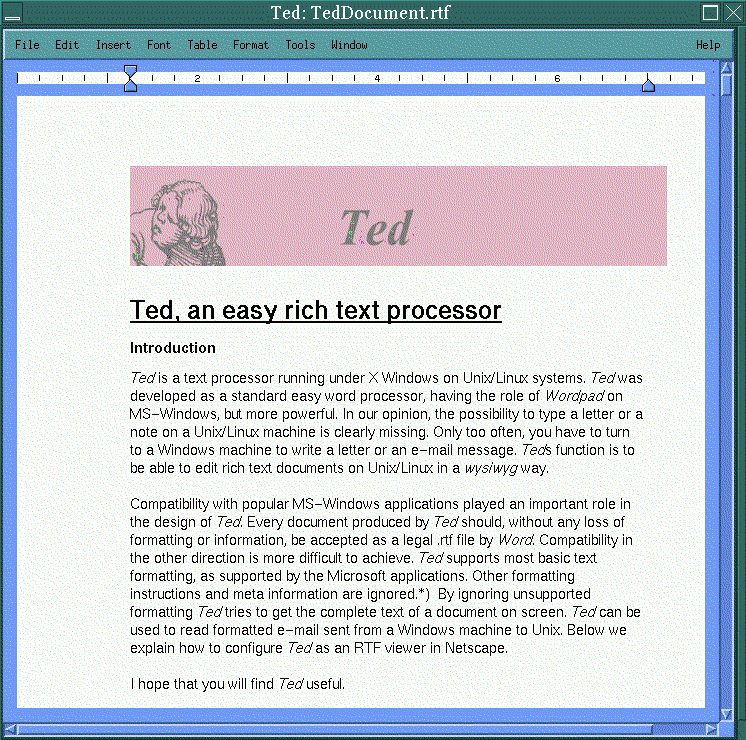
Formatting and Images
Hyperlinks and Bookmarks
Conclusion
Copyright © 1999, Larry Ayers
Published in Issue 44 of Linux Gazette, August 1999
"Linux Gazette...making Linux just a little more fun!"
The Graphics Muse
By Michael Hammel

muse:

 elcome
to the Graphics Muse! Why a "muse"? Well, except for the sisters aspect,
the above definitions are pretty much the way I'd describe my own interest
in computer graphics: it keeps me deep in thought and it is a daily source
of inspiration.
elcome
to the Graphics Muse! Why a "muse"? Well, except for the sisters aspect,
the above definitions are pretty much the way I'd describe my own interest
in computer graphics: it keeps me deep in thought and it is a daily source
of inspiration.

 his
column is dedicated to the use, creation, distribution, and discussion
of computer graphics tools for Linux systems.
his
column is dedicated to the use, creation, distribution, and discussion
of computer graphics tools for Linux systems.
In
this months column you'll find:

The
Artists' Guide To The Gimp.
edited by
The Artists' Guide to the
Gimp
Available online from Fatbrain,
SoftPro
Books and Borders
Books. In Denver, try the Tattered
Cover Book Store.

Other Announcements:
AutoTrace
Panorama
Tools 1.8b1 for Mac/Win/Linux
Joffer's
Linux Guide to new graphics card is back!
New
Quick Mask Tutorial for the Gimp
GIMP
1.1.7
<
More
Mews >
gd library pulled from circulation
Disclaimer:
Before I get too far into this I should note that any of the news items
I post in this section are just that - news. Either I happened to run across
them via some mailing list I was on, via some Usenet newsgroup, or via
email from someone. I'm not necessarily endorsing these products (some
of which may be commercial), I'm just letting you know I'd heard about
them in the past month.

Apple Open Source QuickTime
Streaming Server Now Supports Linux
From NewsAlert
SGI Announces Project
Mongoose: IRIS Performer for Linux
----
Allan Schaffer allan@sgi.com
Silicon Graphics http://reality.sgi.com/allan
Easy Software Products
Releases ESP Print Pro Beta 1
COMPUTER GRAPHICS FORUM
Behr de Ruiter
Centre for Mathematics and
Computer Science
Kruislaan 413
1098 SJ Amsterdam
The Netherlands
Email: behr@cwi.nl
Blender News
July 2, 1999
NaN celebrates its first
anniversary by giving a free Blender shirt with every C-key purchase in
july. Thanks to the support of the growing Blender community it was
an exciting first year! With the Siggraph exhibition in august I expect
to gain serious interest by the international computer graphics community.
A good start for the 2nd NaN year...
http://www.blender.nl/shop/
Check the changelog: http://www.blender.nl/stuff/blenderbeta.html
As promised, some of the
C-key features will be freed after a period. We start with releasing
the plugin development kit in the 2nd half of august.
Because of Siggraph preparations
and holidays the Python release is postponed a month. The Python
interface is shaping up quit well. We didn't expect it to be so powerful!
When things work out as expected this system acts as a true API and outperforms
a traditional plugin-API completely. And best of all: scripts are
cross-platform and in their nature 'open source'.
http://www.blender.nl
info@blender.nl
Xi Graphics Announces
latest version of maXimum cde
New Site: Linux Video
and DVD project
Jul 15, 1999,
13:14 UTC
From LinuxToday
http://livid.on.openprojects.net/
Did You Know?
...there is a web
site for AC3D Users? For more information, to a look at http://www.eilers.net/ac3d/.
The page is sponsored by Hartmut Eilers and includes a mailing list.
Reader Mail
Ariel
Rios Osorio wrote:
I'm working in a
web editor called galway that includes support for script-fu. I think
this is the only tool available for this purpose. It is programmed using
guile scheme. Please take a look. Suggestions are welcome!
'Muse:
Ok, I'll post it in the Muse.
http://erin.netpedia.netBy the way, besides
Structure and Interpretation of Computer Programs, there other great Scheme
books that I recommend to you, The Scheme Programming Language by Dybvig,
the Little Schemer, the Season Schemer.
'Muse:
I had a few other emails regarding this subject. I've posted the
information I received in TheGimp.com's Tips and Tricks section, under
"Useful Printed Texts."
I've been reading
your column since LG started publishing it. I also have your GIMP book
which is great. I wanted to make a comment about video formats that you
may not have been aware of. Newer sites that have quicktime movies are
probably using QT4. This codec isnt supported under linux yet. The java
version of the player from apple won't even run under linux. This was a
highly debated subject on slashdot when the 2nd starwars trailer came out.
Slashdot being a community of mostly linux users, as you know, were hunting
for formats that could be read under linux. Just thought I would pass that
tidbit on. Thanks for all the great articles and all the great work.
Similarly, Moritz Bunkus <m.bunkus@tu-bs.de>
wrote:
Quite good article
about playing video files. Just one remark.
'Muse:
Thanks for the feedback. I'd heard about this but until Moritz passed
me the URL I hadn't seen the trailer. I didn't try this trailer,
however, since it's a 14Mb download and my littl'e 28.8 throughput just
can't deal with it while I'm working on other things. Maybe I'll
start the download one night before going to bed.
http://www.starwars.com/episode-i/news/trailer/index.htmlIt's probably not
very important, but in your review of MpegTV you did not mention that the
command line version (mtvp) is freeware. Also, the SDL library does
not have to really be in /usr/X11R6/lib, a symbolic link works fine on
my system.
'Muse:
The symbollic link didn't seem to work on my box, but maybe I didn't set
things up quite right. I install quite a bit of stuff on my box,
so it's not hard to imagine I got something wrong. As for these other
options for playing VCD's, they still don't work for me. I can't
seem to get mtv, with or without xreadvcd, to play these disks. Too
bad. I'd love to see what's on this Sheryl Crow CD I have.
xreadvcd | mtvp -ac0 -aq2 -
but some VCD requires
xreadvcd -a 1 | mtvp -ac0 -aq2 -
My name is Lorenzo,
and I am italian. I read with much pleasure and interest the articles
of The Muse, appreciating them very much.
'Muse:
I'm glad you find them useful.
But now, I have
a question, and I hope that you can answer it: I read on this month's Linux
Gazette that you use a pretty old SVGA (a Mystique) along with a Commercial
X server.
'Muse:
That is a good question. The simple answer is actually a question:
what do you need to do with your computer? What you plan on doing
with your computer will determine what you need to spend money on.
This curiosity has
arisen in me reading your article: you must be a professional (?) graphics
user, so before making your choice you must surely have evaluated the variuos
opportunities.
'Muse: My purchase decisions
are based on two things: what do I need to do right now, and what will
benefit me in the long term. I spend more up front for hardware in
the expectation that the extra expense will allow me to use that hardware
for a longer period (thus I won't have to keep upgrading hardware every
few months or even every year). I spend less up front for software
because my software needs vary fairly often. Thus, I spent more money
for the Matrox Mystique a few years back, and it's still working quite
well 2 years layer.
May I ask you what
do you really think of Commercial X Servers (like the ones of Xi Graphics),
and to whom you'd suggest one?
'Muse:
I recommend end users buy low end video cards and spend the extra cash
on a commercial X server. I've used XFree86 servers but was not satisfied
with their quality. Take that with a grain of salt, of course.
It's been 2 years since I've used XFree86 with anything other than my Matrox
Mystique. However, I tried the SVGA server from XFree86 last year
in order to make use of it's support for XInput (so I could use my drawing
tablet), but it produced some artifacts on my display, enough that I finally
decided to go back to my AcceleratedX server and forget about the drawing
tablet for now. I've heard Xi has added better tablet support in
their latest releases, but I don't have a copy of that so can't say if
it's any better than the version I have now (which doesn't support X Input
for use with the Gimp at all).
This would be an
important answer for me, and still an important one for the Italian *.comp.linux
newsgroup, that usually gets involved in discussions of this kind, but
without any owner of a commercial server...
'Muse:
To my knowledge, none of the X server vendors have any native italian speakers
working for them. Metro Link and Xi Graphics are mostly english speaking
(although Thomas Roell at Xi is German). I'm not sure about XFree86,
since
they have developers from many parts of the world involved in their project.
It might just be that none of them has time to follow newsgroups anymore.
I know I don't.
Thank you in advance,
and excuse me for my intrusion in your mailbox.
'Muse:
No problem. It's no intrusion. You ask a very important question
that I'm sure many of my readers have also wondered about.
With best wishes
and compliments for your work,
'Muse:
I'm glad you find it useful. You should also keep an eye out to freshmeat.net.
That's where I pick up many of the announcements I post in the Muse.
Lorenzo Del Pace

Cataloging and Clipping - gathering online data
One of the projects I've been
working on lately has had to do with gathering information from the Web.
At first glance the information can seem difficult to collect - so many
different pages with so many formats. How does someone make sense
of all that data, especially when it's wrapped inside the sometimes incomprehensible
world of HTML?
Downloading
from CPAN:
One
of the interesting things I learned while playing with NewsClipper was
how easy it is to update my Perl modules. In order to link NewsClipper
to a database, I installed mSQL.
In the book, Official Guide to MiniSQL 2.0, by Brain Jepson and
David J. Hughes there is a chapter on using mSQL with Perl.
Here I found the little pearl which made updating my Perl modules a breeze.
I simply run
%
perl -MCPAN -e SHELL
and I
get into a shell hooked to the CPAN archives. I can then just
run
cpan>
install <module>
where
<module> is the name of the module you want to install. What's
really nice is that any prerequisite packages are also installed.
There are cases where you might not want to install the prerequisites (none
came up when working with NewsClipper or mSQL, however), but for most cases
this little trick will be a real time saver. If you use this, be
sure you're logged in as a user who has write permissions to the directories
where existing Perl modules are installed. Normally, this would be
the root user. I did wonder if running this as a root user with a
connection across the Internet was a possible security violation for my
local system, but since I don't do it often I didn't worry about it.

No Musings this month.
Those two big projects I'm working
on are taking quite a bit of my time these days. I'll have the 3D
Modellers review soon. But be prepared - major changes are coming
to the Muse!


The following links are
just starting points for finding more information about computer graphics
and multimedia in general for Linux systems. If you have some application
specific information for me, I'll add them to my other pages or you can
contact the maintainer of some other web site. I'll consider adding other
general references here, but application or site specific information needs
to go into one of the following general references and not listed here.
Online Magazines
and News sources
C|Net
Tech News
Linux
Weekly News
Linux
Today
Slashdot.org
TheGimp.com
Linux
Graphics
Linux
Sound/Midi Page
Linux
Artist.org
The
Gimp User and Gimp Developer Mailing Lists.
The
IRTC-L discussion list
comp.graphics.rendering.raytracing
comp.graphics.rendering.renderman
comp.graphics.api.opengl
comp.os.linux.announce
Future Directions
Next month: No Muse next
month. But expect some big changes in the near future!
© 1999
Michael
J. Hammel
Copyright © 1999, Michael Hammel
Published in Issue 44 of Linux Gazette, August 1999
© 1999 Michael
J. Hammel

AutoTrace
Panorama
Tools 1.8b1 for Mac/Win/Linux
Joffer's
Linux Guide to new graphics card is back! Bigger and b
New
Quick Mask Tutorial for the Gimp
GIMP
1.1.7
Disclaimer:
Before I get too far into this I should note that any of the news items
I post in this section are just that - news. Either I happened to run across
them via some mailing list I was on, via some Usenet newsgroup, or via
email from someone. I'm not necessarily endorsing these products (some
of which may be commercial), I'm just letting you know I'd heard about
them in the past month.
AutoTrace
This project is for converting
images to vector graphics. Currently I created a plugin for GIMP (www.gimp.org)
to do this. It is in a very early stage and most of the code is still missing.
Marting.Weber
Marting.Weber@Allianz.De
http://autotrace.sourceforge.net
Panorama
Tools 1.8b1 for Mac/Win/Linux
Joffer's
Linux Guide to new graphics card is back! Bigger and better!
comp.os.linux.announce
posting
New
Quick Mask Tutorial for the Gimp
by Zach Beane
GIMP 1.1.7
© 1999 by Michael
J. Hammel






 The Mailbag!